


WonderBiotics vs Thin 30: Named Strains or Just CFU?

WonderBiotics vs Physician's Choice THIN 30: Named Strains, Weight-Support Ingredients, and Value

Both products name specific probiotic strains rather than hiding behind a single CFU number, so "named strains vs. generic blend" isn't actually the dividing line here. What differs is which named strains carry weight-focused published research, where each formula's weight-management claim really comes from, and what you pay per day.
What's in Each Capsule
Physician's Choice THIN 30 lists six probiotic strains totaling 15 billion CFU: L. plantarum Lp-115, L. rhamnosus Lr-32, L. acidophilus La-14, B. infantis Bi-26, B. lactis BL-04, and L. gasseri (no strain code given).1 Alongside the probiotics, the formula adds a 300 mg caffeine-free green tea Phytosome complex, 10 mg of Capsimax red pepper capsaicinoids, a 20 mg digestive enzyme blend, a 150 mg prebiotic fiber blend (organic chicory root, Jerusalem artichoke root, and acacia, 50 mg each), and 100 mg of organic apple cider vinegar, all in one capsule taken once daily.1
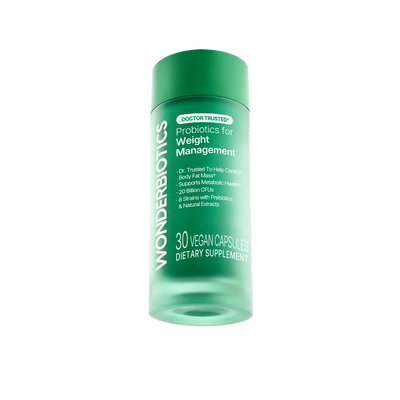
WonderBiotics Probiotics for Weight Management names eight strains at a combined 20 billion CFU, formulated in a probiotic-and-prebiotic blend that also includes polydextrose: B420 (Bifidobacterium animalis subsp. lactis), HN019, L. acidophilus NCFM, L. rhamnosus GG, L. salivarius Ls-33, L. lactis Ll-23, L. paracasei Lpc-37, and L. plantarum, plus a separate blend of dihydroberberine and a lemon fruit extract standardized for eriocitrin content.2 Seven of those eight carry a specific strain code; the eighth, L. plantarum, is listed without a strain code on the product's Supplement Facts panel, though WonderBiotics' own product page names it Lp-116 elsewhere. That's a first-party inconsistency on our own label, the same kind of code-level gap as THIN 30's L. gasseri listing below. Neither brand breaks out CFU by individual strain either, so you can't verify from either label how much of the blend is B420 versus, say, HN019, or how much of THIN 30's 15 billion CFU is L. gasseri versus L. plantarum.
Named Strains vs. Generic CFU: What the Label Tells You
A strain name on a label doesn't guarantee weight-specific evidence for that exact strain. Five of THIN 30's six named strains (Lp-115, Lr-32, La-14, Bi-26, BL-04) are established commercial probiotic strains; in our search of the published literature, we didn't find a body-fat or body-weight RCT for any of these five strain codes specifically.
L. gasseri is the species THIN 30's own marketing credits specifically with helping reduce BMI, waist circumference, and abdominal fat, but that research history belongs to particular coded strains, not the species in general.1 Lactobacillus gasseri SBT2055, developed and studied by its manufacturer Megmilk Snow Brand, was linked to within-group reductions in visceral and subcutaneous fat in an 87-person, 12-week Japanese trial; a separate, larger 210-person trial found a between-group difference in visceral fat but not in subcutaneous fat, and the two tested doses performed similarly rather than showing a clear dose-response.3 L. gasseri BNR17 reduced visceral fat versus placebo at the higher of two tested doses in a separate 12-week trial, though waist circumference only changed within the treatment group, not between groups.4 THIN 30's label lists "L. gasseri" with no strain designation, so there's no way to confirm from the packaging whether it's one of those studied strains or a different L. gasseri strain that doesn't match either one.
WonderBiotics' named-strain approach centers on B420, which does carry a strain code and a dedicated trial. Bifidobacterium animalis subsp. lactis B420 was tested in a 225-person, six-month, placebo-controlled RCT in adults ages 18–65 with a BMI of 28–34.9 who were otherwise metabolically healthy; the trial excluded people with diabetes, cardiovascular disease, recent antibiotic use, or recent use of another weight-loss medication, and it didn't study anyone on a GLP-1 drug, so its results don't directly represent those groups.5 Of the 225 people randomized, the trial's intention-to-treat population was 209; its pre-registered primary endpoint, relative body fat change at 6 months, was analyzed in 199 of those participants across the four arms and showed no significant difference between groups (P=0.46).5 In the per-protocol group taking B420 alongside 12 g/day of polydextrose fiber, body fat dropped an average 4.5% (about 1.4 kg) versus placebo (P=0.02); B420 taken alone in the per-protocol group showed a 3.0% reduction that did not reach significance (P=0.28).5 The frequently cited "−4.0%" figure for B420 comes from a post-hoc analysis that pooled both B420-containing arms against both non-B420 arms after unblinding, not from B420 given by itself.5 The trial was funded by DuPont (Danisco); DuPont, the contract research organization running the trial, and the principal investigator were jointly responsible for the protocol, the interpretation of the data, and the reports, and every author or their institution was compensated by DuPont for their role in the study.5
We chose B420 because it has a specific, citable human trial behind it.
Where Each Formula's Weight-Management Claim Comes From
THIN 30's marketing credits two things: its L. gasseri listing, for BMI, waist, and abdominal-fat effects, and GreenSelect Phytosome, the green tea extract in the formula, for a specific published weight-loss trial.1 The L. gasseri claim isn't tied to a specific trial; the only cited number, from the 2009 GreenSelect trial, applies to the green tea extract, not the six-strain blend. In that trial, 100 people with obesity followed a reduced-calorie diet; 50 also took the green tea extract and 50 followed the diet alone, with no separate placebo capsule for the diet-only group. Over 90 days, the extract group lost an average 14 kg versus 5 kg in the diet-only group.6 That number comes from the 50-person extract arm specifically, not from all 100 people in the study, and the published abstract doesn't state whether assignment to groups was randomized.6
In WonderBiotics' formula, B420 is the strain our weight-management positioning is built around, for the reasons above. Dihydroberberine and the lemon extract are secondary additions to that formula, not the primary evidence we're leaning on.
CFU, Servings, and Price
| Physician's Choice THIN 30 | WonderBiotics Probiotics for Weight Management | |
|---|---|---|
| Named strains | 6 (5 with strain codes, 1 without) | 8 (7 with strain codes, 1 without a confirmed code) |
| Total CFU | 15 billion | 20 billion |
| Added actives | Green tea Phytosome, Capsimax, digestive enzymes, prebiotic fiber, apple cider vinegar | Dihydroberberine, lemon fruit extract, polydextrose (in the probiotic blend) |
| Serving | 1 capsule/day, 30-day bottle | 1 capsule/day, 30-day bottle |
| Approx. price | ~$18–29/bottle across subscription tiers to full one-time price7 | ~$44/bottle on a 3-month subscription, ~$55 one-time8 |
| Approx. cost/day | ~$0.61–0.97 | ~$1.47 (subscription), ~$1.85 (one-time) |
THIN 30 costs less per day, and it packs in more non-probiotic ingredients for that price: the green tea complex, capsaicin, digestive enzymes, and fiber blend. THIN 30 is the lower-cost option if you want one capsule that bundles several weight-support ingredients. WonderBiotics Probiotics for Weight Management costs more but puts your money behind a strain with a dedicated trial record, alongside dihydroberberine, an ingredient with a different proposed mechanism.
Before You Choose: A Safety Note on Dihydroberberine
Dihydroberberine is a modified, more bioavailable form of berberine, a plant compound with limited-quality but suggestive evidence for lowering blood sugar. The one published human study that measured dihydroberberine's own effect on glucose and insulin, a small crossover pilot trial in five healthy men using a multi-dose loading protocol, found no significant difference among the four tested conditions (placebo, 500 mg berberine, and two dihydroberberine doses) in glucose or insulin levels over the two-hour testing window; that study was funded by NNB Nutrition, which manufactures and sells the ingredient, and one author consults for the company.9 Separately, in vitro studies suggest regular berberine may affect how the body metabolizes sulfonylurea diabetes drugs, though the clinical significance of that interaction in people hasn't been established.9 Semaglutide (Wegovy) already carries a well-documented warning about increased hypoglycemia risk when combined with insulin or a sulfonylurea;10 dihydroberberine's own blood-sugar effect in people isn't established the same way, but if you take any glucose-lowering medication, it's still worth telling your prescriber you're adding a berberine-based supplement like WonderBiotics' formula so they can watch for symptoms. Neither product is a treatment for obesity, diabetes, or any medical condition; both are intended to support a diet and lifestyle plan you're already following, not replace one.
Which One Fits Your Goals?
THIN 30 costs less per day and stacks more ingredients into one capsule, though its own six-strain blend doesn't have a public, product-level weight trial behind it, and its L. gasseri listing lacks a confirmed strain code. Our own formula costs more, but B420 is the strain we found with a citable, weight-focused human trial behind it, alongside dihydroberberine, an ingredient with a different proposed mechanism.
Either bottle is meant to sit alongside the food and activity changes doing most of the real work, not replace them. If you're in perimenopause or already taking a GLP-1 medication, talk to your clinician about what else makes sense to add before you commit to either one.
References
- Physician's Choice Thin 30 Probiotic – Official Product Page
- WonderBiotics Probiotics for Weight Management – Product Page
- Kadooka Y, et al. "Regulation of abdominal adiposity by probiotics (Lactobacillus gasseri SBT2055) in adults with obese tendencies in a randomized controlled trial." Eur J Clin Nutr. 2010. PMID: 20216555; Kadooka Y, et al. "Effect of Lactobacillus gasseri SBT2055 in fermented milk on abdominal adiposity in adults in a randomised controlled trial." Br J Nutr. 2013. PMID: 23614897
- Kim J, et al. "Lactobacillus gasseri BNR17 Supplementation Reduces the Visceral Fat Accumulation and Waist Circumference in Obese Adults: A Randomized, Double-Blind, Placebo-Controlled Trial." J Med Food. 2018. PMID: 29688793
- Stenman LK, et al. "Probiotic With or Without Fiber Controls Body Fat Mass, Associated With Serum Zonulin, in Overweight and Obese Adults." EBioMedicine. 2016. PMID: 27810310
- Di Pierro F, et al. "Greenselect Phytosome as an adjunct to a low-calorie diet for treatment of obesity: a clinical trial." Altern Med Rev. 2009. PMID: 19594224
- Physician's Choice Thin 30 Probiotic – Official Product Page (pricing)
- WonderBiotics Probiotic Cost Comparison by Clinically Studied Strain
- Berberine – Memorial Sloan Kettering Cancer Center, About Herbs; Moon JM, et al. "Absorption Kinetics of Berberine and Dihydroberberine and Their Impact on Glycemia: A Randomized, Controlled, Crossover Pilot Trial." Nutrients. 2022;14(1):124. PMC: 8746601
- Wegovy (semaglutide) Prescribing Information – DailyMed, Novo Nordisk


