


WonderBiotics vs Fitbiotic: CFU, Strains, or Fiber?

WonderBiotics vs Garden of Life Fitbiotic: Named Strains, Fiber, CFU, and Weight Support Compared

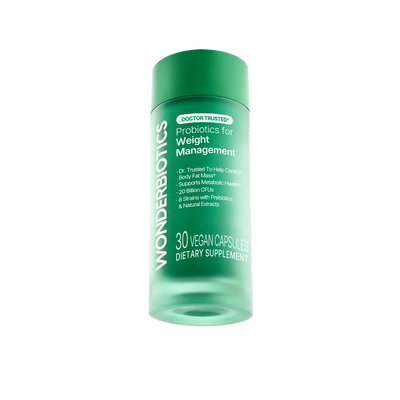
Garden of Life's Fitbiotic and WonderBiotics Probiotics for Weight Management are both marketed for weight support, but they're built on different logic. Fitbiotic packs 50 billion CFU across 14 species plus 4 grams of acacia fiber into a daily powder packet, while WonderBiotics uses 8 named, coded strains, including B420, alongside a separate metabolic blend, in one daily capsule.1, 2
CFU and Strain Count: Why Bigger Numbers Aren't the Whole Story
Fitbiotic's label leads with 50 billion CFU from 14 probiotic strains, split roughly 40 billion CFU from nine Lactobacillus species and 10 billion CFU from five Bifidobacterium species.1, 3 WonderBiotics' capsule totals 20 billion CFU across 8 strains, including Bifidobacterium animalis subsp. lactis B420 and HN019, Lactobacillus acidophilus NCFM, and five others.2 Fitbiotic has more CFU and more listed strains than WonderBiotics, and that's the headline Garden of Life puts on the label.
Those totals don't tell you which product is more likely to do something specific for your weight. In the ingredient-level trial behind WonderBiotics' headline strain, the result came down to one specific strain (B420) at one specific dose, paired with a specific fiber dose. How many different species were in the mix played no role in that result, and B420 alone, in the same trial, didn't reach significance.4 Neither label breaks out how many CFU come from each individual strain, so total CFU and strain count don't reveal how much of any single organism you're actually getting. Neither approach has been shown to beat the other head-to-head for weight outcomes; treat "more strains" and "more CFU" as manufacturing choices rather than evidence of a stronger effect.
Named Strains: Coded Strains vs. Species-Only Labels
The two products diverge much more on strain naming than on CFU count. WonderBiotics names each of its 8 strains down to the specific, trademarked strain code: B420, HN019, NCFM, GG, Ls-33, Ll-23, Lpc-37, and Lp-116.2 Strain codes matter because published research is strain-specific; a study on Bifidobacterium lactis B420 doesn't automatically apply to a different B. lactis strain, even from the same species.
Public retailer listings for Fitbiotic name only genus and species for all 14 organisms, for example "L. gasseri" and "L. rhamnosus," with no proprietary strain codes attached.1, 3 Some of those species, including L. gasseri, do have their own published human weight-related trials in the broader research literature, but those trials were run on specific coded strains (like SBT2055 or CGMCC1.3724), not on "L. gasseri" as a species. Without a strain code on the label, you can't confirm whether the microbe in your packet is the one that was actually studied, or a different isolate that happens to share a species name. That's a transparency gap on Fitbiotic's side: the "clinically studied probiotic strains" language on the box isn't confirmed to describe the exact organisms used in those studies.
Fiber: 4 Grams of Acacia vs. a Trace Prebiotic
Fitbiotic's other headline feature is 4 grams of prebiotic soluble fiber per packet, from organic acacia (Acacia senegal, also called gum arabic).1 That's a meaningful, food-label-relevant amount of fiber. The best available human evidence on acacia fiber and body composition comes from a 2012 randomized, double-blind, placebo-controlled trial in 120 healthy women: in the gum-arabic group, BMI fell by 0.32 points and body fat percentage by 2.18 percentage points from baseline over six weeks of taking 30 grams a day (both P<0.0001); the published results report those figures as within-group change, not as a head-to-head comparison against the pectin placebo group.5 Either way, the tested dose was 30 grams a day, about seven and a half times more acacia fiber than one Fitbiotic packet provides. A single small trial at a much higher dose doesn't confirm what 4 grams a day will do, and our search of the literature turned up no published trial testing acacia fiber at Fitbiotic's actual dose.
WonderBiotics takes a different approach to fiber: none. Its capsule includes a small amount of polydextrose blended in with the 8 strains as a prebiotic for the bacteria themselves, a different job than serving as a meaningful fiber dose.2 If you want a meaningful fiber addition to pair with a probiotic capsule, WonderBiotics Daily Fiber Mix is built for exactly that, a five-fiber blend you dose separately from one to three sachets a day, rather than folding an unadjustable 4-gram dose into a probiotic capsule.10 Building fiber and probiotics as separate products lets you titrate fiber gradually, which matters because fermentable fibers, acacia included, commonly cause gas, bloating, or loose stools when you start at a fixed dose without ramping up.
Powder Packet vs. Capsule: Which Format Fits Your Day
Fitbiotic comes as an unflavored powder in 20 shelf-stable, single-serving stick packets, meant to be stirred into an unheated food or beverage once a day.1 That makes it easy to combine with a smoothie or shake, but it also means you're carrying and mixing a sachet rather than swallowing a pill, and a 20-packet box covers 20 days at one packet daily, short of a full 30-day month.1
WonderBiotics is a single once-daily capsule, taken ideally within 30 minutes of a meal, with no mixing and no powder texture to manage.2 If your routine already includes a protein shake or smoothie, a stick pack is no extra effort. If you'd rather not add another thing to blend, mix, or carry loose in a bag, a capsule is the simpler habit to keep.
The Evidence Behind Each Product's Weight Claim
WonderBiotics: A Named Strain With a Mixed Human Trial
WonderBiotics builds its case around a real, named-strain human trial behind its headline ingredient, the kind of arm-by-arm data most probiotic labels never put in front of you at all. WonderBiotics' headline strain, B420, was tested at 10 billion CFU/day in a 225-person, six-month randomized trial funded by DuPont Nutrition & Health, the company that owned the strain at the time (it now sits under IFF); five of the paper's authors were DuPont employees.4 That trial studied B420 as a standalone ingredient rather than the finished WonderBiotics capsule, and WonderBiotics' label states a 20 billion CFU total across all 8 strains without breaking out how much comes from B420 specifically, so the dose in the capsule can't be confirmed against the dose in the trial.2, 4 The trial's prespecified primary endpoint, relative change in DXA-measured body fat mass across all four study arms, was not statistically significant (P=0.46).4 In the predefined per-protocol population, the overall four-arm comparison also missed significance (P=0.095); B420 combined with 12 g/day of a separate fiber supplement did lose more body fat than placebo (−4.5%, P=0.02), while B420 taken alone did not (−3.0%, P=0.28).4 A post-hoc analysis pooling both B420-containing arms found a significant independent B420 effect (−4.0%, P=0.002), but that's an exploratory result, not the trial's designed comparison.4 A secondary, per-protocol-only finding is closer to an everyday appetite signal: on 5-day food diaries, people taking B420 alone cut about 320 calories a day from their own baseline, versus a 23-calorie drop in the placebo group, a between-group difference of roughly 300 calories a day (P<0.05 vs. placebo); the published trial didn't report this analysis for the full randomized population, so it applies only to participants who completed the protocol as assigned, and hunger hormones were never measured directly.4 WonderBiotics' capsule also includes dihydroberberine and a citrus extract standardized to eriocitrin (Eriomin), which raised GLP-1 by 17% within-group over 12 weeks in a small trial funded by Ingredients by Nature, Eriomin's commercial supplier; the authors reported no conflict of interest and said the sponsor had no role in the study's design or conduct.2, 6 That trial was also run in a different population (people with elevated blood sugar) and measured a different endpoint than weight loss. The full 8-strain capsule, as a finished formula, has not itself been tested in a published trial, either; only B420 (alone or with fiber) and the Eriomin extract have their own human data.
Fitbiotic: No Published Trial on the Finished Formula
We could not find a published clinical trial testing the finished 14-strain Fitbiotic formula in a search of PubMed as of August 2026.7 Fitbiotic's marketing describes its organisms as "clinically studied probiotic strains," but without strain codes on public retailer listings, that claim can't be mapped to any specific published study of species like L. gasseri or L. rhamnosus, let alone to this particular 50-billion-CFU, 14-strain combination.1, 3 The clearest, ingredient-specific human evidence in the entire comparison is actually the gum arabic fiber trial, but as covered above, it tested a dose far higher than what's in one Fitbiotic packet.5
Neither product has an independently replicated trial on its exact finished formula, so that gap doesn't favor either brand.
Ingredients and Formula, Side by Side
| WonderBiotics Probiotics for Weight Management | Garden of Life Fitbiotic | |
|---|---|---|
| Format | Capsule, 1/day | Powder stick packet, 1/day mixed into food or a drink |
| CFU | 20 billion2 | 50 billion1 |
| Strain count | 8, each with a disclosed strain code2 | 14, listed by species only, no strain codes on public listings1, 3 |
| Named strains include | B420, HN019, NCFM, GG, Ls-33, Ll-23, Lpc-37, Lp-1162 | L. gasseri, L. acidophilus, L. rhamnosus, B. lactis, B. longum, and 9 others (species-level only)1, 3 |
| Fiber | Trace polydextrose (prebiotic for the strains, not a fiber dose)2 | 4 g soluble fiber from organic acacia1 |
| Other ingredients | Dihydroberberine, Eriomin citrus extract (eriocitrin)2 | None beyond probiotics and acacia fiber1 |
| Headline human evidence | B420, Stenman 2016, 225 adults, mixed primary result4 | No published trial on the finished formula found7 |
| Supply per package | 30-day capsule supply2 | 20-day packet supply1 |
| Diet-related certifications | Not marketed as organic | USDA Organic, non-GMO, gluten/dairy/soy-free1 |
Who Should Choose Which
WonderBiotics Probiotics for Weight Management is the better fit if you want to know exactly which organisms you're taking, down to the strain code, and you'd rather add a metabolic-support blend than a large fiber dose to your routine. It's also the simpler choice if you don't want to mix a powder every day or manage a 20-day supply cycle.
Fitbiotic is the better fit if you specifically want a bigger, broader-spectrum probiotic blend combined with a real, food-label-relevant dose of soluble fiber in one packet, and you don't mind that the individual strains aren't identified by code. It's also a reasonable pick if you prefer USDA Organic, non-GMO products and are already in the habit of mixing a shake or smoothie each day.
Neither product is the right choice if you're looking for a substitute for a prescription weight-loss medication or a reason to delay a conversation with your doctor about one. Both are food-based, modest-effect supplements, not treatments.
Price and What You Actually Get per Month
WonderBiotics Probiotics for Weight Management runs from about $41.55 to $47.09 a month on subscription, or $55.40 for a one-time 30-capsule supply.2 Fitbiotic has been listed by third-party retailers around $35.69 to $50.99 for its 20-packet box, which is only a 20-day supply at one packet a day, so a true 30-day comparison costs more than the sticker price on that box suggests.1, 9 Prices at either brand's own site and at retailers change over time, so treat these as a starting point for comparison, not a locked-in number.
Safety and When to Loop In Your Doctor
Most healthy adults tolerate either product without major issues, though any new fermentable fiber, including the acacia in Fitbiotic, can cause gas, bloating, or loose stools for the first week or two if you start at the full dose right away. If that doesn't ease up, check in with a doctor or pharmacist about how to adjust before deciding it's not for you.
People who are immunocompromised, critically ill, or have a central venous catheter should talk to a doctor before starting any live-bacteria probiotic, Fitbiotic or WonderBiotics included.8 If you're on a prescription GLP-1 medication or any other prescription for weight or blood sugar, treat either product as something to mention to your prescriber, not a reason to adjust or stop that medication on your own. Neither Fitbiotic nor WonderBiotics is intended to diagnose, treat, cure, or prevent any disease.
Bottom Line
Fitbiotic has the higher raw numbers: more CFU, more strains, and a 4-gram dose of fiber in every packet. WonderBiotics has the traceability: every strain carries a specific code you can look up, backed by a named-strain human trial (B420) and a separate metabolic blend, in a capsule that doesn't require mixing. Neither product has a published trial on its exact finished formula, and neither is a substitute for medical weight-loss care. If transparency down to the strain level matters most to you, WonderBiotics Probiotics for Weight Management is the more traceable pick; if a bigger blend plus a meaningful fiber dose in one packet matters more, Fitbiotic's approach makes sense on its own terms.
References
- Dr. Formulated Probiotics Fitbiotic Powder, Unflavored. Garden of Life; cross-checked against Natural Healthy Concepts and Health Food Emporium
- Probiotics for Weight Management – Supports GLP-1 Journey. WonderBiotics
- Dr. Formulated Probiotics Fitbiotic. Professional Supplement Center; cross-checked against Natural Healthy Concepts
- Stenman LK, Lehtinen MJ, Meland N, et al. Probiotic With or Without Fiber Controls Body Fat Mass, Associated With Serum Zonulin, in Overweight and Obese Adults: Randomized Controlled Trial. EBioMedicine. 2016;13:190-200. PMID 27810310
- Babiker R, Merghani TH, Elmusharaf K, Badi RM, Lang F, Saeed AM. Effects of Gum Arabic ingestion on body mass index and body fat percentage in healthy adult females. Nutrition Journal. 2012;11:111. PMID 23241359
- Cesar TB, Ramos FMM, Ribeiro CB. Nutraceutical Eriocitrin (Eriomin®) Reduces Hyperglycemia by Increasing Glucagon-Like Peptide 1 and Downregulates Systemic Inflammation: A Crossover-Randomized Clinical Trial. J Med Food. 2022;25(11):1050-1058. PMID 35796695
- PubMed search: "Fitbiotic probiotic weight" and related terms, no finished-formula clinical trial identified (accessed August 2026). PubMed
- Doron S, Snydman DR. Risk and Safety of Probiotics. Clin Infect Dis. 2015;60(Suppl 2):S129-S134. PMID 25922398
- Dr Formulated Fitbiotic 20 packets Probiotic Powder pricing. Health Food Emporium
- Daily Fiber Mix – 5-Fiber Blend. WonderBiotics


