


Weight, Fat, or Waist: Which Probiotic Metric Counts?

Body Weight, Body Fat, or Waist Circumference: Which Probiotic Trial Outcome Matters Most?

Body weight, body fat percentage, and waist circumference are three different measurements, and a probiotic trial can move one without moving the others. That isn't a contradiction; it reflects how body composition changes and how trials get analyzed. Before you trust a headline number, check which endpoint the study pre-specified as primary, and whether the result held up in the full randomized group or only in a subgroup found after the fact.
Why the Scale, the Tape Measure, and a Fat Scan Can Disagree
Body weight on a scale is total mass: fat, muscle, water, bone, and whatever you ate that morning. Waist circumference is a proxy for abdominal fat, including the visceral depot most tied to metabolic risk, though a tape measure can't tell visceral fat apart from fat sitting just under the skin. Body fat percentage, when measured well by DXA, separates fat mass from lean mass across the whole body. CT scans, which some of the trials below used instead of DXA, measure a regional fat area rather than a whole-body percentage.
A person can lose visceral fat and hold or gain muscle at the same time. On the scale, that looks like nothing happened. Around the waist, it looks real. This is exactly why a trial can report "no significant weight loss" and "reduced visceral fat" in the same paper without contradicting itself. It's also why marketing copy tends to lead with whichever number moved, not necessarily the one the trial was designed to test.
How to Read a Trial's Endpoint Before You Trust the Number
Not every reported result carries the same weight. In order of how much you should trust a claim:
1. Pre-specified primary endpoint, intention-to-treat (ITT). Everyone randomized, analyzed as randomized. This is what the trial was built and powered to answer.
2. Pre-specified secondary endpoint. Still planned in advance, but the study wasn't necessarily sized to detect a difference here.
3. Per-protocol analysis. Only people who finished the protocol as designed; it can inflate effects by dropping people who quit for treatment-related reasons.
4. Subgroup or post-hoc analysis. An unplanned slice of the data found after unblinding, such as a women-only comparison the trial wasn't designed to test, or two treatment arms pooled together after the fact. Useful for generating a hypothesis, not for proving one.
5. Within-group (before-and-after) change. "The active group lost 4%" with no mention of what the placebo group did. Without a control comparison, this could just be regression to the mean or a seasonal effect.
6. Mechanism, animal, or single-arm pilot data. Informative for the next study, not evidence of an effect in people.
Every strain marketed for weight or "belly fat" below has a real human trial behind it, and each one's headline number sits somewhere different on that ladder.
B420: The Strain Behind WonderBiotics' Anchor Ingredient, and What Its Trial Showed
Bifidobacterium animalis subsp. lactis B420 is the strain we anchor WonderBiotics Probiotics for Weight Management around, so it's worth walking through its trial in full rather than quoting the one number that circulates online.
The trial was a 225-person, four-arm, randomized, placebo-controlled study in adults with BMI 28 to 34.9: placebo, a polydextrose fiber alone, B420 alone (10¹⁰ CFU/day, mixed into a daily smoothie, not a capsule), and B420 plus the fiber1. People with diabetes, cardiovascular disease, or a current weight-loss program were excluded, so it doesn't tell you what happens in people managing diabetes or already on a structured diet.
The three most commonly cited numbers from this trial fall into three different categories:
| Analysis layer | Result |
|---|---|
| Author-defined ITT (209 of 225 randomized had any post-baseline data; the body-fat-mass ANCOVA itself analyzed 199 of them, 53/51/47/48 across the four arms), 6-month change in body-fat mass (DXA) | Not significant across the four arms (P=0.46) |
| Per-protocol (n=134 overall; n=131 for the body-composition analysis specifically) | B420 + fiber: about −4.5% less body-fat mass / −1.4 kg (P=0.02). B420 alone: −3.0%, not significant (P=0.28). Overall per-protocol comparison: P=0.095 |
| Post-hoc, after unblinding (pooling both arms that got any B420 vs. both that didn't) | Body-fat mass −4.0% (P=0.002); waist circumference −2.4 cm (P=0.004) |
That post-hoc number, about 4% less body-fat mass and roughly 2.4 cm off the waist, is the one you'll see quoted most, and it's a pooled, unblinded, after-the-fact comparison, not a finding that "B420 alone beat placebo" on the trial's own primary analysis. The placebo group, meanwhile, gained about a kilogram over six months, which is part of why the pooled comparison looked favorable even though B420 alone didn't separate from placebo in the pre-specified test.
The trial was funded in full by DuPont Nutrition & Health; five of the paper's 15 authors were DuPont employees, and three more disclosed separate industry ties: a shareholder in a clinical-research company and two co-founders of an unrelated biotech firm. DuPont, together with the trial's contract research organization and the principal investigator, was involved in protocol development, data interpretation, and reporting (the formal statistical analysis itself was run by an author affiliated with that contract research organization, not DuPont). Every author or their institution was financially compensated by DuPont for the work1. A 2020 review of B420's mechanism and human data was funded by DuPont Nutrition and Biosciences and written entirely by current or former employees of the strain's manufacturer, and there's no independently run replication of the 225-person trial as of this writing2.
What Four Other Well-Studied Strains Measured, and Which Endpoint Moved
B420 shares this pattern with other strains marketed for weight or "belly fat." Here's how four of them compare:
| Strain (trial) | Design | What actually reached significance |
|---|---|---|
| L. gasseri SBT2055 (Kadooka 2010, 87 adults, 12 wk)3 | Fermented milk, 10¹¹ CFU/day vs. control milk | Visceral fat −4.6% and subcutaneous fat −3.3%, reported as before-and-after change within the active group; the control group showed no significant change, but the abstract doesn't give a formal active-vs-control p-value |
| L. gasseri SBT2055 (Kadooka 2013, 210 adults, 12 wk)4 | Two fermented-milk doses (10⁶ and 10⁷ CFU/g) vs. control | Visceral fat down ~8% at both doses vs. control on the trial's pre-specified primary outcome (P<0.05 vs. control; the P<0.01 sometimes quoted is each active group's within-group change from baseline), meaning no dose-response; subcutaneous fat did not separate from control. CT scans weren't repeated at the 4-week post-cessation follow-up, but several anthropometric measures had partly reversed by then |
| L. rhamnosus CGMCC1.3724 (Sánchez 2014, 153 randomized, 125 analyzed after 28 were excluded post-randomization for dyslipidemia, 24 wk)5 | Capsules combining LPR with oligofructose and inulin, so the probiotic can't be isolated from the prebiotic | Overall result not significant. Only in a women-only subgroup: weight −1.8 kg at 12 weeks (P=0.02), gap widening through 24 weeks (P=0.02); fat mass −4.79 kg vs. −2.16 kg for placebo at 24 weeks (P=0.01). Men showed no difference (P=0.53 at 12 weeks). The trial explicitly excluded postmenopausal women |
| L. gasseri BNR17 (Kim 2018, 90 adults, 12 wk)6 | Low-dose (10⁹) and high-dose (10¹⁰ CFU/day) vs. placebo, as separate randomized arms | Visceral fat area significant only in the high-dose arm vs. placebo (P=0.038); waist circumference dropped in both active arms but only as a within-group change, not confirmed between groups |
| Pasteurized Akkermansia muciniphila (Depommier 2019, 40 enrolled, 32 completers analyzed, insulin-resistant adults with metabolic syndrome, 3 mo)7 | Proof-of-concept pilot; participants kept their usual diet and activity; safety and metabolic parameters were co-primary endpoints | Insulin sensitivity improved 28.6% vs. placebo (P=0.002, a primary endpoint), though the pasteurized-strain group started out with worse insulin sensitivity than placebo (P=0.007), leaving more room to move. Body weight, −2.27 kg vs. placebo, was not significant (P=0.091). The paper's own abstract and results text disagree on whether the 1.37 kg fat-mass change (P=0.09) was measured against baseline or against placebo, so treat it as unresolved either way |
Financial interests run through this list. The 2013 SBT2055 trial explicitly declares no specific grant funding, though its authors are employed by Megmilk Snow Brand, the strain's owner; the 2010 trial's authors were employed by the same company, then named Snow Brand Milk Products3, 4. The CGMCC1.3724 trial was funded by Nestlé, which was involved in the design, sample analysis, and manuscript preparation5. The BNR17 trial's published record doesn't include an accessible funding statement6; the strain itself is patented and commercially marketed by AceBiome, a spinoff of the South Korean company Bioneer13, though that ownership isn't disclosed in the trial paper. The Akkermansia work lists public research grants alongside patent inventors and a company co-founder tied to the business that commercializes the strain7. B420's trial was funded outright by the ingredient's manufacturer, DuPont1. These financial ties are exactly why the pre-specified primary analysis, not the press release, is the number worth reading.
No strain here shows a clean sweep across weight, fat, and waist in its own primary analysis. Two results buck the subgroup/within-group/post-hoc pattern: Kadooka 2013's between-group visceral-fat result was that trial's own pre-specified primary outcome, and BNR17's high-dose-vs-placebo result came from a pre-specified randomized arm rather than a subgroup found after the fact. Even those two didn't move weight, fat, and waist together; something in every trial here still landed on a lower rung of the ladder.
A 2026 follow-up trial on Akkermansia (about 70 randomized, funded by The Akkermansia Company, whose co-founder Willem de Vos is among the authors) tested weight regain after an 8-week low-energy diet, finding people who took the strain regained less (1.2 kg vs. 3.2 kg, P=0.012)8. That's a different question, weight regain after a diet, than the 2019 trial's question about metabolic changes in people keeping their usual diet, so the 2026 result isn't a replication of the earlier one.
What Meta-Analyses Find When You Pool the Trials
The four meta-analyses below don't agree with each other, because none of them pool the same trials, populations, or outcomes.
An older meta-analysis of 20 studies and roughly 1,931 people found small overall reductions in weight (−0.59 kg) and BMI (−0.49); subgroup analyses within that same review found larger BMI reductions specifically in trials using multiple probiotic species, lasting at least 8 weeks, or enrolling people with a baseline BMI of 25 or higher9.
A 2024 meta-analysis limited to women (11 trials) found weight (7 trials, 405 people) and BMI (7 trials, 400 people) were not significant (P=0.43 and 0.18, with substantial heterogeneity, I²=78–79%), and fat mass (5 trials, 336 people) was also not significant (P=0.21) despite no heterogeneity between those particular trials (I²=0%). Waist circumference (6 trials, 366 people) showed a significant standardized mean difference of −0.39 (the paper's results section reports P=0.0003, though its own abstract states P<0.00001)10, a pattern that would seem to support "waist circumference is the more sensitive metric."
But a separate 2025 meta-analysis (7 trials, 412 people; the abstract mistakenly says 8) found a different kind of signal for one specific outcome: only 4 of those trials reported visceral fat, as a secondary outcome, yet pooling them showed a statistically significant reduction with no heterogeneity between studies (P<0.00001, I²=0%)11. That's a tighter result than the small trial count might suggest, but only four trials fed into it, and the authors separately caution that the overall pool of eligible RCTs was small and that no subgroup analysis by probiotic type was possible.
And a 2026 meta-analysis of trials mostly from South Korea, plus China and Saudi Arabia, found the opposite ordering across different outcome denominators: body weight (11 trials, 856 people) fell by about half a kilogram, and BMI (12 trials, 931 people) and body fat percentage (7 trials, 509 people) also dropped, all three with no heterogeneity between studies (I²=0%, P<0.01 each). Waist circumference (11 trials, 900 people), treated as a secondary outcome in that analysis, showed more heterogeneity (I²=37%) and a weaker, barely-significant result (−0.29 cm, P=0.03) that the authors flagged for possible publication bias12.
Which metric looks "most sensitive" flips depending on which set of trials, populations, and strains you pool; none of the four meta-analyses above agree with each other on which endpoint moves most reliably.
So Which Endpoint Should You Care About?
Track more than one number, over more than a few weeks, and pay attention to whether a change shows up against a placebo group or only against your own starting point.
Body weight is the number most people care about. Across the individual strain trials in this piece, it's also the one that most often failed to separate from placebo in the trial's own primary, pre-specified analysis, even though pooled meta-analyses of dozens of trials together do find small, statistically significant average reductions. Waist circumference tracks the fat depot most linked to metabolic risk, but it's measured with a tape measure, which is more operator-dependent than a scale, and its reliability across meta-analyses is inconsistent. Body fat percentage adds body-composition detail a scale alone can't provide, but few trials use a gold-standard method like DXA to measure it, and most people won't have access to one at home either.
If a product or article quotes you one flattering number from one trial, ask what happened to the other two, and whether that number came from the trial's primary comparison or from a subgroup discovered afterward.
Where WonderBiotics Probiotics for Weight Management Fits Into This Picture
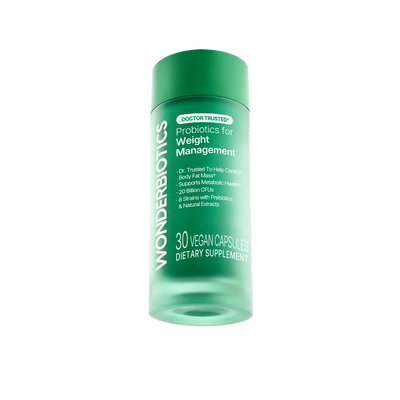
We built WonderBiotics Probiotics for Weight Management around B420 for a specific reason: like the other strains cataloged above, it has actually been tested in a randomized, placebo-controlled human trial, not just in rodents or a dish, the same bar we hold every strain in our formulas to. A lot of strains marketed for "belly fat" on store shelves never clear that bar at all.
The trial's pre-specified ITT analysis (199 of the 225 randomized had complete data for this specific measure) found no significant difference in body-fat mass at six months. The 4% body-fat-mass and 2.4 cm waist numbers that circulate online, "B420 alone cut body fat by 4%," come from a post-hoc comparison run after the blind was broken, not from B420 beating placebo on that primary analysis. That's a smaller, more specific claim, and it's still a large part of why B420 earns a place in our formula.
Our formula pairs B420 with seven other strains that each have their own published research base, HN019, L. acidophilus NCFM, L. rhamnosus GG, L. salivarius Ls-33, L. lactis Ll-23, L. paracasei Lpc-37, and L. plantarum Lp-116, for eight strains and 20 billion CFU total per serving, rather than leaning on B420 in isolation. None of those seven were tested for weight or waist outcomes in the trial above; the Stenman trial tested B420 alone or with fiber as a powder mixed into a smoothie, not this eight-strain capsule blend, so that RCT is the reason B420 is in the formula, not proof of what the finished product does on its own.
Given what this trial shows, a daily probiotic's job here is a supporting one: a habit that pairs with the diet, protein, and activity changes doing the heavier lifting on the scale, and one that can be added to a GLP-1 medication regimen with your prescriber's input, though no trial has tested that specific combination. That's the role WonderBiotics Probiotics for Weight Management is built for, based on the B420 trial detailed here rather than a strain that was never tested in people.
When to Loop In Your Doctor
None of the trials above enrolled people taking semaglutide or tirzepatide, and as of mid-2026 there's no completed trial testing a probiotic specifically alongside a GLP-1 medication. One small study (NCT07213323) is registered to test a probiotic in people starting GLP-1 treatment, and a separate, unrelated study (NCT07209046) is registered to test one after people stop a GLP-1 medication; neither has started recruiting, and neither is a concurrent-use trial. If you're on one of these medications, treat a probiotic as a complement to your treatment plan, not a substitute for it, and loop in your prescriber before adding anything new, especially if you have ongoing digestive symptoms.
Seek care right away, rather than waiting it out, for severe or worsening abdominal pain, pain radiating to your back, persistent vomiting, fever or chills, or yellowing skin; NIDDK lists these as signs of pancreatitis or a gallbladder problem that need prompt medical attention regardless of what you're taking for weight14, 15.
References
- Stenman LK, Lehtinen MJ, Meland N, et al. Probiotic With or Without Fiber Controls Body Fat Mass, Associated With Serum Zonulin, in Overweight and Obese Adults: Randomized Controlled Trial. EBioMedicine. 2016. PMID: 27810310
- Uusitupa HM, Rasinkangas P, Lehtinen MJ, et al. Bifidobacterium animalis subsp. lactis 420 for Metabolic Health: Review of the Research. Nutrients. 2020. PMC7230722
- Kadooka Y, et al. Regulation of abdominal adiposity by probiotics (Lactobacillus gasseri SBT2055) in adults with obese tendencies in a randomized controlled trial. Eur J Clin Nutr. 2010. PMID: 20216555
- Kadooka Y, et al. Effect of Lactobacillus gasseri SBT2055 in fermented milk on abdominal adiposity in adults in a randomised controlled trial. Br J Nutr. 2013. PMID: 23614897
- Sánchez M, et al. Effect of Lactobacillus rhamnosus CGMCC1.3724 supplementation on weight loss and maintenance in obese men and women. Br J Nutr. 2014. PMID: 24299712
- Kim J, Yun JM, Kim MK, Kwon O, Cho B. Lactobacillus gasseri BNR17 Supplementation Reduces the Visceral Fat Accumulation and Waist Circumference in Obese Adults. J Med Food. 2018. PMID: 29688793
- Depommier C, et al. Supplementation with Akkermansia muciniphila in overweight and obese human volunteers: a proof-of-concept exploratory study. Nat Med. 2019. PMID: 31263284
- Pasteurized Akkermansia muciniphila MucT for weight loss maintenance in people with overweight and obesity: a controlled randomized trial. Nat Med. 2026. DOI: 10.1038/s41591-026-04394-7
- Zhang Q, et al. Effect of probiotics on body weight and body-mass index: a systematic review and meta-analysis of randomized, controlled trials. Int J Food Sci Nutr. 2016. PMID: 27149163
- Cao et al. Impact of probiotics on weight loss, glucose and lipid metabolism in overweight or obese women: a meta-analysis. 2024. PMC11305212
- Effects of oral supplementation of probiotics on body weight and visceral fat in obese patients: a meta-analysis and systematic review. Sci Rep. 2025. PMC11845779; DOI: 10.1038/s41598-025-90820-8
- Efficacy of probiotic supplementation for body weight management in overweight and obese adults: a meta-analysis of randomized controlled trials predominantly from East Asia. Front Public Health. 2026. PMID: 41938967; DOI: 10.3389/fpubh.2026.1767108
- UAS Labs licenses BNR17 probiotic strain for weight management. NutraIngredients-USA. 2018. nutraingredients.com
- National Institute of Diabetes and Digestive and Kidney Diseases. Symptoms & Causes of Pancreatitis. niddk.nih.gov
- National Institute of Diabetes and Digestive and Kidney Diseases. Symptoms & Causes of Gallstones. niddk.nih.gov


