


What Determines Whether a Probiotic Helps With Weight Loss

What Determines Whether a Probiotic Will Actually Help with Weight Loss
The word "probiotic" is applied to everything from grocery store yogurt to highly specific, research-grade supplements. When someone asks whether probiotics help with weight loss, the answer depends almost entirely on which probiotic they are talking about. Most products in this category were never designed, selected, or clinically tested for body composition outcomes. The ones that have been are a genuinely different category of product.
The distinction matters because the clinical evidence for weight management is not spread evenly across the category. It is concentrated in a small number of specific, identified strains.

Why the Answer Varies by Product
Most commercially available probiotics were designed with digestive comfort and general gut health in mind. Body composition is a different biological target, and a probiotic has to have been specifically studied against it to deliver on it.
Meta-analyses of probiotic supplementation in overweight and obese adults have found statistically significant but modest effects on body weight, body mass index (BMI), and fat mass, with substantial variation between individual trials.<sup>1</sup> That variation reflects the heterogeneity of the studies themselves: pooled analyses combine trials using different strains, different doses, different population groups, and different durations. A meaningful result in one study does not transfer to a different strain in a different product.
A probiotic that has never been tested in a body composition trial carries no body composition evidence, regardless of its colony-forming unit (CFU) count or species name on the label.
The Strains That Human Trials Have Put to the Test
Two probiotic strains with well-documented human evidence for weight-related endpoints are Bifidobacterium animalisssp. lactis B420 (B420™) and Lactobacillus gasseri SBT2055. Both have randomized, placebo-controlled human trials behind them. Both show measurable effects on body fat under controlled conditions.
In a 6-month, double-blind, randomized controlled trial (RCT) involving 225 adults aged 18 to 65 with overweight or obesity (BMI 28.0–34.9), post-hoc factorial analysis of the B420™ group found a body fat mass change of −4.0% vs. placebo (P=0.002), a waist circumference reduction of 2.4 cm vs. placebo, and approximately 300 kcal less daily energy intake compared to placebo.<sup>2</sup> Notably, the changes in body fat correlated with changes in serum zonulin, a marker of gut barrier integrity, suggesting gut permeability is part of the mechanism.
In a separate 12-week, double-blind, randomized, placebo-controlled trial with 87 adults with higher BMI (24.2–30.7 kg/m<sup>2</sup>), supplementation with Lactobacillus gasseri SBT2055 reduced abdominal visceral fat area by 4.6% from baseline and subcutaneous fat by 3.3%, both significantly greater than control.<sup>3</sup> Body weight and BMI also fell in the active group.
Neither strain's evidence extends to the other. The results belong to the specific strain studied, not to the broader category.
What Drives the Effect at the Biological Level
The gut microbiome shapes metabolic function through several pathways.<sup>4</sup> How efficiently the body extracts energy from food, how the intestinal barrier regulates what enters systemic circulation, and how gut bacteria communicate with appetite-regulating hormones are all influenced by microbiome composition.
In the context of weight management, a compromised gut barrier is one relevant pathway. When the intestinal lining becomes more permeable, bacterial components can enter circulation and trigger a pattern of low-grade, chronic inflammation associated with insulin resistance and altered fat storage. Specific probiotic strains appear to act partly by reinforcing the tight junction proteins that maintain this barrier, consistent with the zonulin findings from the B420™ trial.
Short-chain fatty acids (SCFAs) produced by gut bacteria add another layer. They signal to cells in the gut wall to release appetite-regulating hormones including glucagon-like peptide-1 (GLP-1) and peptide YY, both of which influence hunger and energy intake. A microbiome shaped by researched probiotic strains can shift this signaling environment in ways that support energy balance.
Terms to Know!
- Gut barrier integrity: the structural and functional state of the intestinal lining, which regulates what passes between the gut and systemic circulation. A compromised barrier is associated with metabolic inflammation and insulin resistance.
- Metabolic endotoxemia: a state of chronically elevated circulating bacterial components (such as lipopolysaccharide) from the gut, linked to low-grade inflammation and impaired metabolic function in overweight individuals.
A Probiotic Formulated to Answer Yes
The practical implication of strain-specific evidence is direct: a probiotic formulated for weight management needs ingredients that can be traced to clinical data on body composition endpoints.
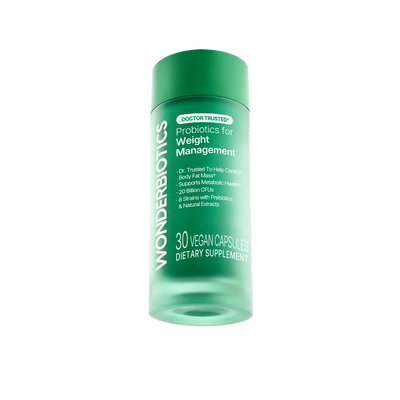
WONDERBIOTICS is built around exactly this framework. The Probiotics for Weight Management formula is designed around the role the gut microbiome plays in metabolic health, with every ingredient carrying a defined role. The core strain is B420™, backed by over 30 clinical trial publications, including the 6-month body fat and waist circumference data described above. The formula extends into metabolic signaling through Eriomin® (lemon extract), which has ingredient-level clinical research reporting support for natural GLP-1 levels, and Dihydroberberine, a modified version of berberine that achieves higher plasma berberine exposure at lower doses. The formula also features CraveLock™ Technology, a proprietary synergistic approach to appetite management and Food Noise.
For delivery protection, WONDERBIOTICS uses PolarSeal Technology. In testing, 99.9% of the bacterial strain survived gut-like acidic conditions, and 98.2% of the bacteria remained alive through the point of consumption.
The key ingredients behind the formula are backed by 624 clinical studies and 44,692 participants, developed by a team of PhD scientists and industry experts.
What the Timeline Actually Looks Like
For a probiotic formulated around body composition endpoints, the clinical evidence points to real effects that unfold over months. We recommend a usage period of 3 to 6 months, to give your gut time to adapt and your body time to respond. This works alongside a nutritious diet and consistent physical activity. A probiotic supports a biological system; the full picture includes everything that system interacts with.
Explore WONDERBIOTICS Probiotics for Weight Management
References
- Borgeraas H, Johnson LK, Skattebu J, Hertel JK, Hjelmesaeth J. Effects of probiotics on body weight, body mass index, fat mass and fat percentage in subjects with overweight or obesity: a systematic review and meta-analysis of randomized controlled trials. Obes Rev. 2018;19(2):219-232. https://onlinelibrary.wiley.com/doi/10.1111/obr.12626
- Stenman LK, Lehtinen MJ, Meland N, et al. Probiotic with or without fiber controls body fat mass, associated with serum zonulin, in overweight and obese adults: randomized controlled trial. EBioMedicine. 2016;13:190-200. https://www.sciencedirect.com/science/article/pii/S2352396416304972
- Kadooka Y, Sato M, Imaizumi K, et al. Regulation of abdominal adiposity by probiotics (Lactobacillus gasseriSBT2055) in adults with obese tendencies in a randomized controlled trial. Eur J Clin Nutr. 2010;64(6):636-643. https://www.nature.com/articles/ejcn201019
- Fan Y, Pedersen O. Gut microbiota in human metabolic health and disease. Nat Rev Microbiol. 2021;19(1):55-71. https://www.nature.com/articles/s41579-020-0433-9


