


Which supplements have the best evidence for weight management?

Which supplements have the best evidence for weight management?
The supplements with the best evidence are the ones most people overlook because they are not exciting: protein powder and dietary fiber. After those, a small number of specific ingredients have meaningful human RCT data for body fat and metabolic endpoints. Most supplements marketed for weight loss do not meet the bar of meaningful human clinical evidence, and knowing which ones do prevents wasted effort and money. This article ranks the options by evidence quality, not by marketing budget.

The Evidence Standard
For a supplement to have meaningful evidence for weight management, it should have at least one randomized controlled trial in humans with body fat, waist circumference, or body weight as a primary or explicitly measured endpoint, with results favoring the supplement over placebo. Evidence from animal studies, in vitro research, or mechanistic observations only does not qualify.
The NIH Office of Dietary Supplements reviews weight loss supplement evidence and consistently notes that most products in this category have modest or limited evidence, and that many come with safety concerns that are underappreciated.1
Tier 1: Strongest Evidence
Protein Supplementation
Protein has the most consistent evidence for supporting satiety, reducing ghrelin, and preserving muscle mass during caloric restriction. Every study finding that higher protein intake supports better weight management outcomes was a study of food and macronutrient composition, but protein powder functions as a supplement for people who cannot meet targets through food alone.
The evidence for protein as a weight management support strategy is extensive, population-nonspecific, and consistent across decades of research. It is not exciting or novel, which is why it is underused. For midlife women specifically, 1.0-1.2 g/kg/day supports both muscle preservation and satiety more reliably than any other supplement.
Dietary Fiber
Soluble fiber, particularly beta-glucan from oats and barley, has consistent evidence for blood sugar stability, satiety extension, and GI transit support. The NIH ODS notes that beta-glucans may increase satiety and delay GI transit.1 These are real and repeatable effects. The weight management benefit comes through blood sugar stability and extended satiety, not direct fat loss.
Glucomannan is widely marketed but the direct appetite suppression evidence is limited. An 8-week placebo-controlled trial found no significant effect on weight, hunger, or fullness. Useful for regularity; not a weight loss product.
Tier 2: Emerging and Meaningful Evidence
Bifidobacterium animalis subsp. lactis 420 (B420™)
B420 has the most directly relevant human RCT data of any named probiotic strain for body fat and waist circumference. A 6-month double-blind RCT in 225 overweight adults found B420 associated with a 4.0% relative reduction in body fat mass vs. placebo and approximately 2.4 cm waist circumference reduction in a post-hoc factorial analysis.2
Evidence classification: ingredient-level, 6-month RCT in overweight adults. Not menopause-specific; post-hoc analysis. Real signal; requires independent replication to be established.
Lactobacillus gasseri SBT2055
Multicenter RCT in 87 Japanese adults with elevated visceral fat: visceral fat area decreased by 4.6% vs. baseline over 12 weeks with significant differences from the control group. Population-specific (Japanese adults, fermented milk delivery); one of the strongest visceral fat findings in the probiotic literature.
Saffron Extract (Satiereal)
One RCT in 60 mildly overweight women showing significantly reduced snacking frequency vs. placebo over 8 weeks. Mechanism: serotonin pathway support. Single trial; modest effect size; directly relevant to mood-linked and carbohydrate-driven cravings.
Dihydroberberine
More bioavailable form of berberine, with AMPK-activating and insulin-sensitizing mechanisms. Evidence is on blood sugar and metabolic markers more than on body weight as a primary endpoint. Relevant for the insulin resistance component of weight management.
Tier 3: Limited or Inconsistent Evidence
Vitamin D: important for musculoskeletal health in midlife women; not a weight loss supplement. Low vitamin D correlates with higher BMI but supplementation has not been shown to cause weight loss.
Omega-3 fatty acids: well-supported for cardiovascular and inflammatory markers; limited direct evidence for body weight as a primary endpoint. Worth taking for metabolic and cardiovascular health during perimenopause; not a weight management supplement specifically.
Green tea extract (EGCG): possible modest effect per NIH ODS review, with significant liver damage risk at higher standardized doses.1 Not recommended given the safety tradeoff.
CLA (conjugated linoleic acid): modest and inconsistent effects on body fat in some studies; some evidence of adverse effects on liver fat and insulin resistance markers. NIH ODS review does not support it as a weight loss supplement.
Raspberry ketone, garcinia cambogia, hoodia: no meaningful human RCT evidence. Skip.
Terms to Know!
- Randomized controlled trial (RCT): A study design in which participants are randomly assigned to receive a supplement or placebo, allowing comparison of outcomes between groups while controlling for confounding factors. The standard of evidence for clinical effectiveness claims.
- Post-hoc factorial analysis: A statistical analysis examining subgroup combinations after the primary trial analysis. Results are real but hypothesis-generating; independent replication strengthens confidence.
How WONDERBIOTICS Fits This Evidence Map
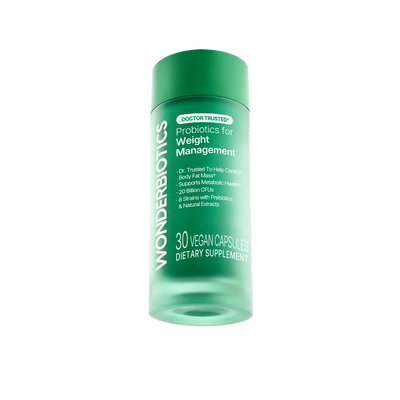
WONDERBIOTICS was formulated to bring Tier 2 gut-metabolic ingredients together in a formula designed for midlife women's weight management routines.
B420™ (Bifidobacterium animalis subsp. lactis 420): the formula's primary weight-management strain, with the 6-month RCT evidence described above. CFU guaranteed at expiration; dose aligns with clinically studied range.
Eriomin® and CraveLock™: ingredient-level clinical research on natural GLP-1 secretion support. Addresses the satiety and cravings dimension through the gut hormone pathway.
5X Dihydroberberine: supports healthy blood sugar within the normal range, addressing the insulin resistance dimension of metabolic weight management. Safety note: discuss with clinician if taking glucose-lowering medications.
HN019 (Bifidobacterium animalis subsp. lactis HN019): gut comfort and regularity support.
WONDERBIOTICS uses PolarSeal Technology to protect the probiotic blend. In testing, 99.9% of the bacterial strain survived gut-like acidic conditions and 98.2% remained alive through the point of consumption. CFU is guaranteed at expiration.
Key ingredients are backed by 624 clinical studies involving 44,692 participants at the ingredient level. The finished product has not been studied in a dedicated clinical trial. The formula supports weight-management habits alongside adequate protein, dietary fiber, resistance training, and sleep.
Read the WONDERBIOTICS Review for a full look at the formula.
This article is for educational purposes only and is not medical advice. It is not intended to diagnose, treat, cure, or prevent any disease. If you have a medical condition or take medications, talk with a licensed clinician before starting supplements.
References
- National Institutes of Health, Office of Dietary Supplements. Dietary Supplements for Weight Loss: Health Professional Fact Sheet. Updated 2024. https://ods.od.nih.gov/factsheets/WeightLoss-HealthProfessional/
- Stenman LK, Lehtinen MJ, Meland N, et al. Probiotic With or Without Fiber Controls Body Fat Mass, Associated With Serum Zonulin, in Overweight and Obese Adults-Randomized Controlled Trial. EBioMedicine. 2016;13:190-200. https://pubmed.ncbi.nlm.nih.gov/27810310/
- Saadati S, Naseri K, Asbaghi O, Yousefi M, Golalipour E, de Courten B. Beneficial effects of the probiotics and synbiotics supplementation on anthropometric indices and body composition in adults: A systematic review and meta-analysis. Obes Rev. 2024;25(3):e13667. https://pubmed.ncbi.nlm.nih.gov/38030409/


