


Best Probiotic for Belly Fat and the Gut-Visceral Fat Link

Best Probiotic for Belly Fat: The Gut-Visceral Fat Link That Shapes the Evidence
Belly fat is not simply fat that happens to sit at the waist. Visceral fat, the fat stored within the abdominal cavity around internal organs, has a different biology from fat beneath the skin, different metabolic consequences, and a more direct anatomical connection to the gut. That last point changes which probiotics are relevant, and why.

What Makes Belly Fat Different from Fat Elsewhere
Fat in the abdominal cavity is not inert storage. Visceral adipose tissue (VAT) is metabolically active tissue that secretes pro-inflammatory signaling molecules and contributes to insulin resistance, elevated triglycerides, and cardiometabolic risk. Even in people who are not clinically overweight, excess VAT is associated with metabolic dysfunction.
The position of visceral fat inside the peritoneal cavity is important for understanding the gut connection. Visceral fat depots sit in immediate proximity to the intestines, the liver, and the portal vein. The portal circulation drains the intestinal environment directly into the liver, passing through visceral fat tissue along the way. This anatomy makes VAT uniquely exposed to what comes out of the gut.
Terms to Know!
- Visceral adipose tissue (VAT): fat stored within the abdominal cavity around organs such as the liver, intestines, and pancreas. VAT is metabolically active, secretes pro-inflammatory signals, and is more strongly associated with insulin resistance and cardiometabolic risk than subcutaneous fat.
The Gut's Direct Connection to Visceral Fat
When the intestinal barrier is intact, it selectively controls what passes from the gut into systemic circulation. When gut barrier function is compromised, bacterial components including lipopolysaccharide (LPS), a molecule from the outer membrane of gram-negative bacteria, can cross the intestinal lining and enter the portal vein.
Animal model research established that chronically elevated circulating LPS promotes weight gain, adipose tissue inflammation, and insulin resistance at levels comparable to those induced by a high-fat diet.<sup>1</sup> In human populations, circulating zonulin, a protein that regulates gut barrier permeability, is elevated in individuals with obesity and correlates independently with insulin resistance.<sup>2</sup> Together, these findings make the case that the gut barrier is not a passive boundary. Its functional state directly influences the metabolic environment in the liver and visceral fat depots.
This is why gut barrier integrity is relevant specifically to belly fat, in a way that general probiotic activity around digestion or immune function is not.
What the Probiotic Evidence Shows for Waist and Abdominal Fat
Of the probiotic strains with human trial data on body composition endpoints, Bifidobacterium animalis ssp. lactis B420 (B420™) has the most direct mechanistic connection to the gut barrier pathway described above.
In a 6-month, double-blind, randomized controlled trial (RCT) involving 225 overweight and obese adults aged 18 to 65 (body mass index (BMI) 28.0–34.9), B420™ produced a waist circumference reduction of 2.4 cm vs. placebo, a body fat mass change of −4.0% vs. placebo (P=0.002), and an energy intake approximately 300 kcal less per day vs. placebo in post-hoc factorial analysis.<sup>3</sup> Importantly, these body fat changes correlated with changes in serum zonulin. The strain that produced the waist and fat reduction was also the strain associated with improved gut barrier markers. The mechanism matches the biology.
The data come from post-hoc factorial analysis within the trial, not a pre-specified primary outcome. This framing is important when evaluating the strength of the finding.
Formulating for the Full Biology
Visceral fat accumulation involves more than gut barrier dysfunction alone. Appetite dysregulation, insulin sensitivity, and systemic inflammation all contribute. A probiotic designed specifically for belly fat reduction addresses multiple aspects of this biology.
Eriomin® (lemon extract) is a standardized flavonoid complex with ingredient-level clinical research in prediabetic populations reporting support for natural glucagon-like peptide-1 (GLP-1) levels.<sup>4</sup> GLP-1 is a gut hormone involved in appetite regulation and blood glucose response. Appetite-driven overconsumption is a direct driver of visceral fat accumulation, and having a formula that addresses GLP-1 signaling alongside the probiotic strain adds a second metabolic lever.
Dihydroberberine provides a more bioavailable berberine-delivery route, supporting metabolic function through a pathway distinct from both gut bacteria and appetite hormones.
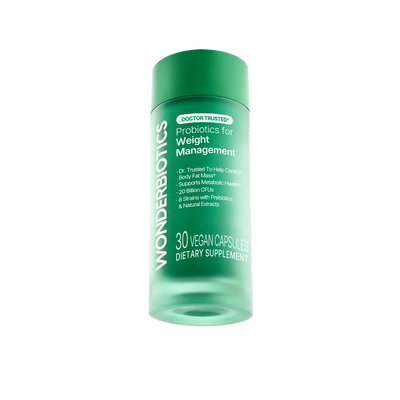
WONDERBIOTICS is formulated with this full biological picture in mind. The Probiotics for Weight Management formula brings together B420™, Eriomin® (lemon extract), and Dihydroberberine to address gut composition, gut barrier function, appetite signaling, and metabolic support as a single intervention. The formula also features CraveLock™ Technology, a proprietary approach to appetite management and Food Noise.
For delivery, WONDERBIOTICS uses PolarSeal Technology to help protect the probiotic blend. In testing, 99.9% of the bacterial strain survived conditions simulating gut-like acidity, and 98.2% of the bacteria remained alive through the point of consumption.
The key ingredients behind the formula are backed by 624 clinical studies and 44,692 participants. The formula was developed by a team of PhD scientists and industry experts.
The Long-Term View
Visceral fat is among the most metabolically stubborn fat to address. The biology behind it is not resolved quickly. We recommend a usage period of 3 to 6 months, to give your gut time to adapt and your body time to respond, alongside a nutritious diet and consistent physical activity.
Explore WONDERBIOTICS Probiotics for Weight Management
References
- Cani PD, Amar J, Iglesias MA, et al. Metabolic endotoxemia initiates obesity and insulin resistance. Diabetes.2007;56(7):1761-1772. https://diabetesjournals.org/diabetes/article/56/7/1761/12590/Metabolic-Endotoxemia-Initiates-Obesity-and
- Moreno-Navarrete JM, Sabater M, Ortega F, Ricart W, Fernández-Real JM. Circulating zonulin, a marker of intestinal permeability, is increased in association with obesity-associated insulin resistance. PLoS One.2012;7(5):e37160. https://journals.plos.org/plosone/article?id=10.1371/journal.pone.0037160
- Stenman LK, Lehtinen MJ, Meland N, et al. Probiotic with or without fiber controls body fat mass, associated with serum zonulin, in overweight and obese adults: randomized controlled trial. EBioMedicine. 2016;13:190-200. https://www.sciencedirect.com/science/article/pii/S2352396416304972
- Cesar TB, Manzini Ramos FM, Ribeiro CB. Nutraceutical Eriocitrin (Eriomin) Reduces Hyperglycemia by Increasing Glucagon-Like Peptide 1 and Downregulates Systemic Inflammation: A Crossover-Randomized Clinical Trial. J Med Food. 2022;25(11):1087-1094. https://www.ncbi.nlm.nih.gov/pmc/articles/PMC9700344/


