


What Makes a Probiotic Evidence-Backed for Weight Management?

What Makes a Probiotic Evidence-Backed for Weight Management?
"Evidence-backed" has become a marketing claim rather than a meaningful standard in the supplement industry. Nearly every probiotic product uses the phrase, including those with no published human clinical data on weight management endpoints. An evidence-backed probiotic for weight management specifically means something precise: named strains with published human randomized controlled trial data showing effects on body fat, waist circumference, or related metabolic endpoints, at doses that match what was studied, with quality documentation verifying what is in the bottle. This article defines each component of that standard and applies it to help evaluate what you are considering.

The Five Components of Genuine Evidence
1. Named strains with strain-level designation
Evidence for probiotic effects lives at the strain level, identified by the full taxonomic name plus a proprietary code: for example, Bifidobacterium animalis subsp. lactis 420, not just "Bifidobacterium lactis" or "Bifidobacterium blend."
This matters because clinical studies are conducted on specific strains, and their results do not transfer to other strains in the same species, much less to unnamed blends. A product label that does not include strain codes cannot be evaluated against any published clinical record for weight management.
2. Human RCT data on the relevant endpoints
A study in mice showing reduced fat mass is not evidence that a probiotic is evidence-backed for human weight management. In vitro fermentation studies showing that a strain produces butyrate are not evidence. A population survey showing correlation between probiotic use and lower BMI is not evidence.
The relevant evidence type is a randomized, double-blind, placebo-controlled trial in humans, with body fat mass, waist circumference, or body weight as a measured outcome. A 2024 meta-analysis of 200 such trials found that probiotics and synbiotics were associated with modest but statistically significant reductions in these endpoints, confirming that the category-level effect is real.1 This does not mean any individual product produces these results; it means the strain-specific evidence for eligible products is worth examining.
3. Dose alignment
A probiotic can include a strain with genuine RCT evidence but at a dose far below what was studied. If the published trial used 10 billion CFU per day and the product provides 1 billion CFU per day of the same strain, the product cannot be assumed to replicate the study's effects.
Check: does the product label specify CFU per dose? Is that CFU in the range of what the clinical trial used for the named strain? Is the CFU guaranteed at expiration rather than at manufacture?
4. CFU at expiration and delivery protection
CFU at manufacture means nothing without knowing how much is viable by the time you use the product. Viable bacteria decline over shelf life; a product guaranteeing CFU at manufacture may have substantially fewer viable organisms by expiration. The relevant specification is CFU guaranteed at expiration.
Separately, live bacteria must survive stomach acid to reach the intestinal environment where they have effect. Products with published acid-protection testing, showing bacterial survival through simulated gastric conditions, have a more defensible claim than those with no published viability data.
5. Evidence classification transparency
An evidence-backed probiotic for weight management should clearly state whether the evidence is ingredient-level (from studies of the named strain in isolation) or finished-product level (from studies of the actual commercial product). These are different standards. Finished-product clinical trials are rare in the supplement category. Most evidence is ingredient-level, which is meaningful but not equivalent to a validated finished-product claim.
Products that present ingredient-level evidence as if it were finished-product validation are misrepresenting their evidence status.
Applying the Standard to Available Options
B420 (Bifidobacterium animalis subsp. lactis 420)
Named strain: yes, fully designated. Human RCT data: yes. A 6-month double-blind, placebo-controlled RCT in 225 overweight adults found B420 associated with a 4.0% relative reduction in body fat mass vs. placebo, approximately 2.4 cm waist circumference reduction, and reduced energy intake in a post-hoc factorial analysis.2 Evidence type: ingredient-level. The clinical data is on B420 as a standalone ingredient; not on any finished commercial product. Mechanism: gut barrier integrity support and reduction of metabolic endotoxemia, reviewed across multiple in vitro, animal, and human studies.3
B420 passes all five criteria for ingredient-level evidence. It is the standard against which weight-management probiotic strains are currently measured.
Generic Probiotic Blends
Named strains: typically not provided to strain level. Human RCT data on weight management endpoints: typically not available, because the specific unnamed strains in the blend have not been studied for these endpoints. Evidence type: cannot be classified without strain designation. Assessment: does not pass the evidence standard for weight management claims. May have legitimate evidence for general digestive health, but that evidence is different from weight management evidence.
What "Evidence-Backed" Is Not
A strain having extensive evidence for one endpoint (for example, Lactobacillus rhamnosus GG for antibiotic-associated diarrhea) does not give that strain evidence for weight management. Every evidence claim must be matched to the specific endpoint it was studied for.
High CFU count is not evidence. Diverse strain blends are not evidence. Customer reviews are not evidence. Partnerships with wellness influencers are not evidence.
As dietary supplements, probiotics in the United States are not required to demonstrate efficacy before marketing. Manufacturers can make general well-being claims without published RCT data.4 The evaluation burden falls on the consumer.
Terms to Know!
- Strain designation: The full taxonomic name plus proprietary code for a specific bacterial strain (e.g., B. animalis subsp. lactis 420). The minimum information required to trace clinical evidence to a specific strain.
- Ingredient-level evidence: Clinical findings from studies of a specific named ingredient in isolation, as opposed to finished-product clinical trials. B420's RCT evidence is ingredient-level; it describes what B420 did in a 6-month trial, not what any particular supplement containing B420 will do.
How WONDERBIOTICS Meets This Standard
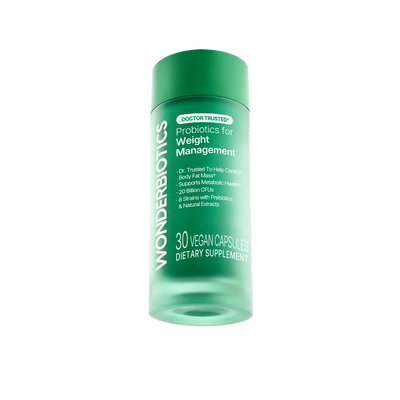
WONDERBIOTICS was formulated by PhD scientists to meet the evidence standard described in this article.
B420™ (Bifidobacterium animalis subsp. lactis 420): named to strain level; CFU guaranteed at expiration; dose aligns with the clinically studied range; ingredient-level RCT evidence on body fat mass and waist circumference. Ingredient-level only; not a finished-product clinical claim.2
HN019 (Bifidobacterium animalis subsp. lactis HN019): named to strain level; ingredient-level evidence on gut comfort and abdominal symptom management; CFU guaranteed at expiration.
Eriomin® and CraveLock™: ingredient-level clinical research on natural GLP-1 secretion support, relevant to satiety and appetite management.
5X Dihydroberberine: metabolic support ingredient with blood sugar stability evidence at the ingredient level.
WONDERBIOTICS uses PolarSeal Technology with published acid-condition viability testing: 99.9% of the bacterial strain survived gut-like acidic conditions, and 98.2% remained alive through the point of consumption.
Key ingredients are backed by 624 clinical studies involving 44,692 participants. The finished WONDERBIOTICS product has not been studied in a dedicated clinical trial; all cited evidence is ingredient-level.
WONDERBIOTICS may be a more targeted option than generic blends if you want a probiotic designed around weight-management routines, because the strains were selected for their ingredient-level evidence on those specific endpoints rather than for general digestive health.
Read the WONDERBIOTICS Review for a full look at the formula.
This article is for educational purposes only and is not medical advice. It is not intended to diagnose, treat, cure, or prevent any disease. If you have a medical condition or take medications, talk with a licensed clinician before starting supplements.
References
- Saadati S, Naseri K, Asbaghi O, Yousefi M, Golalipour E, de Courten B. Beneficial effects of the probiotics and synbiotics supplementation on anthropometric indices and body composition in adults: A systematic review and meta-analysis. Obes Rev. 2024;25(3):e13667. https://pubmed.ncbi.nlm.nih.gov/38030409/
- Stenman LK, Lehtinen MJ, Meland N, et al. Probiotic With or Without Fiber Controls Body Fat Mass, Associated With Serum Zonulin, in Overweight and Obese Adults-Randomized Controlled Trial. EBioMedicine. 2016;13:190-200. https://pubmed.ncbi.nlm.nih.gov/27810310/
- Uusitupa HM, Rasinkangas P, Lehtinen MJ, et al. Bifidobacterium animalis subsp. lactis 420 for Metabolic Health: Review of the Research. Nutrients. 2020;12(4):892. https://pmc.ncbi.nlm.nih.gov/articles/PMC7230722/
- National Center for Complementary and Integrative Health. Probiotics: Usefulness and Safety. https://www.nccih.nih.gov/health/probiotics-usefulness-and-safety


