


Best Probiotic for Belly Fat and the Gut Barrier

Best Probiotic for Belly Fat: The Gut-Barrier Connection Behind the Evidence
Belly fat is a more specific problem than general body weight, and it has a more specific biology. The fat deposited around the abdominal organs responds to metabolic signals differently from fat stored elsewhere on the body. The gut microbiome connects to belly fat through pathways that the weight management probiotic research has started to map, with findings more targeted than for general weight loss. Understanding those pathways makes the clinical evidence easier to evaluate.

Why Belly Fat Has Its Own Biology
Visceral fat, the fat surrounding the liver, intestines, and pancreas, is metabolically active in ways that subcutaneous fat (the fat stored just under the skin) is not. It releases inflammatory molecules and free fatty acids directly into the portal circulation, driving insulin resistance and low-grade systemic inflammation. Two people at the same body weight can carry significantly different amounts of visceral fat, and it is visceral fat more than total body weight that correlates with cardiometabolic risk. Waist circumference is the commonly used proxy for visceral fat burden.
The clinical endpoints most relevant to belly fat reduction are waist circumference and abdominal fat area, which are more specific measures than overall body weight or body mass index (BMI).
The Gut Barrier and Belly Fat
The intestinal barrier plays a specific role in the belly fat story. When the gut lining becomes more permeable, bacterial components from the gut can pass into systemic circulation and trigger a low-grade chronic inflammatory response. This inflammatory state is associated with impaired insulin sensitivity and visceral fat accumulation.
Circulating zonulin, a protein that regulates intestinal tight junction permeability, has been found to increase with BMI and waist-to-hip ratio in adults with obesity, while inversely correlating with insulin sensitivity.<sup>1</sup> This direct association between a gut permeability marker and abdominal adiposity measures provides a biological mechanism connecting gut barrier function to belly fat.
The gut microbiome also shapes this picture through energy extraction from food, short-chain fatty acid (SCFA) production, and the regulation of appetite-related hormones.<sup>2</sup> Each of these pathways interacts with where and how the body stores fat.
Terms to Know!
- Zonulin: a protein that regulates intestinal permeability by modulating tight junction proteins between gut lining cells. Elevated serum zonulin is associated with increased gut permeability, higher BMI, and greater abdominal adiposity in human studies.
What the Clinical Evidence Shows
Among probiotic strains studied against abdominal fat endpoints in controlled human trials, two have peer-reviewed data.
Bifidobacterium animalis ssp. lactis B420 (B420™) was tested in a 6-month, double-blind, randomized, placebo-controlled trial (N=225, adults aged 18–65, BMI 28.0–34.9). Post-hoc factorial analysis found that waist circumference was 2.4 cm smaller in the B420™ group vs. placebo after 6 months, alongside a −4.0% change in body fat mass (P=0.002) and approximately 300 kcal less daily energy intake vs. placebo. The trial also found that body fat changes correlated with reductions in serum zonulin, directly linking the gut barrier mechanism to the observed body composition outcome.<sup>3</sup>
Lactobacillus gasseri SBT2055 was tested in a separate 12-week, randomized controlled trial (RCT) (N=87, Japanese adults, BMI 24.2–30.7), with visceral fat area decreasing by 4.6% vs. control.<sup>4</sup> This evidence is limited by its population specificity and fermented milk delivery vehicle.
Both trials point to abdominal fat reduction as a strain-level, measurable outcome when the right strain is matched to the right study design.
Addressing the Other Drivers of Belly Fat
Belly fat accumulation responds to more than gut bacterial composition alone. Appetite dysregulation, blood glucose instability, and hormonal signaling all contribute to whether and where the body stores fat. A formula built for belly fat should address more than one of these.
Eriomin® (lemon extract) is a standardized flavonoid complex with ingredient-level clinical research in prediabetic populations reporting support for natural glucagon-like peptide-1 (GLP-1) levels. GLP-1 is a gut hormone that plays a role in appetite regulation and blood glucose response. Persistent appetite dysregulation is one of the factors that makes belly fat difficult to shift, and an ingredient that supports appetite-regulating hormone signaling adds a complementary layer to a probiotic formula.
Dihydroberberine offers a more bioavailable berberine-delivery route, supporting metabolic function through a pathway distinct from gut bacteria and appetite hormones.
WONDERBIOTICS for Belly Fat
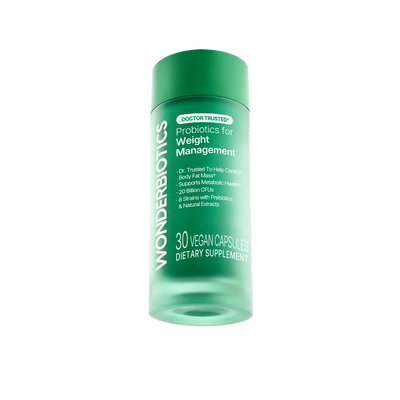
WONDERBIOTICS is formulated specifically around the role the gut microbiome plays in metabolic health. The Probiotics for Weight Management formula brings together B420™, the strain with the strongest combination of waist circumference data and gut barrier evidence, Eriomin® (lemon extract) for natural GLP-1 level support, and Dihydroberberine for metabolic support. The formula also features CraveLock™ Technology, a proprietary approach to appetite management and Food Noise.
For delivery, WONDERBIOTICS uses PolarSeal Technology to help protect the probiotic blend. In testing, 99.9% of the bacterial strain survived conditions simulating gut-like acidity, and 98.2% of the bacteria remained alive through the point of consumption.
The key ingredients behind the formula are backed by 624 clinical studies and 44,692 participants. The formula was developed by a team of PhD scientists and industry experts.
Getting Results Over Time
Belly fat responds slowly to any intervention, and probiotics are no exception. The B420™ evidence emerged from a 6-month trial, and the effect on waist circumference was measured at the end of that period. We recommend a usage period of 3 to 6 months, to give your gut time to adapt and your body time to respond, alongside a nutritious diet and regular physical activity.
Explore WONDERBIOTICS Probiotics for Weight Management
References
- Moreno-Navarrete JM, Sabater M, Ortega F, Ricart W, Fernández-Real JM. Circulating zonulin, a marker of intestinal permeability, is increased in association with obesity-associated insulin resistance. PLoS One.2012;7(5):e37160. https://journals.plos.org/plosone/article?id=10.1371/journal.pone.0037160
- Fan Y, Pedersen O. Gut microbiota in human metabolic health and disease. Nat Rev Microbiol. 2021;19(1):55-71. https://www.nature.com/articles/s41579-020-0433-9
- Stenman LK, Lehtinen MJ, Meland N, et al. Probiotic with or without fiber controls body fat mass, associated with serum zonulin, in overweight and obese adults: randomized controlled trial. EBioMedicine. 2016;13:190-200. https://www.sciencedirect.com/science/article/pii/S2352396416304972
- Kadooka Y, Sato M, Imaizumi K, et al. Regulation of abdominal adiposity by probiotics (Lactobacillus gasseriSBT2055) in adults with obese tendencies in a randomized controlled trial. Eur J Clin Nutr. 2010;64(6):636-643. https://www.nature.com/articles/ejcn201019


