


Best Probiotic Brands for Women Over 40 Trying to Lose Weight

Which Probiotic Brands Are Best for Women Over 40 Trying to Lose Weight?
If you're in your 40s and the body you've lived in for two decades suddenly behaves differently, the search for a probiotic that actually fits your situation can be confusing. The "women's weight loss probiotic" shelf is crowded, mostly with products that combine anonymous probiotic blends with herbal extracts like chasteberry, black cohosh, or turmeric and promise relief from a long list of symptoms. The honest assessment is that few of these brands have published finished-product RCT data on weight outcomes in women 40+ specifically, and the marketing claims often exceed what the underlying ingredients have actually been tested for. This article walks through what 40+ female biology actually involves, what the published evidence shows for probiotics in this population, and how to evaluate any brand against the same criteria.

For Women 40+
There is no probiotic clinically validated as a finished product for weight loss specifically in women aged 40+. The category is full of products marketed to this demographic; the evidence behind most of them sits in individual ingredient claims rather than in trials of the actual finished formula in women 40+.
What the published evidence supports:
- A probiotic with a named, deposited strain (not "Lactobacillus blend")
- Strain-level human RCT data on weight or weight-related endpoints
- Mechanism alignment with the actual biology of perimenopause and menopause (visceral fat, insulin sensitivity, appetite signaling)
- Delivery technology that protects live cultures
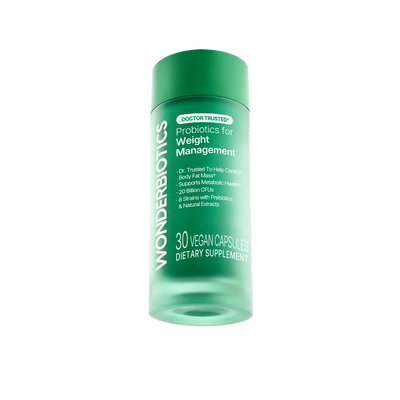
WONDERBIOTICS Probiotics for Weight Management is one such option built around B420™, a Bifidobacterium animalis subsp. lactis strain with published RCT data in overweight and obese adults aged 18-65 (not in women 40+ specifically), paired with non-probiotic ingredients chosen for appetite and metabolic biology.
What "Women Over 40" Actually Covers Biologically
The 40+ window spans three distinct biological phases, and the lived experience can differ dramatically across them.
Late premenopause (early 40s, regular cycles). Hormones are usually still cycling normally, but metabolic rate begins a gradual decline, muscle mass starts decreasing if not actively maintained, and insulin sensitivity may shift slightly. Most women in this phase do not yet feel "menopause" but may notice the same nutrition patterns yielding different results.
Perimenopause (mid-40s to early 50s, irregular cycles). This is the most disruptive phase. Progesterone usually declines first, then estrogen begins to fluctuate unpredictably. Fat distribution shifts toward the abdomen and visceral compartment, even before menopause is officially reached. Sleep, mood, appetite, and energy can all become more variable. Perimenopause typically lasts 2-10 years.
Menopause and postmenopause (12+ months without a period). Estrogen production stabilizes at a lower level. The metabolic shifts that began in perimenopause continue. Population-scale research shows that the postmenopausal gut microbiome differs significantly from the premenopausal female microbiome and resembles the male microbiome more closely, with reduced hormone-related metabolic potential.[1]
The biology that makes weight loss harder after 40 is not a personal failing. Hormonal adaptations to weight loss persist for at least a year after weight is lost, with hunger hormones rising and fullness signals fading.[2] Layered on top of perimenopausal and menopausal hormone shifts, the result is a body that defends central fat more vigorously than it did a decade earlier.
Terms to Know!
- Perimenopause: the transitional phase before menopause, typically beginning in a woman's mid-40s, during which estrogen and progesterone fluctuate unpredictably; weight gain, visceral fat redistribution, sleep disruption, and mood changes are common.
- Estrobolome: the collection of gut bacterial genes involved in metabolizing estrogen; shifts in the estrobolome during peri- and postmenopause influence how the body recycles and uses circulating estrogen.
What Published Evidence Shows for Probiotics in 40+ Women
The most relevant body of clinical evidence comes from studies of postmenopausal women specifically. A 2023 systematic review and meta-analysis covered 5 RCTs with 281 postmenopausal overweight or obese women. Compared to placebo, probiotic supplementation produced statistically significant reductions in fasting insulin, HOMA-IR, and TNF-α. Improvements in body adiposity and lipid profile were observed but did not reach statistical significance in the pooled analysis.[3] The plain reading: probiotic effects in this specific population are clearer on metabolic and inflammatory markers than on body weight or fat mass at the meta-analysis level.
At the strain level, the strongest published positive signal in women specifically comes from Lactobacillus rhamnosusCGMCC 1.3724 (LPR). A 24-week trial in 125 obese adults on energy restriction reported a sex-by-treatment interaction: mean weight loss in women in the LPR group was significantly higher than in women in the placebo group (P=0.02), with no comparable signal in men.[4] A follow-up paper on appetite-related outcomes from the same cohort found that women in the LPR group had significantly higher satiety efficiency (P=0.02), lower hunger scores (P=0.02), reduced disinhibition (P=0.05), and lower food craving (P=0.05) compared to the female placebo group.[5] The trial enrolled obese adults aged 18 and older rather than women 40+ specifically, so the female-specific signal is informative for this age group without constituting direct demonstration in a defined 40+ cohort.
Another strain worth noting is Bifidobacterium animalis subsp. lactis B420™. A 6-month RCT in 225 overweight and obese adults aged 18-65 reported that the post-hoc factorial analysis showed body fat mass differing by -4.0% versus placebo (P=0.002), waist circumference dropping by 2.4 cm more than placebo, and daily energy intake reduced by approximately 300 kcal compared to placebo. The pre-specified primary outcome in the intention-to-treat population did not reach significance.[6] The trial enrolled mixed sex in the general adult range, so the data is at the ingredient-level evidence tier rather than at a women-40+-specific validation tier.
At the broader category level, a 2019 meta-analysis of 12 RCTs in overweight or obese adults showed modest pooled effects: -0.55 kg body weight, -0.30 kg/m² BMI, -1.20 cm waist circumference, with substantial heterogeneity.[7] The category as a whole shows real but modest effects; strain-level evidence is the more useful unit of analysis.
The Typical "Women's Weight Loss Probiotic" Template
A pattern repeats across most brands marketed to women 40+ for weight loss. Recognizing it helps separate products with real ingredient-level evidence from products built around marketing logic.
The template usually includes:
- A multi-strain probiotic blend (often 10-15 strains)
- Total CFU count typically in the 10-50 billion range
- Herbal additives commonly marketed for menopause symptoms: chasteberry (vitex), black cohosh, dong quai, red clover, turmeric/curcumin, bioperine
- Sometimes additional vitamins (D, B-complex) or omega-3
What this template tends to lack:
- Strain identifiers for each named strain (most use genus-species without strain codes)
- Per-strain CFU disclosure (often anonymous "proprietary blend")
- Published RCT data on the finished product in women 40+ specifically
- Strain-level RCT data on weight endpoints for the specific strains used
- Distinction between probiotic mechanism (gut microbiome) and herbal mechanism (estrogen-receptor modulators, anti-inflammatory effects)
The honest problem: combining 10-15 anonymous strains with several herbs at undisclosed doses, then marketing the result as a probiotic for weight loss, is not the same as a single named strain with published RCT data at the studied dose. The product may still help individual users, particularly through its herbal components or general placebo response, but the probiotic claim is largely uncoupled from probiotic evidence.
Some category templates also include strains like Lactobacillus gasseri, Bifidobacterium lactis, or Lactobacillus rhamnosus. When these appear with specific strain identifiers (such as B420™, HN019, or LGG), they can be matched against published evidence. When they appear as anonymous species, they cannot.
What to Look For in a Brand
Across the category, four criteria separate brands with real evidence from brands relying on marketing.
Named strains with deposited identifiers. Each strain on the label has a genus, species, and strain code (such as B420™ or CGMCC 1.3724). Probiotic effects are strain-specific, and evidence from one strain does not transfer to another.[8] An anonymous "Lactobacillus blend" cannot be matched to any specific human evidence.
Strain-level human RCT data on weight-relevant endpoints. Body fat mass, waist circumference, energy intake, body weight, or related outcomes. Published in peer-reviewed journals. Ideally with population characteristics similar to yours (overweight/obese adults, mixed sex, age 40+).
Mechanism alignment with peri- and postmenopausal biology. Strains studied for visceral fat, insulin sensitivity, or appetite signaling are more relevant than strains studied for traveler's diarrhea or general digestive comfort. Herbal additives are not probiotic mechanism and should be evaluated on their own evidence base if they are present.
Delivery technology with disclosed testing. Live strains have to survive shelf life and stomach acid. Specific, testable claims (survival in acidic conditions, viability at point of consumption) carry more weight than the phrase "live cultures."
If a brand meets all four, the probability that it does what the label suggests is meaningfully higher than the category average.
How WONDERBIOTICS Holds Up Against These Criteria
Applying the four criteria to WONDERBIOTICS Probiotics for Weight Management directly:
Named strain with deposited identifier. Yes. The probiotic component is B420™ (Bifidobacterium animalis subsp. lactis 420), a deposited strain matched to public RCT data.
Strain-level human RCT data on weight-relevant endpoints. Yes, with disclosed nuances. The B420™ 6-month RCT in 225 overweight/obese adults aged 18-65 provides ingredient-level human evidence on body composition and energy intake, with the methodological caveats described above (ITT primary outcome not significant; post-hoc factorial analysis is the source of the -4.0% body fat number). The trial population overlaps the upper end of "women 40+" but is not exclusively 40+ or exclusively female.
Mechanism alignment. The formula combines B420™ with non-probiotic ingredients chosen for adjacent appetite and metabolic biology. Eriomin® (lemon extract) is a citrus flavonoid extract studied at the ingredient level for endogenous GLP-1 support and adiponectin levels in prediabetic adults.[9] Dihydroberberine is a modified version of berberine that achieves higher plasma berberine exposure at lower doses; it supports maintaining healthy blood sugar levels already within the normal range, relevant given the shifts in insulin sensitivity associated with perimenopause and menopause. Direct human evidence at the dihydroberberine level remains limited; its role here is to deliver berberine more effectively, with the active end-form remaining berberine in tissue.
Delivery technology with disclosed testing. WONDERBIOTICS uses PolarSeal Technology to help protect the probiotic blend. In simulated acidic test conditions, 99.9% of the bacterial strain survived; at the point of consumption, 98.2% of the bacteria remained alive. These are in vitro test results and shelf-life measurements rather than in vivo human intestinal survival demonstration.
The formula also features CraveLock™ Technology, a proprietary synergistic approach to appetite management and Food Noise.
The core ingredients in the formula are backed by 624 clinical studies covering 44,692 participants. The formula was developed by PhD scientists and industry experts.
The honest framing for women 40+ specifically: WONDERBIOTICS sits at the ingredient-level human evidence tier, not at the population-specific validation tier. The strain has not been tested in a women-40+-specific RCT. The formula is designed around biology that overlaps with what perimenopausal and menopausal women experience (gut-microbiome-mediated metabolic signaling, appetite biology, glucose-management adjacency), but the direct evidence in this specific demographic remains a gap shared with most of the category.
We recommend taking it consistently for 3-6 months alongside a balanced diet and regular movement, to give your gut time to adapt and your body time to respond.
FAQ
Will a probiotic help if I'm on hormone replacement therapy (HRT)?
Many women take both. Current evidence does not point to a specific interaction between probiotic supplements and standard menopausal hormone therapy, and the two work through different pathways. Talk with your prescribing clinician before combining anything new.
Are women's probiotics with chasteberry or black cohosh better than regular probiotics?
They are different products. Chasteberry and black cohosh have their own evidence base for menopause symptoms (with varying strength of evidence), but they are not probiotic mechanism. If you want both gut-microbiome-mediated effects and herbal support for menopause symptoms, separating them into discrete decisions (which probiotic for gut and metabolic biology, which herbal for symptoms) is one approach. Combining them into a single product is convenient but makes it harder to evaluate what is doing what.
How long should I try a probiotic before deciding it isn't working?
We recommend 3-6 months of consistent use, paired with a balanced diet and regular movement. Trial durations for the published RCTs in this space typically run 12-24 weeks. Effects on the gut microbiome and metabolic biology unfold over weeks to months, not days.
Do I need a probiotic specifically formulated for women?
Not necessarily. "Women's probiotic" is often a marketing category rather than a biological one. Some products labeled for women include strains for vaginal flora (which has its own evidence base separate from weight management). For weight-related endpoints, the relevant question is whether the strain has published RCT data on those endpoints, not whether the package is labeled for women specifically.
Match the Evidence, Not the Demographic Marketing
The "women over 40 weight loss probiotic" search returns a long list of products that share a similar template: anonymous strain blends paired with herbal additives, packaged with marketing that promises relief from a long list of symptoms. The honest assessment is that few of these brands have published finished-product RCT data in women 40+ specifically, and the probiotic claims often outrun the strain-level evidence for the actual strains used.
A probiotic worth your consideration in this demographic has named strains with public identifiers, published human RCT data on relevant endpoints, mechanism alignment with peri- and postmenopausal biology, and disclosed delivery technology. For a probiotic built around the named strain B420™ with strain-level human evidence on body composition and energy intake, plus non-probiotic ingredients selected for appetite and metabolic biology, WONDERBIOTICS Probiotics for Weight Management is one option built on that logic.
Related reading: The science of perimenopause weight gain — the evidence-based breakdown.
References
- Peters BA, Lin J, Qi Q, et al. Menopause is associated with an altered gut microbiome and estrobolome, with implications for adverse cardiometabolic risk in the Hispanic Community Health Study/Study of Latinos. mSystems. 2022;7(3):e00273-22. https://journals.asm.org/doi/10.1128/msystems.00273-22
- Sumithran P, Prendergast LA, Delbridge E, et al. Long-term persistence of hormonal adaptations to weight loss. N Engl J Med. 2011;365(17):1597-1604. https://www.nejm.org/doi/full/10.1056/NEJMoa1105816
- Li Z, Li Y, Pan B, et al. The effects of oral probiotic supplementation in postmenopausal women with overweight and obesity: a systematic review and meta-analysis of randomized controlled trials. Probiotics Antimicrob Proteins. 2023;15(6):1567-1582. https://link.springer.com/article/10.1007/s12602-022-10037-3
- Sanchez M, Darimont C, Drapeau V, et al. Effect of Lactobacillus rhamnosus CGMCC 1.3724 supplementation on weight loss and maintenance in obese men and women. Br J Nutr. 2014;111(8):1507-1519. https://www.cambridge.org/core/journals/british-journal-of-nutrition/article/effect-of-lactobacillus-rhamnosus-cgmcc13724-supplementation-on-weight-loss-and-maintenance-in-obese-men-and-women/7C9810D79528C4ADC77A22EE45F9CA8E
- Sanchez M, Darimont C, Marette A, et al. Effects of a diet-based weight-reducing program with probiotic supplementation on satiety efficiency, eating behaviour traits, and psychosocial behaviours in obese individuals. Nutrients. 2017;9(3):284. https://www.mdpi.com/2072-6643/9/3/284
- Stenman LK, Lehtinen MJ, Meland N, et al. Probiotic with or without fiber controls body fat mass, associated with serum zonulin, in overweight and obese adults: randomized controlled trial. EBioMedicine. 2016;13:190-200. https://www.sciencedirect.com/science/article/pii/S2352396416304972
- Wang ZB, Xin SS, Ding LN, et al. The potential role of probiotics in controlling overweight/obesity and associated metabolic parameters in adults: a systematic review and meta-analysis. Evid Based Complement Alternat Med. 2019;2019:3862971. https://onlinelibrary.wiley.com/doi/10.1155/2019/3862971
- Hill C, Guarner F, Reid G, et al. Expert consensus document. The International Scientific Association for Probiotics and Prebiotics consensus statement on the scope and appropriate use of the term probiotic. Nat Rev Gastroenterol Hepatol. 2014;11(8):506-514. https://www.nature.com/articles/nrgastro.2014.66
- Ribeiro CB, Ramos FM, Manthey JA, Cesar TB. Effectiveness of Eriomin® in managing hyperglycemia and reversal of prediabetes condition: A double-blind, randomized, controlled study. Phytother Res. 2019;33(7):1921-1933. https://onlinelibrary.wiley.com/doi/10.1002/ptr.6386


