


Are probiotics or prebiotics better for menopause weight management?

Are probiotics or prebiotics better for menopause weight management?
Neither is unambiguously better for menopause weight management, and for most practical purposes the question should be reframed as which combination addresses the specific mechanisms at work during this transition. Probiotics contribute named bacterial strains with evidence on metabolic and gut comfort endpoints; prebiotics provide the substrate that those bacteria and the broader microbiome need to produce the metabolic signals that influence satiety and body composition. The strongest available evidence for menopause weight management shows that the probiotic-plus-fiber (synbiotic) combination outperforms either component alone.

What Probiotics and Prebiotics Each Do
A probiotic is a live microorganism that, when taken in adequate amounts, confers a health benefit. For weight management specifically, the benefit depends on the strain: only named strains with human RCT data on body fat, waist circumference, or metabolic endpoints are evidence-backed for this goal. The effects are indirect, working through gut barrier integrity, metabolic endotoxemia reduction, and appetite hormone pathway support.
A prebiotic is a substrate that is selectively used by beneficial microorganisms in the host, conferring a health benefit. For menopause weight management, dietary fiber acts as prebiotic by feeding the gut bacteria that produce short-chain fatty acids, which stimulate GLP-1 and peptide YY from intestinal L-cells and contribute to satiety signaling. Beta-glucan from oats and barley has the most consistent evidence for this satiety-relevant prebiotic effect.
The NIH ODS confirms that beta-glucans may increase satiety, delay GI transit, and slow glucose absorption.1 These are prebiotic mechanisms that operate independently of which specific bacteria are present, though the efficiency of fermentation and short-chain fatty acid production is influenced by the microbiome composition.
What the Evidence Shows
For weight management specifically, a 2024 meta-analysis of 200 RCTs found that both probiotics and synbiotics (probiotic plus prebiotic combinations) were associated with statistically significant but modest reductions in body weight, BMI, and waist circumference.2 Effect sizes were heterogeneous across trials, with outcomes depending strongly on which strain, dose, prebiotic substrate, and population were studied.
The most directly relevant ingredient-level evidence for the synbiotic effect is the B420 RCT: Bifidobacterium animalissubsp. lactis 420 with prebiotic fiber produced a 4.5% relative reduction in body fat mass vs. placebo in a 6-month double-blind trial, compared to 4.0% for B420 alone.3 The synbiotic combination showed a modest incremental advantage over the probiotic alone, supporting the principle that the fiber substrate enhances the probiotic's effect.
These are ingredient-level findings in overweight adults, not in menopausal women specifically. They support the combination approach at the principle level, not as a validated outcome for any specific finished product.
For Menopause Specifically
The estrobolome, the collection of gut bacterial genes that metabolize estrogens, changes during perimenopause and may affect how efficiently estrogens are recycled in circulation, with downstream effects on fat distribution. Both probiotics that support beneficial microbial composition and dietary fiber that feeds those microbes are relevant to maintaining a healthy estrobolome.
Prebiotics from food, particularly vegetables, legumes, and whole grains, are the most evidence-consistent approach. Supplemental prebiotic fibers like beta-glucan and psyllium husk extend this when dietary intake is insufficient.
Specific probiotic strains with weight management evidence, such as B420, address a different dimension: the gut barrier, metabolic endotoxemia, and body fat endpoint. This is not a prebiotic-achievable effect; it requires the named strain.
For bloating and regularity, prebiotics must be chosen carefully. Highly fermentable fibers (inulin, FOS, chicory) worsen bloating in many women during perimenopause. Non-fermentable or slowly fermentable options like psyllium and beta-glucan are more appropriate when bloating is a concern.
Terms to Know!
- Synbiotic: A formulation combining a probiotic and a prebiotic designed to work together, where the prebiotic selectively feeds the included probiotic strain to enhance its survival and activity.
- Estrobolome: The collection of gut bacterial genes capable of metabolizing estrogens. Both probiotic strains and dietary fiber influence the estrobolome through their effects on gut microbiome composition and function.
WONDERBIOTICS: A Combination Approach
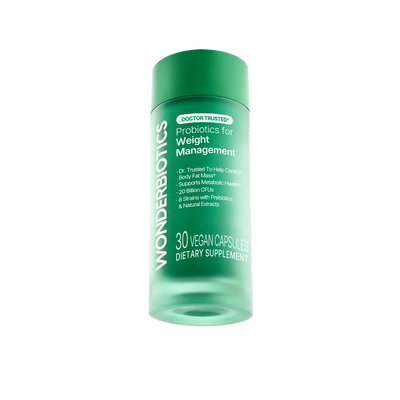
WONDERBIOTICS was formulated to address both the probiotic and the prebiotic-adjacent dimensions of menopause gut-metabolic health.
B420™ (Bifidobacterium animalis subsp. lactis 420): the formula's primary weight-management strain, with ingredient-level RCT evidence on body fat mass and waist circumference. CFU guaranteed at expiration; dose aligns with clinically studied range.3 Ingredient-level evidence; not a finished-product claim.
Eriomin® and CraveLock™: ingredient-level clinical research on natural GLP-1 secretion support. Supports the gut hormone pathway that dietary fiber fermentation also activates, through a direct botanical mechanism.
5X Dihydroberberine: supports healthy blood sugar levels within the normal range. Addresses the insulin resistance component of menopause metabolic change.
HN019 (Bifidobacterium animalis subsp. lactis HN019): gut comfort and regularity support, relevant to the bloating and GI changes common during perimenopause.
The formula is designed to support gut comfort and weight-management routines during menopause, working best alongside dietary fiber from food or supplemental sources. WONDERBIOTICS uses PolarSeal Technology to protect the probiotic blend. In testing, 99.9% of the bacterial strain survived gut-like acidic conditions and 98.2% remained alive through the point of consumption. CFU is guaranteed at expiration.
Key ingredients are backed by 624 clinical studies involving 44,692 participants at the ingredient level.
Read the WONDERBIOTICS Review for a full look at the formula.
This article is for educational purposes only and is not medical advice. It is not intended to diagnose, treat, cure, or prevent any disease. If you are experiencing menopausal symptoms or take medications, talk with a licensed clinician before starting supplements.
Related reading: best probiotics for women over 40 — our evidence-based picks.
References
- National Institutes of Health, Office of Dietary Supplements. Dietary Supplements for Weight Loss: Health Professional Fact Sheet. Updated 2024. https://ods.od.nih.gov/factsheets/WeightLoss-HealthProfessional/
- Saadati S, Naseri K, Asbaghi O, Yousefi M, Golalipour E, de Courten B. Beneficial effects of the probiotics and synbiotics supplementation on anthropometric indices and body composition in adults: A systematic review and meta-analysis. Obes Rev. 2024;25(3):e13667. https://pubmed.ncbi.nlm.nih.gov/38030409/
- Stenman LK, Lehtinen MJ, Meland N, et al. Probiotic With or Without Fiber Controls Body Fat Mass, Associated With Serum Zonulin, in Overweight and Obese Adults-Randomized Controlled Trial. EBioMedicine. 2016;13:190-200. https://pubmed.ncbi.nlm.nih.gov/27810310/


