


How Gut Health Supports Bloating, Satiety, and Weight Routines During Menopause

How Gut Health Supports Bloating, Satiety, and Weight Routines During Menopause
The gut microbiome does not work in isolation from the hormonal changes of menopause. Declining estrogen directly alters the estrobolome, the gut bacterial genes that metabolize estrogens, and those changes feed back into fat distribution, metabolic function, appetite signaling, and GI motility. Supporting gut health during this transition is not a substitute for protein, exercise, and sleep, but it is a meaningful part of the picture that dietary and probiotic approaches can address.

How Gut Health Connects to Each Dimension
Bloating
Bloating during perimenopause and menopause is driven by multiple overlapping factors: altered gut motility from hormonal changes, shifts in the gut microbiome composition, dietary changes that accompany reduced appetite, and increased sensitivity to fermentation gas.
Supporting gut health for bloating means maintaining a microbiome that ferments fiber efficiently without excess gas production, supporting regular bowel transit (since constipation is the most common cause of bloating in this life stage), and using fiber types that are less fermentable for women prone to gas.
Psyllium husk supports regularity and has minimal fermentation, making it better tolerated than highly fermentable fibers like inulin for bloating-prone women. Probiotics with gut comfort evidence, such as HN019, may reduce abdominal pain and bloating symptoms during the adjustment period of perimenopause.
Satiety
GLP-1, the gut hormone involved in satiety signaling, gastric emptying, and insulin response, is produced partly through gut microbiome activity: when bacteria ferment dietary fiber, they produce short-chain fatty acids that stimulate GLP-1 from intestinal L-cells. As dietary patterns change during menopause and the microbiome shifts, this pathway may be less efficient.
Supporting the gut environment through dietary fiber and evidence-backed probiotic strains maintains one of the inputs into the satiety hormone system during a period when leptin resistance and insulin resistance are already weakening the satiety signal. The NIH ODS notes that beta-glucans may increase satiety and delay GI transit.2 These effects are directly relevant to the appetite management challenges of perimenopause.
Weight Management
The gut microbiome changes during menopause through the estrobolome.1 Reduced microbial diversity and altered fermentation patterns are associated with worse metabolic outcomes in observational data. The gut also influences metabolic health through barrier integrity: when bacterial components leak through a compromised gut barrier, they drive the chronic low-grade inflammation associated with insulin resistance and visceral fat accumulation.
A 2024 meta-analysis of 200 RCTs found that probiotics and synbiotics were associated with modest but statistically significant reductions in body weight, BMI, and waist circumference in diverse adult populations.3 The effects were strain-specific and population-dependent, meaning specific named strains with relevant evidence matter more than generic supplementation.
The Evidence by Endpoint
Bloating and regularity evidence: HN019 (Bifidobacterium animalis subsp. lactis HN019) has the most relevant ingredient-level data on abdominal comfort. The most recent large RCT found abdominal pain scores significantly favoring HN019 over placebo at weeks 6 and 8, with the increase in abdominal symptoms seen in the placebo group not observed in the HN019 group.
Satiety evidence: beta-glucan fiber and botanical GLP-1 secretion support (such as Eriomin lemon extract) address the gut-hormone pathway that influences satiety. These work upstream of the hypothalamic satiety mechanisms disrupted by leptin resistance.
Weight management evidence: B420™ (Bifidobacterium animalis subsp. lactis 420) has a 6-month double-blind, placebo-controlled RCT in 225 overweight adults showing a 4.0% relative reduction in body fat mass vs. placebo and approximately 2.4 cm waist circumference reduction in a post-hoc factorial analysis.4 Ingredient-level evidence in overweight adults; not menopause-specific; not a finished-product claim.
Terms to Know!
- Estrobolome: The collection of gut bacterial genes capable of metabolizing estrogens. Changes in the estrobolome during perimenopause may affect circulating estrogen levels and downstream effects on fat distribution and metabolic function.
- Gut barrier integrity: The ability of the intestinal lining to selectively allow nutrients to pass while blocking bacterial components from entering systemic circulation. Compromised integrity contributes to metabolic endotoxemia and the inflammatory state associated with visceral fat accumulation.
WONDERBIOTICS: Evidence Mapped to the Three Dimensions
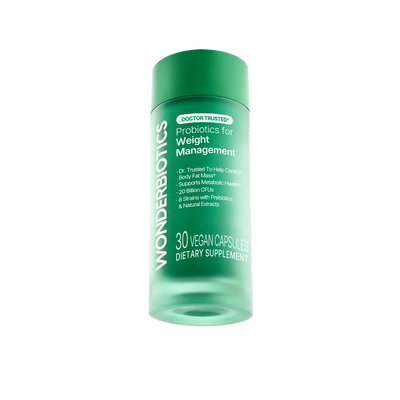
WONDERBIOTICS was formulated by PhD scientists with midlife women as the target population, and each ingredient addresses one of the three dimensions above.
For bloating and regularity: HN019 (Bifidobacterium animalis subsp. lactis HN019). Role: abdominal comfort and gut transit support. CFU guaranteed at expiration; ingredient-level evidence.
For satiety support: Eriomin® and CraveLock™. Role: ingredient-level clinical research on natural GLP-1 secretion support. Supports the gut hormone pathway involved in satiety through a nutritional mechanism. Not a pharmaceutical GLP-1 drug.
For weight management support: B420™ (Bifidobacterium animalis subsp. lactis 420). Role: gut barrier integrity, metabolic endotoxemia reduction, body fat and waist circumference support. Six-month RCT evidence at the ingredient level. CFU guaranteed at expiration.
For metabolic and blood sugar stability: 5X Dihydroberberine. Role: supports healthy blood sugar levels within the normal range. Addresses the insulin resistance component of menopause weight management. Safety note: discuss with clinician if taking glucose-lowering medications.
WONDERBIOTICS uses PolarSeal Technology to protect the probiotic blend. In testing, 99.9% of the bacterial strain survived gut-like acidic conditions and 98.2% remained alive through the point of consumption. CFU is guaranteed at expiration.
Key ingredients are backed by 624 clinical studies involving 44,692 participants at the ingredient level. The formula supports gut comfort and weight-management routines during menopause. It does not treat menopause, reverse hormonal changes, or produce direct fat loss.
Read the WONDERBIOTICS Review for a full look at the formula.
This article is for educational purposes only and is not medical advice. It is not intended to diagnose, treat, cure, or prevent any disease. If you are experiencing menopausal symptoms or take medications, talk with a licensed clinician before starting supplements.
References
- Mayo Clinic. Menopause weight gain: Stop the middle age spread. https://www.mayoclinic.org/healthy-lifestyle/womens-health/in-depth/menopause-weight-gain/art-20046058
- National Institutes of Health, Office of Dietary Supplements. Dietary Supplements for Weight Loss: Health Professional Fact Sheet. Updated 2024. https://ods.od.nih.gov/factsheets/WeightLoss-HealthProfessional/
- Saadati S, Naseri K, Asbaghi O, Yousefi M, Golalipour E, de Courten B. Beneficial effects of the probiotics and synbiotics supplementation on anthropometric indices and body composition in adults: A systematic review and meta-analysis. Obes Rev. 2024;25(3):e13667. https://pubmed.ncbi.nlm.nih.gov/38030409/
- Stenman LK, Lehtinen MJ, Meland N, et al. Probiotic With or Without Fiber Controls Body Fat Mass, Associated With Serum Zonulin, in Overweight and Obese Adults-Randomized Controlled Trial. EBioMedicine. 2016;13:190-200. https://pubmed.ncbi.nlm.nih.gov/27810310/


