


Can WONDERBIOTICS Help with Food Noise and Cravings? An Honest Answer

Can WONDERBIOTICS Help with Food Noise and Cravings?
If you're asking this question, the underlying experience is real. Persistent food-related thoughts that don't quiet down, cravings that survive a sensible meal, the feeling that your relationship with food is louder than it needs to be: these are biological outputs, not character failures. The honest answer to whether WONDERBIOTICS can help requires distinguishing what the formula is built around from what has and has not been directly tested in people experiencing Food Noise or cravings as their primary concern.
This article covers what cravings and Food Noise actually are at the biological level, what WONDERBIOTICS engages and what it doesn't, and how to set realistic expectations.

What It Comes Down To
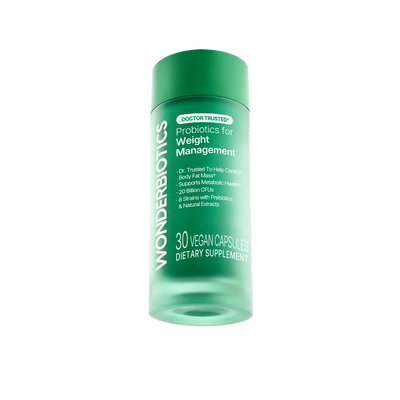
WONDERBIOTICS Probiotics for Weight Management is built around appetite-related signaling biology, with ingredient-level human RCT evidence on endpoints adjacent to cravings.
Three claims at clearly different evidence tiers:
- B420™ has RCT evidence on body composition and energy intake in overweight and obese adults
- Eriomin® (lemon extract) has RCT evidence on natural GLP-1 levels in prediabetic adults
- CraveLock™ Technology is a proprietary synergistic approach to appetite management and Food Noise
Finished-product clinical validation in users specifically experiencing Food Noise or cravings is not part of the current evidence base. The formula is designed around the relevant biology; whether and how it shifts cravings in any individual remains a question that ingredient-level evidence and biological plausibility can address but not finally answer.
WONDERBIOTICS Probiotics for Weight Management is one option to consider within those evidence limits.
Why Cravings and Food Noise Aren't Willpower Failures
Cravings ride on appetite signaling between your gut, your hormones, and your brain. When you cut calories, your body adjusts: hunger-promoting hormones rise, fullness-signaling hormones fade, and food becomes more compelling. A 1-year follow-up of adults who completed a low-energy diet found that these hormonal adaptations to weight loss persist long after the diet ends.1 The biology is doing what it's designed to do.
Food Noise describes the experiential layer that sits on top of that biology: persistent, intrusive food-related thoughts that don't quiet down even after eating, and that get louder under restriction. Food Noise can persist after a full meal because the signaling that drives it runs in parallel with how full or empty your stomach feels. The term has gained popular usage in part because GLP-1 receptor agonists have given many people their first experience of what it's like for that internal volume to drop.
The biology behind cravings combines homeostatic signals (the hunger and fullness loops that defend energy balance) with hedonic signals (the reward-related responses to palatable foods) and the gut-brain axis that connects them. None of these are within direct conscious control. A supplement that engages this biology has to engage the signaling, not the willpower.
Terms to Know!
- Hedonic hunger: hunger driven by the anticipated pleasure of eating rather than by an immediate energy need; distinguished from homeostatic hunger, which arises from low energy availability and signals through hormones such as ghrelin and leptin.
- Gut-brain axis: the bidirectional communication network between the gut (including its microbiome) and the central nervous system, operating through neural pathways (vagus nerve), hormonal messengers (gut peptides), and immune signals; one of the routes by which gut composition can influence appetite and food-related behavior.
What WONDERBIOTICS Engages
WONDERBIOTICS Probiotics for Weight Management is formulated specifically around the gut-microbiome contribution to appetite-related signaling. Each named ingredient has a defined role.
B420™ (Bifidobacterium animalis subsp. lactis 420) is the probiotic strain in the formula. Probiotic effects depend on the specific strain, and evidence from one strain does not transfer to another.2 A 6-month randomized, placebo-controlled trial in 225 overweight and obese adults aged 18-65, with post-hoc factorial analysis, showed body fat mass differing by -4.0% versus placebo (P=0.002), waist circumference dropping 2.4 cm more than placebo, and daily energy intake reduced by approximately 300 kcal compared to placebo.3 The energy intake endpoint is the closest of the three to what cravings are about: when people in the active group ate less without reporting comparable distress or compensation, that pattern is consistent with shifts in appetite-related signaling. The trial enrolled general overweight and obese adults rather than a craving-specific or Food Noise-specific cohort, so this evidence informs the rationale for B420™ inclusion in a weight-management formula and does not constitute a direct demonstration in any cravings-defined group.
Eriomin® (lemon extract) is a citrus flavonoid extract studied for its effects on appetite-related signaling. Ingredient-level clinical research in prediabetic adults reports support for natural GLP-1 levels and adiponectin levels.4 GLP-1 signaling is one of the hormonal pathways involved in appetite regulation, including the hormone class that GLP-1 receptor agonist medications engage pharmacologically. Eriomin® (lemon extract) is included for its ingredient-level evidence on this signaling endpoint in a specific population, not as a finished-product validation in WONDERBIOTICS users.
Dihydroberberine is a modified version of berberine that achieves higher plasma berberine exposure at lower doses. It supports maintaining healthy blood sugar levels already within the normal range. Stable post-meal blood sugar is one input to steadier appetite signals across the day; large blood-sugar swings are commonly associated with the rebound hunger many people recognize as a craving trigger. Direct human evidence at the dihydroberberine level remains limited; its role here is to deliver berberine more effectively, with the active end-form remaining berberine in tissue.
The formula also features CraveLock™ Technology, a proprietary synergistic approach to appetite management and Food Noise. CraveLock™ is brand positioning rather than an independently validated biological mechanism; we name it here as a feature of the formula without making mechanism claims beyond what the underlying ingredients support.
WONDERBIOTICS uses PolarSeal Technology to help protect the probiotic blend. In testing, 99.9% of the bacterial strain survived gut-like acidic conditions, and 98.2% of the bacteria remained alive through to the point of consumption.
The core ingredients in the formula are backed by 624 clinical studies covering 44,692 participants. The formula was developed by PhD scientists and industry experts.
What WONDERBIOTICS Doesn't Claim
Honest positioning means being clear about what the formula is not designed to do.
It is not a finished-product validated cravings intervention. No published RCT has tested WONDERBIOTICS specifically in users selected for cravings or Food Noise as a primary inclusion criterion. The evidence sits at the strain and ingredient level in adjacent populations, with biological plausibility connecting that evidence to the cravings experience.
It is not a substitute for clinical or behavioral support when cravings have psychological roots. Disordered eating, binge-eating disorder, eating-related compulsions linked to anxiety or depression, and emotionally driven eating patterns benefit from professional support. A supplement engages biological signaling; the psychological and emotional layers are a separate kind of work, and many people benefit from addressing both at once rather than choosing.
It is not a pharmacological intervention. GLP-1 receptor agonist medications (semaglutide, tirzepatide) engage appetite biology pharmacologically, with prescribing oversight, defined dose escalation, and clinical monitoring. A non-prescription probiotic formula operates at a different intensity and on a different timescale, and the two are not interchangeable.
It is not a faster-than-biology product. Microbiome shifts, appetite-signaling adjustments, and observable changes in eating patterns unfold over weeks to months. Anyone selling overnight craving suppression is selling something other than evidence.
Setting Realistic Expectations
We recommend taking WONDERBIOTICS consistently for 3-6 months alongside a balanced diet and regular movement, to give your gut time to adapt and your body time to respond. The timeline reflects how the underlying biology actually works.
What to track during that window is more informative than what shows up on a scale:
- Whether your eating pattern feels less driven (fewer episodes of intrusive food thoughts)
- Whether your portion sizes settle without conscious restriction
- Whether you feel comfortably full earlier in a meal
- Whether the "between meals" hours feel less hijacked
Scale weight is a downstream output of these earlier signals. Many people notice changes in their relationship with food before they notice changes in body composition.
FAQ
Will WONDERBIOTICS help if my cravings feel mostly emotional?
Disrupted appetite signaling and emotionally driven eating often overlap rather than separate cleanly. A probiotic engages the biological signaling layer; behavioral and clinical support remain important when emotional patterns are dominant. Many people benefit from working on both at once.
Can I take WONDERBIOTICS alongside a GLP-1 medication?
Many people on GLP-1 medications use complementary supplements. Current FDA labeling for semaglutide does not list a specific interaction with probiotics, and a direct enzyme-based interaction is not expected based on available data. Talk with the clinician who prescribed your medication before adding any supplement.
Is Food Noise a clinical diagnosis?
No. Food Noise is descriptive language for the experience of intrusive food-related thoughts. It is not a formal diagnosis in the diagnostic manuals used by clinicians. The fact that it isn't a diagnosis doesn't mean the experience isn't real; it means that supplements and lifestyle approaches address it as an experience rather than as a clinical condition.
Engage the Biology, Set Honest Expectations
Cravings and Food Noise are biological experiences with honest answers and overpromised marketing in roughly equal supply. WONDERBIOTICS Probiotics for Weight Management is built around named ingredients with ingredient-level RCT evidence on endpoints adjacent to cravings (energy intake, GLP-1 levels), positioned through proprietary CraveLock™ Technology, and delivered with PolarSeal Technology designed to protect live cultures. Finished-product validation in cravings users specifically is not yet part of the evidence base.
For people whose cravings have outlasted careful dieting and whose interest is in engaging appetite biology rather than overriding it through restriction, WONDERBIOTICS Probiotics for Weight Management is an option worth considering, with its evidence positioning stated openly.
This article is for educational purposes only and is not medical advice. If you experience persistent eating-related distress, intrusive food thoughts that interfere with daily functioning, or patterns that suggest disordered eating, consider talking with a qualified clinician or therapist. Supplements address one biological layer; clinical and behavioral support address others.
References
- Sumithran P, Prendergast LA, Delbridge E, et al. Long-term persistence of hormonal adaptations to weight loss. N Engl J Med. 2011;365(17):1597-1604. https://www.nejm.org/doi/full/10.1056/NEJMoa1105816
- Hill C, Guarner F, Reid G, et al. Expert consensus document. The International Scientific Association for Probiotics and Prebiotics consensus statement on the scope and appropriate use of the term probiotic. Nat Rev Gastroenterol Hepatol. 2014;11(8):506-514. https://www.nature.com/articles/nrgastro.2014.66
- Stenman LK, Lehtinen MJ, Meland N, et al. Probiotic with or without fiber controls body fat mass, associated with serum zonulin, in overweight and obese adults: randomized controlled trial. EBioMedicine. 2016;13:190-200. https://www.sciencedirect.com/science/article/pii/S2352396416304972
- Ribeiro CB, Ramos FM, Manthey JA, Cesar TB. Effectiveness of Eriomin® in managing hyperglycemia and reversal of prediabetes condition: A double-blind, randomized, controlled study. Phytother Res. 2019;33(7):1921-1933. https://onlinelibrary.wiley.com/doi/10.1002/ptr.6386


