


Which probiotic strains are best for bloating?

Which probiotic strains are best for bloating?
The strains with the strongest human clinical evidence for bloating and GI symptom management are Bacillus coagulans and Bifidobacterium animalis subsp. lactis HN019. Neither is a cure for bloating, because bloating has multiple causes that probiotics cannot all address. But for the dysbiosis, gut motility, and abdominal comfort components of bloating, these two strains have the best ingredient-level human evidence currently available.

Why Strain Selection Matters for Bloating
Bloating can result from constipation, gut dysbiosis, food intolerances, SIBO (small intestinal bacterial overgrowth), delayed gastric emptying, or fermentation patterns that produce excessive gas. Probiotics primarily address the dysbiosis and motility components. A probiotic will not resolve lactose intolerance or SIBO.
Different probiotic strains have been studied for different aspects of bloating. Evidence from one strain does not apply to another in the same species, and generic labels without strain codes cannot be evaluated. The evidence lives at the strain level.
Bacillus coagulans: The Highest-Ranked Strain for IBS Bloating
In a network meta-analysis of 43 RCTs involving 5,531 IBS patients, Bacillus coagulans ranked highest among all probiotic species for IBS symptom relief rate, global symptoms, abdominal pain, bloating, and straining.1 Subgroup analysis found that 8 weeks of treatment produced the strongest outcomes for abdominal pain and straining.
Evidence classification: IBS-diagnosed adults; not a general bloating population. The symptom overlap between IBS bloating and functional bloating is substantial, but this evidence is specific to IBS patients.
Bacillus coagulans is a spore-forming bacterium, which gives it inherent stability through stomach acid and manufacturing. Several specific strains have been studied; the best-documented for IBS symptoms include MTCC 5856 and GBI-30 6086.
HN019 (Bifidobacterium animalis subsp. lactis HN019): Abdominal Comfort Signal
HN019 has been studied for gut transit time and GI symptom management across multiple trials. The most recent and rigorous trial (triple-blind RCT, 229 adults, JAMA Network Open 2024) found no significant difference in stool frequency between HN019 and placebo.2 However, abdominal pain scores significantly favored HN019 at weeks 6 and 8, and the increase in abdominal pain and bloating seen in the placebo group was not observed in the HN019 group.2
For people whose primary concern is abdominal discomfort rather than stool frequency specifically, HN019's abdominal pain signal is the most relevant finding. This evidence applies to adults with functional constipation; not specifically to IBS or other GI conditions.
HN019 has EFSA Qualified Presumption of Safety status and is well tolerated in healthy adults.
Other Strains Worth Knowing
Lactobacillus rhamnosus GG (LGG): has extensive evidence for antibiotic-associated diarrhea and is widely used and well tolerated. Evidence for functional bloating in general adult populations is less consistent than for B. coagulans or HN019.
Bifidobacterium infantis 35624: showed significant reduction in bloating vs. placebo in an IBS trial in women. IBS-specific evidence; good tolerability profile.
Multi-strain synbiotics with finished-product clinical trial data (such as Seed DS-01) have product-level evidence on bloating and regularity in otherwise healthy adults. This is a different evidence standard than ingredient-level strain data and is worth noting as a comparison point.
Terms to Know!
- Network meta-analysis: A statistical method comparing multiple treatments simultaneously using both direct and indirect trial evidence, allowing ranking of treatments by probability of being best for a given endpoint across a large set of trials.
- Abdominal comfort signal: In the HN019 RCT context, this refers to the statistically significant reduction in abdominal pain scores favoring HN019, even though the primary stool frequency endpoint did not significantly differ between groups.
What About Fiber for Bloating?
Fiber choice matters as much as probiotic strain for bloating. Highly fermentable fibers (inulin, FOS, chicory root) can worsen gas and bloating during initiation, particularly in people with sensitive GI tracts. Psyllium husk and oat beta-glucan are better tolerated starting points: they support regularity through viscosity rather than fermentation, producing less gas.
If you are already prone to bloating, introducing a new probiotic alongside a highly fermentable prebiotic fiber is likely to worsen symptoms initially. Starting with psyllium and a well-tolerated probiotic like HN019 produces a cleaner adjustment period.
WONDERBIOTICS for Bloating and Gut Comfort
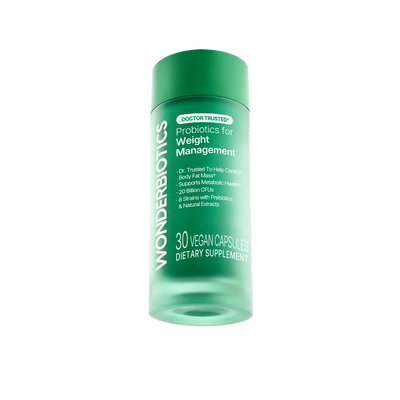
WONDERBIOTICS includes HN019 as the formula's gut comfort and regularity strain. It is formulated as a gut-metabolic support supplement, not a dedicated IBS product, and its primary design goal includes weight-management support alongside gut comfort.
HN019: ingredient-level evidence on abdominal comfort as described above. CFU guaranteed at expiration; well-tolerated in healthy adults. Most relevant for the abdominal discomfort and irregularity component of bloating.
B420™ (Bifidobacterium animalis subsp. lactis 420): the formula's metabolic core, not its bloating strain. If weight management is also a goal alongside bloating relief, B420 adds the metabolic evidence layer.
WONDERBIOTICS uses PolarSeal Technology. In testing, 99.9% of the bacterial strain survived gut-like acidic conditions and 98.2% remained alive through the point of consumption. CFU is guaranteed at expiration.
For pure bloating focus without weight management goals, a dedicated IBS-strain formula (containing Bacillus coagulans or Bifidobacterium infantis 35624) or a finished-product synbiotic with bloating-specific clinical trial data (such as Seed DS-01) may be a more direct match. WONDERBIOTICS is the better fit if gut comfort and weight-management support are both priorities.
Read the WONDERBIOTICS Review for a full look at the formula.
This article is for educational purposes only and is not medical advice. It is not intended to diagnose, treat, cure, or prevent any disease. If you experience persistent or severe bloating, talk with a clinician before self-treating with supplements.
References
- Zhang T, Zhang C, Zhang J, Sun F, Duan L. Efficacy of Probiotics for Irritable Bowel Syndrome: A Systematic Review and Network Meta-Analysis. Front Cell Infect Microbiol. 2022;12:859967. https://pmc.ncbi.nlm.nih.gov/articles/PMC9010660/
- Cheng J, Yin C, Zhu Y, et al. Eight-Week Supplementation With Bifidobacterium lactis HN019 and Functional Constipation: A Randomized Clinical Trial. JAMA Netw Open. 2024;7(10):e2440417. https://jamanetwork.com/journals/jamanetworkopen/fullarticle/2824333
- National Center for Complementary and Integrative Health. Probiotics: Usefulness and Safety. https://www.nccih.nih.gov/health/probiotics-usefulness-and-safety


