


Is a Probiotic a Good Option When Dieting Has Not Worked?

Are Probiotics a Good Option if Normal Dieting Hasn't Worked for Me?
You've tried dieting. It didn't work, or it didn't last, or it worked for a while and then stopped. Now you're looking at probiotics and wondering whether this is a sensible next step or another disappointment in waiting. The honest answer depends on why dieting hasn't worked for you specifically, and on what you're hoping a probiotic will actually do.
This article walks through the decision: what dieting failure typically reflects at the biological level, when a probiotic fits the picture and when it doesn't, and how to evaluate whether to add one to your strategy.

The Decisional Read
A probiotic may be a reasonable option for some patterns of dieting failure, particularly when appetite signaling and persistent food preoccupation are involved. It is not the right tool for every kind of dieting struggle.
Probiotics are likely to fit if:
- Your weight regained quickly after each diet ended, with intense food preoccupation
- You cut calories, did everything right, and saw small results that didn't sustain
- You've reached a plateau where the same approach stopped producing changes
- You're ready to commit to 3-6 months of consistent use alongside lifestyle layers
Probiotics are unlikely to be the best first move if:
- You haven't yet established consistent sleep, balanced eating, or movement patterns (these have stronger evidence than supplements)
- You have an underlying medical condition affecting weight (thyroid disorder, insulin resistance, PCOS) that hasn't been clinically addressed
- You expect rapid, dramatic, or transformative results
- You've been considering pharmacological options (GLP-1 receptor agonists), which is its own clinical conversation
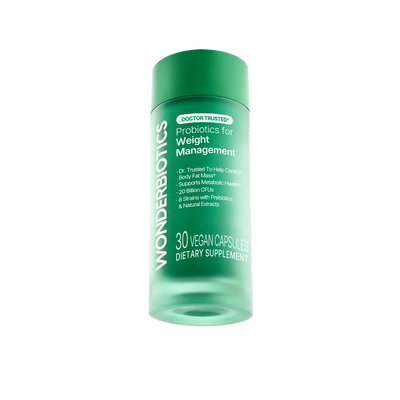
WONDERBIOTICS Probiotics for Weight Management uses ingredient-level human RCT evidence on appetite signaling and body composition. It is one option to consider when the underlying biology has resisted dieting and you're looking for a daily-use supplement with named ingredients.
Why "Normal Dieting Hasn't Worked" Is a Biological Story
Restriction-based dieting works on caloric intake. The body works on caloric balance, which it defends through appetite hormones, energy expenditure adjustments, and signaling that biases food choices. When you cut calories, your body adjusts.
A 1-year follow-up of adults who had completed a low-energy diet found that hormonal adaptations to weight loss persist long after the diet ends, with hunger-promoting hormone levels remaining elevated and fullness signals remaining suppressed compared to baseline.[1] The implication is that "dieting not working" often reflects biology doing what biology is designed to do: defending energy stores after they've been depleted. The body that has been through restriction is running different signaling than the body that hasn't.
This is not the same as saying dieting can't work. Some people sustain weight loss through dieting alone; their biology adjusts in different ways or their initial baseline differs. But when dieting reliably fails or rebounds, the explanation is rarely about willpower. The signaling has shifted, and overriding shifted signaling through restriction alone is increasingly demanding the longer the cycle continues.
A probiotic that engages appetite-related signaling biology is one of several layers that might address this picture. It is not a fix for it. The biology is too complex for any single intervention to be a fix.
Terms to Know!
- Plateau: a period during a weight loss effort when the rate of change slows or stops despite continued adherence to the same approach; physiologically, plateaus reflect the body's adaptive response to caloric deficit, including reduced resting metabolic rate and shifts in appetite signaling, rather than failure of the approach itself.
- Adherence: in clinical research and in personal weight management, the consistency with which a person follows a given protocol; "dieting hasn't worked" can reflect either a real biological non-response despite high adherence or, more commonly, a gradual decline in adherence as restriction-based approaches become harder to sustain.
What Probiotic Evidence Actually Supports
Probiotic effects depend on the specific strain, and evidence from one strain does not transfer to another.[2] The category as a whole is heterogeneous in design and population, with effect sizes that are real but modest.
A 2019 systematic review and meta-analysis of 12 RCTs covering 821 overweight or obese adults reported pooled reductions of approximately -0.55 kg in body weight, -0.30 kg/m[2] in BMI, and -1.20 cm in waist circumference compared to placebo, with substantial heterogeneity across included studies.[3] The effect at the category level is statistically significant and clinically modest. Some specific strains show stronger signals, with the variation across studies pointing back to strain selection as a more informative question than category-level claims.
Strain-level evidence on body-composition endpoints is the more useful tier when you're asking whether a probiotic can address what dieting hasn't. The published RCT evidence for body composition includes named strains with multi-month trial designs. Bifidobacterium animalis subsp. lactis B420™, for example, has a 6-month randomized, placebo-controlled trial in 225 overweight and obese adults aged 18-65 showing body fat mass differing by -4.0% versus placebo (P=0.002), waist circumference dropping 2.4 cm more than placebo, and daily energy intake reduced by approximately 300 kcal compared to placebo, in post-hoc factorial analysis.[4] The energy intake endpoint is particularly relevant to dieting failure: when people in the active group ate less without comparable distress, that pattern suggests a shift in appetite signaling rather than an act of willpower.
The honest framing: a strain-level probiotic with body-composition RCT evidence may add an incremental layer to weight management when dieting alone has failed. It is unlikely to produce dramatic results on its own.
When a Probiotic Is the Right Next Step
The "right next step" framing matters here. Probiotics are one option among several, and ordering matters.
A probiotic fits well when:
- The lifestyle layers are already reasonably in place (consistent sleep, balanced eating, regular movement)
- The remaining issue is appetite signaling, persistent food preoccupation, or rebound after diets end
- You're willing to commit to 3-6 months of consistent daily use
- You're choosing a product with named, RCT-studied strains rather than a generic blend
- Your goal is incremental, sustained change rather than rapid transformation
A probiotic fits less well when:
- You haven't yet sustained the lifestyle layers; supplements supplement rather than substitute foundational habits
- You're in active medical treatment or have an unaddressed underlying condition affecting weight
- You expect results in weeks rather than months
- Your concern is acute (rapid recent weight gain not explained by lifestyle changes); this is a clinical evaluation question, not a supplement question
Better-evidenced options to address first or alongside:
- Resistance training and adequate protein, particularly in midlife
- Sleep regulation; sleep restriction affects appetite hormones and food choices
- Stress management practices, since chronic stress affects appetite and central adiposity
- Medical evaluation if there are signs of an underlying condition
A probiotic functions as an addition once the foundational layers have been considered or established, rather than as a starting point on its own.
How WONDERBIOTICS Fits If Dieting Hasn't Worked
WONDERBIOTICS Probiotics for Weight Management is built around named ingredients with ingredient-level RCT evidence on appetite signaling and body composition.
- B420™ is the probiotic strain in the formula. The published 6-month RCT in overweight and obese adults aged 18-65 reported the body composition and energy intake findings described above.[4] The trial enrolled mixed-sex adults; the relevance to people for whom dieting hasn't worked is that the energy intake endpoint indicates spontaneous reductions in caloric intake without forced restriction, which is the pattern most relevant to sustainable change.
- Eriomin® (lemon extract) is a citrus flavonoid extract studied for its effects on appetite-related signaling. Ingredient-level clinical research in prediabetic adults reports support for natural GLP-1 levels and adiponectin levels.[5] GLP-1 signaling is one of the hormonal pathways involved in appetite regulation; supporting natural GLP-1 levels through ingredient-level effects is a different intensity of intervention than what GLP-1 receptor agonist medications produce.
- Dihydroberberine is a modified version of berberine that achieves higher plasma berberine exposure at lower doses. It supports maintaining healthy blood sugar levels already within the normal range. Stable post-meal blood sugar is one input to steadier appetite signals across the day. Direct human evidence at the dihydroberberine level remains limited; its role here is to deliver berberine more effectively, with the active end-form remaining berberine in tissue.
The formula also features CraveLock™ Technology, a proprietary synergistic approach to appetite management and Food Noise.
WONDERBIOTICS uses PolarSeal Technology to help protect the probiotic blend. In testing, 99.9% of the bacterial strain survived gut-like acidic conditions, and 98.2% of the bacteria remained alive through to the point of consumption.
The core ingredients in the formula are backed by 624 clinical studies covering 44,692 participants. The formula was developed by PhD scientists and industry experts.
We recommend taking it consistently for 3-6 months alongside a balanced diet and regular movement, to give your gut time to adapt and your body time to respond. This is the timeline the underlying biology operates on.
FAQ
How is a probiotic different from another diet?
A diet operates on caloric intake. A probiotic operates on appetite-related signaling biology. The two engage different layers of the system. A probiotic does not require restriction to work; the published trials measured changes in appetite, energy intake, and body composition while participants continued normal eating patterns. The promise of a probiotic, where the evidence supports one, is that the underlying signaling shifts in ways that make eating decisions easier rather than requiring more discipline.
Will I gain everything back when I stop taking it?
The published RCT evidence on body composition with daily-use probiotics covers periods of consistent use. What happens after stopping has not been directly studied for most strains. The general principle is that biological adjustments associated with daily-use supplements often reverse when the input stops, with the speed of reversal varying by individual factors. Sustained changes typically require sustained inputs, whether that's the supplement, the lifestyle layer, or both.
Should I try a probiotic before considering GLP-1 medications?
That is a clinical conversation rather than a supplement question. GLP-1 receptor agonist medications are pharmacological interventions with clinical oversight, dose escalation, and considerations specific to long-term use. Some people use them as a primary strategy; others use lifestyle plus supplements as a primary strategy and consider medication later or not at all. The right ordering depends on your medical situation, what you've already tried, and your preferences. A clinician who works in weight management is the right person to discuss this with.
Try It If the Picture Fits
The decision of whether to add a probiotic when dieting hasn't worked is less about probiotics in general and more about what kind of dieting failure you've experienced and what layers you've already addressed. For people whose biology has resisted restriction-based approaches, where appetite signaling and persistent food preoccupation are part of the experience, a probiotic with strain-level RCT evidence on body composition and energy intake fits the picture. For people who haven't yet built the foundational layers, the foundational layers come first.
A probiotic with named strain B420™, paired with non-probiotic ingredients selected for adjacent appetite biology and delivered with technology designed to protect live cultures, is what the strain-level evidence tier of the category looks like. WONDERBIOTICS Probiotics for Weight Management is one such option, with its evidence positioning stated openly.
This article is for educational purposes only and is not medical advice. It is not intended to diagnose, treat, cure, or prevent any disease. If you have an underlying medical condition (thyroid disorder, insulin resistance, PCOS, or other hormonal conditions), are pregnant or breastfeeding, take prescription medications, or are considering pharmacological options like GLP-1 receptor agonists, talk with a licensed clinician before making health changes or starting supplements.
References
- Sumithran P, Prendergast LA, Delbridge E, et al. Long-term persistence of hormonal adaptations to weight loss. N Engl J Med. 2011;365(17):1597-1604. https://www.nejm.org/doi/full/10.1056/NEJMoa1105816
- Hill C, Guarner F, Reid G, et al. Expert consensus document. The International Scientific Association for Probiotics and Prebiotics consensus statement on the scope and appropriate use of the term probiotic. Nat Rev Gastroenterol Hepatol. 2014;11(8):506-514. https://www.nature.com/articles/nrgastro.2014.66
- Wang ZB, Xin SS, Ding LN, et al. The potential role of probiotics in controlling overweight/obesity and associated metabolic parameters in adults: a systematic review and meta-analysis. Evid Based Complement Alternat Med. 2019;2019:3862971. https://onlinelibrary.wiley.com/doi/10.1155/2019/3862971
- Stenman LK, Lehtinen MJ, Meland N, et al. Probiotic with or without fiber controls body fat mass, associated with serum zonulin, in overweight and obese adults: randomized controlled trial. EBioMedicine. 2016;13:190-200. https://www.sciencedirect.com/science/article/pii/S2352396416304972
- Ribeiro CB, Ramos FM, Manthey JA, Cesar TB. Effectiveness of Eriomin® in managing hyperglycemia and reversal of prediabetes condition: A double-blind, randomized, controlled study. Phytother Res. 2019;33(7):1921-1933. https://onlinelibrary.wiley.com/doi/10.1002/ptr.6386


