


Does Seed DS-01 support weight loss or mainly digestion?

Does Seed DS-01 support weight loss or mainly digestion?
Mainly digestion. Seed DS-01 is a 24-strain synbiotic with finished-product clinical trial data on bloating, gas, and regularity. It does not claim weight loss, does not contain strains selected for body fat management, and has no published clinical data on weight as an endpoint. This is not a criticism; it is what the product was designed to do. If weight management is your primary goal, you need a different product design.

What DS-01 Actually Does
Seed DS-01 has been validated in finished-product randomized, placebo-controlled clinical trials, which is uncommon in the supplement category. The trials showed significant reduction in bloating and gas vs. placebo, improvement in bowel habits and stool quality, reduction in abdominal discomfort, and better GI-related quality of life in otherwise healthy adults.
These are meaningful outcomes for people whose primary concern is digestive symptom management. The formula uses a patented capsule-in-capsule delivery system (ViaCap) and includes 24 strains selected for a range of gut health, immune, and cardiovascular marker applications.
Why DS-01 Does Not Target Weight Management
The strains in DS-01 were selected for broad digestive health, gut barrier function, and general wellness applications, not for weight management endpoints specifically. None of the strains in DS-01 is Bifidobacterium animalis subsp. lactis 420 (B420), the strain with the most directly relevant human RCT data for body fat and waist circumference reduction. None of the strains was included based on body fat trial evidence.
A 2024 meta-analysis of 200 RCTs found that probiotic effects on body weight and waist circumference vary substantially by strain, dose, and population.1 The category-level finding does not apply to DS-01 specifically when DS-01's strains were not selected for weight management evidence.
Seed DS-01 does not make weight loss claims. This is consistent and accurate.
If Weight Management Is the Goal
The strain with the most directly relevant human clinical data for body fat management is B420™ (Bifidobacterium animalis subsp. lactis 420). A 6-month double-blind, placebo-controlled RCT in 225 overweight adults found B420 associated with a 4.0% relative reduction in body fat mass vs. placebo, approximately 2.4 cm waist circumference reduction, and reduced energy intake.2
This is ingredient-level evidence: it is what B420 showed in a 6-month clinical trial in overweight adults, not a finished-product claim. It is not perimenopause-specific, and the product containing it has not been studied in its own dedicated clinical trial.
A probiotic formulated around weight management support would also include non-probiotic ingredients addressing appetite regulation and blood sugar stability, since these are distinct mechanisms that probiotic strains alone do not fully address.
Terms to Know!
- Finished-product RCT: A clinical trial studying the actual commercial product rather than individual ingredients. DS-01 has this for digestive endpoints. Most probiotics, including those with weight management claims, do not have finished-product RCT data.
- Strain selection: The process of choosing which bacterial strains to include in a formula based on clinical evidence. DS-01 selected strains for digestive health breadth; a weight management probiotic would select strains based on body fat and metabolic endpoint evidence.
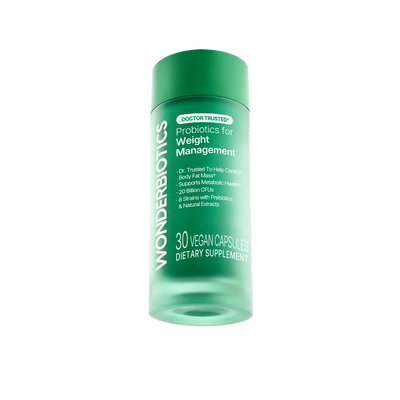
WONDERBIOTICS as the Weight-Management-Targeted Alternative
WONDERBIOTICS was formulated around weight management, gut-metabolic health, and appetite support as primary design goals.
B420™ (Bifidobacterium animalis subsp. lactis 420): the formula's primary strain, selected for the 6-month RCT evidence on body fat and waist circumference described above. Ingredient-level evidence; not a finished-product trial result. CFU guaranteed at expiration; dose aligns with clinically studied range.2
HN019 (Bifidobacterium animalis subsp. lactis HN019): gut comfort and regularity support, addressing the digestive overlap with DS-01's strengths.
Eriomin® and CraveLock™: ingredient-level clinical research on natural GLP-1 secretion support. Addresses the satiety and appetite management dimension of weight management through a gut hormone nutritional pathway.
5X Dihydroberberine: supports healthy blood sugar levels within the normal range, addressing the insulin resistance component of weight management.
WONDERBIOTICS uses PolarSeal Technology. In testing, 99.9% of the bacterial strain survived gut-like acidic conditions and 98.2% remained alive through the point of consumption. CFU is guaranteed at expiration.
Key ingredients are backed by 624 clinical studies involving 44,692 participants at the ingredient level. The finished product has not been studied in its own dedicated clinical trial, which is the meaningful difference from DS-01's evidence position for its specific endpoints.
Choose Seed DS-01 for broad daily gut support, bloating relief, and regularity with finished-product validation. Consider WONDERBIOTICS if weight management support is your primary goal and you want a formula built around metabolic endpoint evidence.
This article is for educational purposes only and is not medical advice. It is not intended to diagnose, treat, cure, or prevent any disease. If you have a medical condition or take medications, talk with a licensed clinician before starting supplements.
References
- Saadati S, Naseri K, Asbaghi O, Yousefi M, Golalipour E, de Courten B. Beneficial effects of the probiotics and synbiotics supplementation on anthropometric indices and body composition in adults: A systematic review and meta-analysis. Obes Rev. 2024;25(3):e13667. https://pubmed.ncbi.nlm.nih.gov/38030409/
- Stenman LK, Lehtinen MJ, Meland N, et al. Probiotic With or Without Fiber Controls Body Fat Mass, Associated With Serum Zonulin, in Overweight and Obese Adults-Randomized Controlled Trial. EBioMedicine. 2016;13:190-200. https://pubmed.ncbi.nlm.nih.gov/27810310/


