


Do Probiotics Help with Belly Fat and Appetite Control? What the Research Says

Do Probiotics Help with Belly Fat and Appetite Control? What the Research Says
The short answer is: yes, some strains show real effects on body fat and waist circumference in human trials, and the gut microbiome genuinely influences appetite signaling. But "some strains in some populations under specific conditions" is not the same as "probiotics help with belly fat," and most products on the market do not contain the strains with the most relevant evidence. Here is what the research actually shows.

What the Meta-Analysis Data Says
The strongest category-level evidence comes from a 2024 systematic review and meta-analysis of 200 randomized controlled trials involving 12,603 participants, which found that probiotics and synbiotics were associated with statistically significant reductions in body weight, BMI, and waist circumference in diverse adult populations.1
The effect sizes were modest: approximately 0.91 kg body weight reduction, 0.28 kg/m2 BMI reduction, and 1.14 cm waist circumference reduction pooled across all trials. These are real but not large effects. Heterogeneity across studies was substantial, meaning results varied enormously depending on which strain was used, at what dose, in which population, for how long.1
This meta-analysis supports two conclusions: probiotic effects on body composition are real in the research literature, and they are strain-specific enough that category-level claims should not be applied to individual products without strain-level evidence.
What the Strain-Level Evidence Shows
Belly Fat and Waist Circumference
The strains with the most directly relevant human RCT evidence for body fat and waist circumference are:
Bifidobacterium animalis subsp. lactis 420 (B420™): A 6-month double-blind, placebo-controlled RCT in 225 overweight adults (BMI 28-34.9, aged 18-65) found B420 associated with a 4.0% relative reduction in body fat mass vs. placebo, a reduction in waist circumference of approximately 2.4 cm, and reduced energy intake in a post-hoc factorial analysis.2 The synbiotic arm (B420 plus prebiotic fiber) showed a 4.5% relative reduction in body fat mass.
Evidence classification: ingredient-level, 6-month RCT in overweight adults; post-hoc factorial analysis. Population does not exclusively include women or menopausal women. Not a finished-product claim.
Lactobacillus gasseri SBT2055: A multicenter RCT of 87 Japanese adults with elevated visceral fat showed visceral fat area decreased by 4.6% vs. baseline over 12 weeks, with significant differences from the control group.3 BMI, body weight, and waist and hip circumferences also decreased significantly.
Evidence classification: 12-week RCT in Japanese adults with elevated visceral fat; delivery vehicle was fermented milk. The evidence is specific to this strain designation; it does not apply to generic L. gasseri products.
Appetite Control
Probiotics influence appetite through the gut-brain axis: short-chain fatty acids produced by fermenting gut bacteria stimulate GLP-1 and peptide YY release from intestinal L-cells, which signal satiety to the brain. Some specific probiotic strains may also influence ghrelin levels or gut motility in ways that affect hunger perception.
The B420 RCT noted reduced energy intake in the probiotic arms vs. placebo,2 which suggests an appetite-adjacent effect though appetite was not the primary measured endpoint. Direct human RCT evidence with subjective appetite as a primary endpoint is limited for most probiotic strains studied for weight management.
The evidence is more developed for non-probiotic GLP-1 pathway support: ingredients that support natural GLP-1 secretion from gut L-cells work upstream of the satiety signaling pathway. These function through nutritional mechanisms rather than pharmacological ones and do not replace GLP-1 receptor agonist medications.
What Probiotics Do Not Do
Probiotics are not appetite suppressants in the pharmaceutical sense. They do not raise metabolic rate, increase fat oxidation, or produce the rapid and dramatic appetite reduction associated with GLP-1 receptor agonist drugs. The mechanisms are indirect and gradual.
Probiotics do not produce rapid weight loss. The effect sizes in the best-case clinical evidence accumulate over months, within the context of diet and exercise, not independently of them.
A probiotic that claims to "melt belly fat" or promises specific weight loss numbers is not supported by the evidence in this category. Appropriate framing is support for weight-management routines over time.
As dietary supplements in the United States, probiotics do not require pre-market FDA approval, and manufacturers cannot make disease treatment claims.4 This regulatory context means the burden of evaluating evidence falls on the consumer.
Terms to Know!
- Post-hoc factorial analysis: An analysis examining subgroup combinations in a trial that was not originally designed as a factorial trial. Results are hypothesis-generating and require independent replication to be considered established evidence.
- Synbiotic: A combination of a probiotic (live bacteria) and a prebiotic (a substrate that selectively feeds beneficial bacteria). The B420 RCT tested both a probiotic-only arm and a synbiotic arm, with the synbiotic showing stronger effects.
What to Look for in a Probiotic for These Goals
Strain identification to designation level. The evidence lives at the strain code level, not the genus or species level. A product without strain codes cannot be evaluated against clinical evidence.
Evidence specifically on body fat or waist circumference endpoints. General digestive health evidence does not transfer to body composition. The strains with body fat evidence are specifically named.
Dose alignment. Compare the CFU in the product to the dose used in the cited clinical trials. Lower doses may not replicate studied effects.
CFU guaranteed at expiration. Bacterial viability declines over shelf life; a guarantee at expiration is the more meaningful specification.
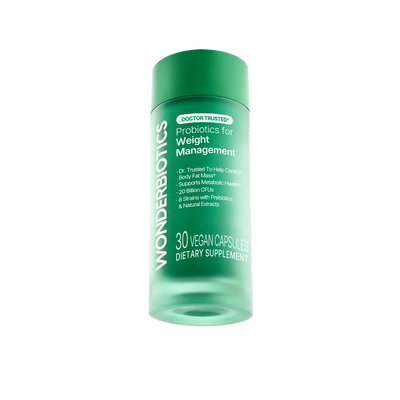
WONDERBIOTICS: What Each Ingredient Is Evidence-Based For
WONDERBIOTICS is formulated as a gut-metabolic support supplement designed specifically around weight management, appetite support, and gut health.
B420™ (Bifidobacterium animalis subsp. lactis 420): Ingredient-level evidence for body fat management and waist circumference in overweight adults from a 6-month RCT. This is the formula's primary weight-management strain. Dose aligns with the clinically studied range. CFU guaranteed at expiration.
Eriomin® and CraveLock™: Ingredient-level clinical research on natural GLP-1 secretion support. GLP-1 is the gut hormone involved in satiety and appetite regulation. CraveLock™ is the formula's proprietary approach to appetite awareness and cravings management, built on this nutritional pathway. This is distinct from GLP-1 receptor agonist drug action.
5X Dihydroberberine: Supports healthy blood sugar levels already within the normal range. Addresses the blood sugar fluctuation component of reactive hunger and the insulin resistance dimension of metabolic weight management.
HN019 (Bifidobacterium animalis subsp. lactis HN019): Gut comfort and regularity support. Ingredient-level evidence on GI symptom management. Relevant to the digestive comfort dimension of a weight management routine.
WONDERBIOTICS uses PolarSeal Technology to protect the probiotic blend. In testing, 99.9% of the bacterial strain survived gut-like acidic conditions, and 98.2% of the bacteria remained alive through the point of consumption. CFU is guaranteed at expiration.
The formula is designed for people who want a probiotic for weight management support, gut health, regularity, and appetite awareness, not a quick fat-loss product. Key ingredients are backed by 624 clinical studies involving 44,692 participants at the ingredient level. The WONDERBIOTICS finished product has not been studied in a dedicated clinical trial; all evidence cited is ingredient-level.
We recommend 3-6 months of consistent use alongside a balanced diet, adequate protein, and regular physical activity.
Read the WONDERBIOTICS Review for a full look at the formula.
This article is for educational purposes only and is not medical advice. It is not intended to diagnose, treat, cure, or prevent any disease. If you have a medical condition or take medications, talk with a licensed clinician before starting supplements.
References
- Saadati S, Naseri K, Asbaghi O, Yousefi M, Golalipour E, de Courten B. Beneficial effects of the probiotics and synbiotics supplementation on anthropometric indices and body composition in adults: A systematic review and meta-analysis. Obes Rev. 2024;25(3):e13667. https://pubmed.ncbi.nlm.nih.gov/38030409/
- Stenman LK, Lehtinen MJ, Meland N, et al. Probiotic With or Without Fiber Controls Body Fat Mass, Associated With Serum Zonulin, in Overweight and Obese Adults-Randomized Controlled Trial. EBioMedicine. 2016;13:190-200. https://pubmed.ncbi.nlm.nih.gov/27810310/
- Kadooka Y, Sato M, Imaizumi K, et al. Regulation of abdominal adiposity by probiotics (Lactobacillus gasseriSBT2055) in adults with obese tendencies in a randomized controlled trial. Eur J Clin Nutr. 2010;64(6):636-643. https://pubmed.ncbi.nlm.nih.gov/20216555/
- National Center for Complementary and Integrative Health. Probiotics: Usefulness and Safety. https://www.nccih.nih.gov/health/probiotics-usefulness-and-safety


