


Best Probiotic Strains for Gut Comfort and Weight-Management Support

Best Probiotic Strains for Gut Comfort and Weight-Management Support
Gut comfort and weight management require different probiotic strains, and the best formula for both addresses each endpoint separately with named strains that have relevant ingredient-level human clinical data. No single probiotic strain is simultaneously the best for bloating relief and the best for body fat management, because these outcomes have different mechanistic pathways and different evidence bases. This article maps the strains with the most relevant human RCT data to each goal.
For Gut Comfort and Bloating
The strains with the most relevant ingredient-level evidence for gut comfort and GI symptom management are:
Bifidobacterium animalis subsp. lactis HN019: HN019 has been studied in multiple trials for gut transit time and GI symptom management. A 2024 triple-blind RCT (JAMA Network Open, 229 adults) found abdominal pain scores significantly favoring HN019 over placebo at weeks 6 and 8, and the increase in abdominal pain and bloating seen in the placebo group was not observed in the HN019 group. Stool frequency did not significantly differ between groups. For people whose primary concern is GI comfort and abdominal symptoms, this is the most directly applicable evidence.
Bacillus coagulans: In a network meta-analysis of 43 RCTs involving 5,531 IBS patients, Bacillus coagulans ranked highest among all probiotic species for IBS symptom relief, bloating, abdominal pain, and straining. This is IBS-population evidence, not general bloating evidence, but the symptom overlap is significant.
For bloating caused by constipation (the most common mechanism), fiber alongside the probiotic is at least as important as the strain selection: psyllium husk and beta-glucan support transit without excessive fermentation gas.
For Weight-Management Support
The strains with the most directly relevant human RCT data for body fat, waist circumference, and metabolic endpoints are:
Bifidobacterium animalis subsp. lactis 420 (B420™): A 6-month double-blind, placebo-controlled RCT in 225 overweight adults found B420 associated with a 4.0% relative reduction in body fat mass vs. placebo, approximately 2.4 cm waist circumference reduction, and reduced energy intake in a post-hoc factorial analysis.1 This is the strongest strain-level weight management evidence currently available in the probiotic category.
Lactobacillus gasseri SBT2055: A multicenter RCT in 87 Japanese adults with elevated visceral fat showed 4.6% visceral fat reduction over 12 weeks. Population-specific evidence; relevant to the visceral fat component of weight management.
A 2024 meta-analysis of 200 RCTs in 12,603 adults found that probiotics and synbiotics were associated with modest but statistically significant reductions in body weight, BMI, and waist circumference, with substantial heterogeneity across strains and populations.2 The category-level effect is real but strain-specific; these findings do not transfer to unnamed blends.
Terms to Know!
- Post-hoc factorial analysis: A statistical analysis examining subgroup combinations after the primary analysis. B420's body fat evidence comes from this type of analysis; results are real but require independent replication to be established.
- Ingredient-level evidence: Clinical findings from studies of the named strain in isolation, not from a finished commercial product. All strain evidence cited here is ingredient-level.
Why Most Probiotic Labels Cannot Be Evaluated for These Goals
Most commercial probiotics list genus and species names without strain designations (e.g., "Bifidobacterium lactis" rather than "B. animalis subsp. lactis 420"). Without the strain code, you cannot look up the clinical record, verify the dose, or determine whether the evidence applies to your goal. Generic blends listing 10 or 20 strains without codes are not evaluable.
For most healthy adults, probiotics are safe with minor GI adjustment symptoms.3 The safety baseline changes for people who are immunocompromised, seriously ill, or post-surgical.
What to Look For in Any Probiotic for These Goals
Named strains to the strain designation level. CFU guaranteed at expiration, not manufacture. Delivery protection with published acid-condition viability data. Claims that match the evidence: "supports weight-management routines" and "gut comfort support" are appropriate; "burns belly fat" and "eliminates bloating" are not.
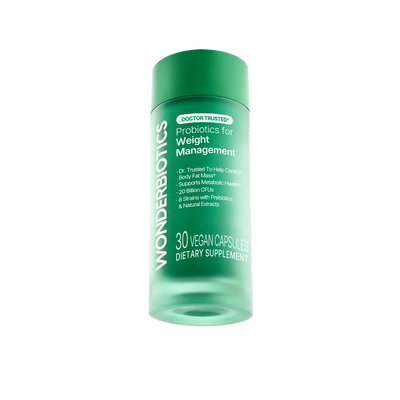
WONDERBIOTICS for Both Goals
WONDERBIOTICS was formulated to address both gut comfort and weight management support with named, strain-specific evidence.
B420™ (Bifidobacterium animalis subsp. lactis 420): weight-management and metabolic support. Six-month RCT ingredient-level evidence. CFU guaranteed at expiration; dose aligns with clinically studied range.
HN019 (Bifidobacterium animalis subsp. lactis HN019): gut comfort and regularity support. Ingredient-level evidence on abdominal symptom management.
Eriomin® and CraveLock™: ingredient-level clinical research on natural GLP-1 secretion support for satiety and appetite management.
5X Dihydroberberine: supports healthy blood sugar within the normal range. Safety note: discuss with clinician if taking glucose-lowering medications.
WONDERBIOTICS uses PolarSeal Technology. In testing, 99.9% of the bacterial strain survived gut-like acidic conditions and 98.2% remained alive through the point of consumption. CFU is guaranteed at expiration.
The formula is designed to support gut comfort and healthy weight-management routines. It is not a belly-fat cure, and it does not claim to eliminate bloating or produce direct fat loss.
Key ingredients are backed by 624 clinical studies involving 44,692 participants at the ingredient level.
Read the WONDERBIOTICS Review for a full look at the formula.
This article is for educational purposes only and is not medical advice. It is not intended to diagnose, treat, cure, or prevent any disease. If you have a medical condition or take medications, talk with a licensed clinician before starting supplements.
References
- Stenman LK, Lehtinen MJ, Meland N, et al. Probiotic With or Without Fiber Controls Body Fat Mass, Associated With Serum Zonulin, in Overweight and Obese Adults-Randomized Controlled Trial. EBioMedicine. 2016;13:190-200. https://pubmed.ncbi.nlm.nih.gov/27810310/
- Saadati S, Naseri K, Asbaghi O, Yousefi M, Golalipour E, de Courten B. Beneficial effects of the probiotics and synbiotics supplementation on anthropometric indices and body composition in adults: A systematic review and meta-analysis. Obes Rev. 2024;25(3):e13667. https://pubmed.ncbi.nlm.nih.gov/38030409/
- National Center for Complementary and Integrative Health. Probiotics: Usefulness and Safety. https://www.nccih.nih.gov/health/probiotics-usefulness-and-safety

Taylor Cottle, PhD
Serial Biotech Entrepreneur| PhD, John Hopkins University
Read more

WonderBiotics Weight Management: What the Evidence Shows

Food Noise Meaning: Definition, Scale and Tracking Guide

Weight-Loss Probiotic Strains With Replicated Evidence


