


Best Probiotic Strains for Appetite Control

Which Probiotic Strains Are Best for Appetite Control?
Appetite control is a more specific question than weight loss, and the published evidence on probiotics has different depth at each level. A small number of named strains have appetite-specific outcomes published in human randomized controlled trials (RCTs). Most of the probiotic supplement market does not. This article walks through which strains have appetite-specific clinical data, how to read the evidence (including findings that complicate a clean answer), and how to evaluate any probiotic claim on appetite.

Quick Answer
No single strain owns appetite control. A short list of named strains have appetite-specific endpoints published in human RCTs, with the best signals concentrated in a few specific trials.
The strains with appetite-related RCT data:
- Lactobacillus rhamnosus CGMCC 1.3724 (LPR): decreases in hunger and food craving scores in obese women in a diet-restriction context
- Hafnia alvei HA4597®: increased feeling of fullness alongside weight loss in overweight adults on a hypocaloric diet
- Bifidobacterium animalis subsp. lactis B420™: reduction in daily energy intake (a behavioral readout linked to appetite) in overweight and obese adults
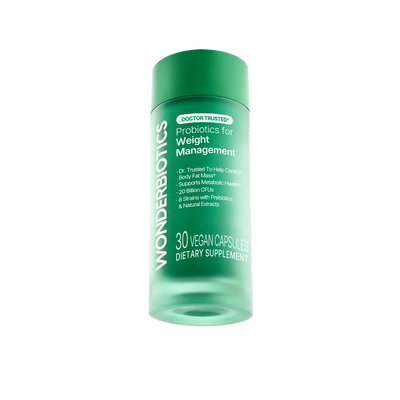
WONDERBIOTICS Probiotics for Weight Management uses B420™ at the strain level, paired with non-probiotic ingredients that engage adjacent appetite-related signaling at the ingredient level.
What "Appetite Control" Means in a Clinical Trial
Appetite is a layered concept. A trial that wants to measure it has to pick a specific operational definition, and those definitions are not interchangeable. The three most common categories:
Subjective appetite ratings. Hunger, fullness, satiety, and desire to eat, typically measured on a visual analog scale before and after a standardized meal. These ratings capture the felt experience of appetite directly.
Eating behavior measures. Disinhibition, cognitive restraint, food craving frequency, and satiety quotient (how much a meal reduces appetite per calorie consumed). These come from validated questionnaires and capture how appetite plays out in eating decisions.
Energy intake. Ad libitum meal tests, food diaries, or sustained measurement of daily calories consumed. This is a downstream behavioral readout: when appetite is engaged differently, intake usually moves.
Hormonal markers. Leptin, ghrelin, peptide YY, GLP-1, and adiponectin. These are upstream biological signals that intersect with appetite, though correlations between hormone changes and subjective appetite or intake are not always tight.
A strain studied for leptin levels has not automatically been shown to change how hungry someone feels. A strain that reduces energy intake has not automatically been shown to lower craving frequency. The endpoint matters when reading the evidence.
Terms to Know!
- Satiety quotient: a measure of how efficiently a meal suppresses appetite, calculated as the change in appetite rating divided by the energy content of the meal; a higher satiety quotient means the meal was more filling per calorie.
- Visual analog scale: a continuous self-report scale used in appetite trials, where participants mark a line between two anchors (such as "not at all hungry" and "extremely hungry") to rate a subjective feeling at a specific moment.
The Category-Level Picture Is Mixed
Before zooming into specific strains, the category-level evidence is worth seeing clearly. A 2023 systematic review and meta-analysis covering 26 RCTs with 1,536 participants examined probiotic and synbiotic supplementation against appetite-regulating hormones and self-reported desire to eat. Pooled analyses showed a significant decrease in serum leptin (standardized mean difference -0.38) and a trending increase in adiponectin, both of which can shift appetite signaling in a favorable direction in theory.[1] The same meta-analysis also found that probiotic and synbiotic supplementation was associated with a small but statistically significant increase in self-reported desire to eat (standardized mean difference 0.34, P=0.030).
The honest reading of that combination: the hormonal markers move in a direction associated with better appetite regulation, while subjective desire to eat moves slightly in the opposite direction at the category level, with substantial heterogeneity across the included trials. The finding is a reminder that biology is not always one-directional, and that pooled category-level data smooths out what individual strain trials show more clearly.
The Strains With Appetite-Specific RCT Data
The following strains have published, peer-reviewed RCTs reporting appetite-specific outcomes. The list is selective rather than exhaustive. Many probiotic trials report weight or body composition endpoints without measuring appetite directly, and inclusion here means appetite or appetite-adjacent endpoints were primary or secondary outcomes in the cited trial.
LPR (Lactobacillus rhamnosus CGMCC 1.3724). A 24-week randomized, double-blind, placebo-controlled trial in 105 obese adults (45 men, 60 women) on moderate energy restriction reported sex-specific effects. In women in the LPR group, satiety efficiency at lunch increased (P=0.02), hunger scores decreased (P=0.02), disinhibition decreased (P=0.05), and food craving decreased (P=0.05) compared with the female placebo group. In men, the LPR group showed increased fasting fullness and cognitive restraint.[2] Both sexes showed some appetite-related response, with the more pronounced behavioral changes in women. The trial was funded by the strain's commercial sponsor and combined LPR with oligofructose and inulin, so the published effect reflects the combination rather than LPR in isolation.
Hafnia alvei HA4597®. A 12-week multicenter randomized, double-blind, placebo-controlled trial enrolled 236 overweight adults on a 20% hypocaloric diet. The HA4597® group showed a significantly higher proportion of subjects reaching 3% weight loss (54.9% versus 41.4%, P=0.048) and an increased feeling of fullness (P=0.009) compared to placebo.[3] The proposed mechanism involves a bacterial protein called ClpB that mimics the satietogenic effects of alpha-melanocyte-stimulating hormone. The trial was sponsor-funded, and the strain is a non-Lactobacillus/Bifidobacterium species, so its evidence profile sits separately from the more familiar dairy probiotic strains.
B420™ (Bifidobacterium animalis subsp. lactis 420). A 6-month randomized, placebo-controlled trial in 225 overweight and obese adults aged 18-65 examined body composition as the primary outcome. Post-hoc factorial analysis showed body fat mass differed by -4.0% versus placebo (P=0.002), waist circumference dropped by 2.4 cm more than placebo, and daily energy intake was reduced by approximately 300 kcal compared to placebo.[4] The energy intake reduction is the closest direct appetite-related readout: participants spontaneously consumed less food without an explicit calorie target. Hunger ratings and craving frequency were not primary endpoints in this trial.
The pattern across these three: published positive appetite-related signals exist, are tied to specific endpoints, and in some cases are sex- or population-specific. Other strains have been studied with neutral or null appetite findings, and many appetite trials use mixed-strain blends that make it difficult to attribute effects to any single component.
How to Evaluate Appetite Claims on a Product Label
The phrase "supports appetite control" appears on supplement labels with no consistent evidentiary meaning. Reading past the phrase takes a few specific questions.
Named strain with appetite-specific RCT data. A label that says lactobacillus without a strain code cannot be matched to specific trials. A label that names the strain (such as B420™ or HA4597®) is the prerequisite for checking the evidence, and the relevant question is whether that strain has been tested on appetite, hunger, satiety, food craving, energy intake, or related endpoints.
Endpoint specificity. A trial that measured leptin alone is not the same as a trial that measured subjective hunger. Map the marketed claim (appetite, cravings, fullness, food noise) to the actual endpoint in the cited trial.
Population fit. A trial in obese women does not automatically generalize to other groups. A trial in overweight French adults on a 20% hypocaloric diet does not automatically transfer to a population not in a structured weight-loss program. Read the inclusion criteria of the cited trial against your own situation.
Dose and form. Strain effects are dose-dependent. A product that contains a fraction of the studied dose, in a different delivery format, cannot claim the studied effect. Check the colony-forming unit count against the trial cited.
Sponsorship. Most strain-specific RCTs are funded by the strain's commercial sponsor. This is standard in nutrition research, and the sponsorship does not invalidate the finding. It does shape what gets published and how the data are framed. Look for the disclosure statement, then weigh accordingly.
How WONDERBIOTICS Fits This Picture
WONDERBIOTICS Probiotics for Weight Management was formulated around the role of the gut microbiome in metabolic health. Each named ingredient has a defined role.
- B420™ is the probiotic strain in the formula, and the published 6-month RCT in overweight/obese adults provides ingredient-level human evidence on body composition and energy intake. The energy intake reduction is the appetite-relevant readout. Hunger ratings, satiety, and food craving frequency were not primary endpoints in the cited trial, and the formula does not claim direct demonstration on those specific subjective endpoints.
- Eriomin® (lemon extract) is a citrus flavonoid extract studied at the ingredient level. Clinical research in prediabetic adults reports support for natural GLP-1 levels and adiponectin levels, both of which intersect with appetite signaling.[5] These are ingredient-level results in a specific population, not finished-product results in WONDERBIOTICS users.
- Dihydroberberine is a modified version of berberine that achieves higher plasma berberine exposure at lower doses. It supports maintaining healthy blood sugar levels already within the normal range. Direct human evidence at the dihydroberberine level remains limited; its role here is to deliver berberine more effectively, with the active end-form remaining berberine in tissue.
The formula also features CraveLock™ Technology, a proprietary synergistic approach to appetite management and Food Noise.
WONDERBIOTICS uses PolarSeal Technology to help protect the probiotic blend. In testing, 99.9% of the bacterial strain survived gut-like acidic conditions, and 98.2% of the bacteria remained alive through to the point of consumption.
The core ingredients in the formula are backed by 624 clinical studies covering 44,692 participants. The formula was developed by PhD scientists and industry experts.
We recommend taking it consistently for 3-6 months alongside a balanced diet and regular movement, to give your gut time to adapt and your body time to respond. The timeline reflects how the underlying biology actually works.
FAQ
How quickly should I expect appetite to change?
Probiotic effects on appetite-related biology unfold over weeks, not days. The trials cited in this article ran for 12 to 24 weeks. We recommend 3-6 months of consistent use to give your gut time to adapt and your body time to respond.
If a label says it supports appetite, does that mean it will work for cravings?
Not necessarily. Appetite and cravings are related but not identical. A product with evidence on energy intake or fullness may not have evidence on craving frequency specifically. Match the marketed claim to the actual studied endpoint.
Why does the category-level meta-analysis show mixed appetite effects?
The probiotic category includes thousands of strains with different biological actions. Pooling across heterogeneous trials produces an average that may not reflect what any single strain does. Strain-level evidence is the more useful unit of analysis for individual decisions.
Read the Strain, Not the Category
"Best probiotic for appetite control" is a category-level question; the evidence is a strain-level answer. Specific named strains have appetite-relevant RCT data with specific endpoints in specific populations, and the strongest evidence sits at the strain-and-population intersection rather than at the broad probiotic label.
A probiotic formulated around a strain with strain-level RCT data, paired with non-probiotic ingredients chosen for adjacent appetite biology, is the form of evidence-backed that applies in this category. WONDERBIOTICS Probiotics for Weight Management is one option built on that logic.
Related reading: weight loss probiotics — what the evidence shows.
References
- Noormohammadi M, Ghorbani Z, Löber U, et al. The effect of probiotic and synbiotic supplementation on appetite-regulating hormones and desire to eat: A systematic review and meta-analysis of clinical trials. Pharmacol Res. 2023;187:106614. https://www.sciencedirect.com/science/article/pii/S1043661822005606
- Sanchez M, Darimont C, Marette A, et al. Effects of a diet-based weight-reducing program with probiotic supplementation on satiety efficiency, eating behaviour traits, and psychosocial behaviours in obese individuals. Nutrients. 2017;9(3):284. https://www.mdpi.com/2072-6643/9/3/284
- Déchelotte P, Breton J, Trotin-Picolo C, et al. The probiotic strain H. alvei HA4597® improves weight loss in overweight subjects under moderate hypocaloric diet: a proof-of-concept, multicenter randomized, double-blind placebo-controlled study. Nutrients. 2021;13(6):1902. https://www.mdpi.com/2072-6643/13/6/1902
- Stenman LK, Lehtinen MJ, Meland N, et al. Probiotic with or without fiber controls body fat mass, associated with serum zonulin, in overweight and obese adults: randomized controlled trial. EBioMedicine. 2016;13:190-200. https://www.sciencedirect.com/science/article/pii/S2352396416304972
- Ribeiro CB, Ramos FM, Manthey JA, Cesar TB. Effectiveness of Eriomin® in managing hyperglycemia and reversal of prediabetes condition: A double-blind, randomized, controlled study. Phytother Res. 2019;33(7):1921-1933. https://onlinelibrary.wiley.com/doi/10.1002/ptr.6386


