


Appetite-Control Supplements That May Reduce Food Noise

Which Appetite-Control Supplements Actually Reduce Food Noise?
Food noise is a recent term. The first formal academic definition appeared in 2023, and most appetite-related research published before then did not use the phrase at all. No appetite-control supplement has a randomized controlled trial (RCT) with "food noise" as a labeled primary endpoint, because the concept did not exist in research vocabulary until very recently. What does exist is a set of related, more clinically established endpoints (food craving, hunger, satiety, food-related intrusive thoughts, energy intake) that map onto pieces of what people mean when they say food noise. The honest question is which supplements have evidence on those component endpoints.
This article covers what food noise actually is in the research literature, the supplement categories with the most relevant component-endpoint evidence, and how to evaluate any product that claims to reduce food noise.

The Gist
No supplement has direct "food noise" RCT data. The term was only formally defined in 2023, and supplement trials use the older component endpoints that food noise sits on top of.
The supplement categories with evidence on those component endpoints:
- Targeted probiotic strains with hunger, food-craving, or energy-intake outcomes
- Soluble fiber (glucomannan) with EFSA-recognized satiety effects
- 5-HTP with early satiety and reduced carbohydrate intake7
- Ingredient-level appetite-related signaling support such as Eriomin® (lemon extract) for GLP-18
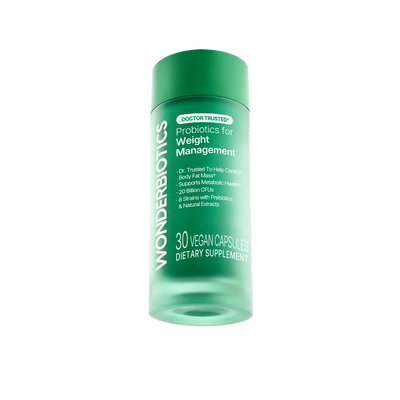
WONDERBIOTICS Probiotics for Weight Management uses B420™ as its named strain, plus non-probiotic ingredients selected for adjacent appetite biology.
What "Food Noise" Actually Refers To
Food noise is a colloquial term that exploded into public conversation alongside GLP-1 medications, when patients began describing the unexpected quieting of persistent food-related thoughts on semaglutide and tirzepatide. The first peer-reviewed conceptual model, published in 2023, defined food noise as "heightened and/or persistent manifestations of food cue reactivity, often leading to food-related intrusive thoughts and maladaptive eating behaviors."1 The paper grouped food noise under the broader concept of food cue reactivity (how strongly the brain responds to food-related stimuli) and proposed a framework for studying it.
The practical implication: food noise is not one endpoint. It is a cluster of behaviors and experiences that researchers have historically measured separately:
Food craving frequency. How often a person experiences strong, specific food urges, often measured by validated questionnaires.
Hunger ratings. Subjective hunger between meals, typically measured by visual analog scale.
Food-related intrusive thoughts. Persistent, unwanted thoughts about food that feel difficult to suppress.
Satiety efficiency. How effectively a meal quiets appetite per calorie consumed.
Energy intake. A downstream behavioral readout reflecting how appetite plays out in eating.
A supplement that reduces food craving has not automatically been shown to reduce food-related intrusive thoughts; an ingredient that increases satiety per calorie has not automatically been shown to reduce hunger between meals. When a label says "reduces food noise," the honest reading is to look for which specific component endpoint the underlying evidence actually addresses.
Terms to Know!
- Food cue reactivity: the degree to which exposure to food-related stimuli (sight, smell, advertising, mental imagery) triggers physiological, emotional, or behavioral responses; the academic construct that food noise sits inside.
- Food-related intrusive thoughts (FRITs): persistent, unwanted thoughts about food that the person experiences as difficult to suppress, distinct from straightforward physical hunger; one of the central experiences that the colloquial term food noise points to.
The Category-Level Picture for Supplements
The probiotic and synbiotic literature on appetite-regulating biology has been pooled in a 2023 systematic review of 26 RCTs covering 1,536 participants. The pooled analysis showed a significant decrease in serum leptin (standardized mean difference -0.38) and a trending increase in adiponectin, both of which can shift appetite signaling in a theoretically favorable direction.2 The same meta-analysis also found a small but statistically significant increase in self-reported desire to eat (standardized mean difference 0.34, P=0.030), with substantial heterogeneity across included trials.
The take-away is that category-level probiotic effects on appetite biology are real but mixed, and pooled numbers smooth over what strain-level evidence shows more clearly. The honest answer for someone asking which supplements reduce food noise is that the question has to drop one level down, to specific named strains and specific other named ingredients with specific component-endpoint evidence.
The principle behind this is the strain-specificity rule from the international consensus statement on probiotics: probiotic effects are tied to specific strains and specific endpoints, and evidence from one strain does not transfer to another.3 A strain studied for body fat mass has been studied for body fat mass; not for hunger, not for craving, not for intrusive thoughts unless those endpoints were measured.
Supplement Options With Component-Endpoint Evidence
The supplements below are listed by category, with the specific food-noise-related endpoint each addresses. None of them used "food noise" as a labeled endpoint; the question is which component of the food noise experience each has data on.
Targeted probiotic strains (food craving, hunger, energy intake)
LPR (Lactobacillus rhamnosus CGMCC 1.3724). A 24-week RCT in 105 obese adults on moderate energy restriction reported sex-specific effects on appetite outcomes. In women in the LPR group, satiety efficiency at lunch increased (P=0.02), hunger scores decreased (P=0.02), and food craving decreased (P=0.05) compared with the female placebo group.4 Hunger and food craving are two of the clearest component endpoints of food noise. The trial was sponsor-funded and combined LPR with oligofructose and inulin, so the published effect reflects the combination rather than LPR alone.
B420™ (Bifidobacterium animalis subsp. lactis 420). A 6-month RCT in 225 overweight and obese adults reported daily energy intake reduced by approximately 300 kcal compared to placebo (post-hoc factorial analysis), alongside body fat mass and waist circumference changes.5 The energy intake reduction is the strongest behavioral readout of changed appetite regulation. Hunger ratings, food craving frequency, and food-related intrusive thoughts were not primary endpoints in this trial, so the connection to those specific subjective experiences is not directly demonstrated.
Soluble fiber (satiety)
Glucomannan. A water-soluble fiber from konjac root, glucomannan has an EFSA-authorized health claim for weight loss under specific conditions: at least 3g daily in three doses of 1g each, taken with 1-2 glasses of water before meals, in the context of an energy-restricted diet, in overweight adults.6 The mechanism is satiety through gel formation in the stomach. This category addresses physical fullness at meals; it does not directly target food-related intrusive thoughts between meals.
Single-ingredient appetite supplements (early satiety, carbohydrate intake)
Ingredient-level appetite-related signaling
Eriomin® (lemon extract). A citrus flavonoid extract studied at the ingredient level for effects on appetite-related signaling. Clinical research in prediabetic adults reports support for natural GLP-1 levels and adiponectin levels.8 Elevated GLP-1 is the same broad signaling category that prescription GLP-1 receptor agonists engage, though the magnitude of effect from an oral flavonoid is much smaller than from an injected GLP-1 receptor agonist. The evidence is ingredient-level in a specific population (prediabetic adults), not finished-product evidence on food noise.
How to Evaluate "Reduces Food Noise" Claims on a Label
A growing number of supplement labels use the phrase "reduces food noise" or similar. Reading past the phrase takes a few specific questions.
What is the actual endpoint behind the claim? Ask which specific component of food noise the cited trial measured: food craving, hunger, satiety, energy intake, or intrusive thoughts. Many products cite trials on adjacent but different endpoints.
Was the ingredient named and tested at a studied dose? A named strain or ingredient at the dose actually used in the cited trial is the standard. Lower doses or unspecified amounts cannot inherit the trial's findings.
Was the population reasonably similar? A trial in obese women in a structured dietary program may not transfer to a normal-weight person without one. A trial in prediabetic adults may not transfer to people with normal glucose regulation.
Is the marketed effect described at the right level? Food noise is a layered concept. A product that supports satiety may genuinely do that and still have no data on food-related intrusive thoughts. The careful version of the claim names the component endpoint; the loose version conflates them.
How WONDERBIOTICS Fits This Picture
WONDERBIOTICS Probiotics for Weight Management was formulated around the role of the gut microbiome in metabolic health. Each named ingredient has a defined role.
- B420™ is the probiotic strain in the formula, and the published 6-month RCT provides ingredient-level human evidence on energy intake reduction and body composition.5 The energy intake outcome is the closest component to a food noise readout; food craving frequency and food-related intrusive thoughts were not primary endpoints in the cited trial, and the formula does not claim direct demonstration on those specific subjective experiences.
- Eriomin® (lemon extract) is a citrus flavonoid extract with ingredient-level RCT data on natural GLP-1 levels and adiponectin levels in prediabetic adults.8 These are ingredient-level results in a specific population, not finished-product results in WONDERBIOTICS users.
- Dihydroberberine is a modified version of berberine that achieves higher plasma berberine exposure at lower doses. It supports maintaining healthy blood sugar levels already within the normal range. Direct human evidence at the dihydroberberine level remains limited; its role here is to deliver berberine more effectively, with the active end-form remaining berberine in tissue.
The formula also features CraveLock™ Technology, a proprietary synergistic approach to appetite management and Food Noise.
WONDERBIOTICS uses PolarSeal Technology to help protect the probiotic blend. In testing, 99.9% of the bacterial strain survived gut-like acidic conditions, and 98.2% of the bacteria remained alive through to the point of consumption.
The core ingredients in the formula are backed by 624 clinical studies covering 44,692 participants. The formula was developed by PhD scientists and industry experts.
We recommend taking it consistently for 3-6 months alongside a balanced diet and regular movement, to give your gut time to adapt and your body time to respond. The timeline reflects how the underlying biology actually works.
FAQ
Does any non-prescription supplement reduce food noise as strongly as GLP-1 medications?
No. Patient reports on GLP-1 receptor agonists describe a marked quieting of food-related intrusive thoughts that has not been replicated by any supplement in the published literature. Non-prescription options can address component endpoints (satiety, energy intake, craving), but the magnitude and the breadth of the food noise effect on GLP-1 medications is in a different range.
How long before I notice a difference?
Effects on appetite-related biology unfold over weeks. The trials cited above ran from 6 weeks to 6 months. We recommend 3-6 months of consistent use to give your gut time to adapt and your body time to respond.
Can I combine these supplement categories?
Many of these ingredients can be combined, with two cautions: 5-HTP must not be combined with SSRIs or other serotonergic medications because of serotonin syndrome risk, and any supplement plan is worth running by a clinician if you take prescription medications, are pregnant, or have a medical condition.
Match the Claim to the Endpoint
"Reduces food noise" is a marketing-friendly phrase for a recently named cluster of experiences. The underlying research uses older, more specific component endpoints, and the supplements with the best evidence have data on those components rather than on food noise as a single labeled outcome. The useful question is which component the marketing language is actually mapping onto, and whether the cited trial measured that specific thing.
A probiotic formulated around a named strain with strain-level RCT data on appetite-related component endpoints, paired with non-probiotic ingredients chosen for adjacent biology, is what evidence-backed looks like in this category. WONDERBIOTICS Probiotics for Weight Management is one option built on that logic.
References
- Hayashi D, Edwards C, Emond JA, et al. What is food noise? A conceptual model of food cue reactivity. Nutrients. 2023;15(22):4809. https://www.mdpi.com/2072-6643/15/22/4809
- Noormohammadi M, Ghorbani Z, Löber U, et al. The effect of probiotic and synbiotic supplementation on appetite-regulating hormones and desire to eat: A systematic review and meta-analysis of clinical trials. Pharmacol Res. 2023;187:106614. https://www.sciencedirect.com/science/article/pii/S1043661822005606
- Hill C, Guarner F, Reid G, et al. Expert consensus document. The International Scientific Association for Probiotics and Prebiotics consensus statement on the scope and appropriate use of the term probiotic. Nat Rev Gastroenterol Hepatol. 2014;11(8):506-514. https://www.nature.com/articles/nrgastro.2014.66
- Sanchez M, Darimont C, Marette A, et al. Effects of a diet-based weight-reducing program with probiotic supplementation on satiety efficiency, eating behaviour traits, and psychosocial behaviours in obese individuals. Nutrients. 2017;9(3):284. https://www.mdpi.com/2072-6643/9/3/284
- Stenman LK, Lehtinen MJ, Meland N, et al. Probiotic with or without fiber controls body fat mass, associated with serum zonulin, in overweight and obese adults: randomized controlled trial. EBioMedicine. 2016;13:190-200. https://www.sciencedirect.com/science/article/pii/S2352396416304972
- EFSA Panel on Dietetic Products, Nutrition and Allergies (NDA). Scientific Opinion on the substantiation of health claims related to konjac mannan (glucomannan) and reduction of body weight. EFSA Journal. 2010;8(10):1798. https://efsa.onlinelibrary.wiley.com/doi/10.2903/j.efsa.2010.1798
- Cangiano C, Ceci F, Cascino A, et al. Eating behavior and adherence to dietary prescriptions in obese adult subjects treated with 5-hydroxytryptophan. Am J Clin Nutr. 1992;56(5):863-867. https://academic.oup.com/ajcn/article-abstract/56/5/863/4715513
- Ribeiro CB, Ramos FM, Manthey JA, Cesar TB. Effectiveness of Eriomin® in managing hyperglycemia and reversal of prediabetes condition: A double-blind, randomized, controlled study. Phytother Res. 2019;33(7):1921-1933. https://onlinelibrary.wiley.com/doi/10.1002/ptr.6386


