


What do women say actually helps with menopause weight gain?

What do women say actually helps with menopause weight gain?
Across menopause forums, health communities, and clinical consultations, the experiences women share about menopause weight management are surprisingly consistent with each other and with the clinical evidence. Certain changes come up again and again as turning points, and most of them are not medications or supplements. This article summarizes what women describe as genuinely effective, explains why each aligns with the underlying biology, and clarifies where supplementation fits within that picture.

What Comes Up Most Often
Lifting weights, not just walking
The most consistent shift women describe as meaningful is adding resistance training to a routine that previously focused only on walking or aerobic exercise. The reason this works where cardio alone does not is muscle metabolism: every pound of muscle burns more calories at rest than the same pound of fat. As muscle mass declines during perimenopause, resting metabolic rate drops. Rebuilding muscle through resistance training changes the body's energy equation in a way that walking, however consistent, cannot.
Mayo Clinic recommends strength training at least twice a week alongside at least 150 minutes of moderate aerobic activity per week for women managing menopause weight.1 Women who report the most noticeable body composition changes typically describe a combination, with resistance training producing the visible waistline changes.
Increasing protein, not just reducing calories
Many women describe a shift that happens when they stop focusing on eating less and start focusing on eating enough protein. The biology is straightforward: protein is the most satiating macronutrient per calorie, suppresses ghrelin more effectively than carbohydrates or fat, and provides the amino acids needed for muscle protein synthesis. Without adequate protein, resistance training does not produce muscle gain.
For midlife women, 1.0-1.2 g/kg/day is the target range supported by clinical nutrition guidance, higher than the standard adult recommendation of 0.8 g/kg/day. Distributing protein across meals, rather than loading it at dinner, produces more sustained satiety throughout the day.
A recurring theme in women's accounts is that protein-focused eating reduces afternoon and evening cravings more than calorie restriction alone, which aligns with what ghrelin suppression and GLP-1 stimulation data predict.
Addressing sleep seriously
Women who describe significant improvements in weight management during menopause often point to sleep quality as the variable they were underestimating. Night sweats, disrupted sleep architecture, and cortisol elevation from chronic poor sleep all raise appetite hormones and lower satiety hormones independently of caloric intake.
NHS guidance on menopause management emphasizes that sleep, diet, and mental health are all important components of managing perimenopause and menopause.2 This is consistent with the clinical picture: when sleep improves, whether through HRT for vasomotor symptoms, behavioral changes, or other means, the appetite dysregulation that was making weight management feel impossible often also improves.
Managing blood sugar through food choices
Women who reduce ultra-processed carbohydrates and stabilize blood sugar report fewer cravings, more predictable hunger, and less afternoon energy crashes. The mechanism is insulin resistance, which increases during perimenopause and creates a cycle: blood sugar spikes and drops generate reactive hunger and carbohydrate cravings, which reinforce the metabolic state that drives them.
Dietary fiber, particularly soluble fiber from oats, legumes, and vegetables, slows glucose absorption and extends satiety. This is not a dramatic intervention, but it is a consistent one: women who describe reducing food noise and reducing cravings often also describe eating more fiber and fewer refined carbohydrates.
Adding gut support as a supporting layer
A smaller but consistent thread in women's accounts is finding that gut health interventions, including dietary changes and probiotics, contribute to reduced bloating, better regularity, and sometimes improved appetite management. This is not described as a primary solution but as a meaningful complementary piece.
The clinical rationale is real: the gut microbiome changes during the menopause transition through the estrobolome, the collection of gut bacterial genes that metabolize estrogens. A gut environment that supports short-chain fatty acid production and GLP-1 secretion from intestinal L-cells provides metabolic signals that are relevant to appetite and weight management. Specific probiotic strains with ingredient-level human RCT evidence on body fat and waist circumference, such as B420™ (Bifidobacterium animalis subsp. lactis 420), address this layer with actual clinical data.3
This is a supportive role, not a primary solution. Women who describe meaningful gut support contributions are typically also doing the protein, resistance training, and sleep work.
Terms to Know!
- Ghrelin and leptin: Ghrelin is the hunger-signaling hormone produced in the stomach; leptin is the satiety hormone produced by fat cells. Poor sleep raises ghrelin and lowers leptin, directly increasing appetite. Declining estrogen may reduce leptin sensitivity during perimenopause.
- Estrobolome: The collection of gut bacterial genes capable of metabolizing estrogens. Changes in the estrobolome during perimenopause may affect circulating estrogen levels and fat distribution.
What Does Not Appear in Women's Accounts as a Solution
Reducing calories without increasing protein or changing exercise patterns consistently comes up as what was tried before other things and what produced short-term changes that did not hold.
Taking a probiotic in isolation, without the dietary and lifestyle changes above, is not described as producing meaningful weight management change. Probiotics are described as helpful when they address specific issues: bloating, irregularity, and as part of a broader gut-health approach alongside dietary fiber.
HRT, while described as helpful for vasomotor symptoms and sleep quality by many women, is not described as producing weight loss directly. This aligns with the clinical evidence: menopausal hormone therapy addresses the conditions that make weight management harder; it does not directly produce fat loss.
Where WONDERBIOTICS Fits in This Picture
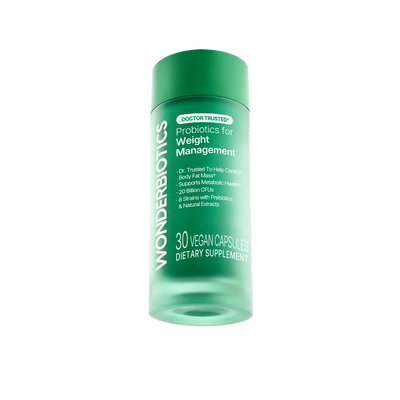
WONDERBIOTICS is designed as the gut-metabolic support layer within the broader approach described above. It is not a replacement for protein, resistance training, or sleep management, and it is not positioned as the primary solution for menopause weight gain.
B420™ (Bifidobacterium animalis subsp. lactis 420): ingredient-level RCT evidence on body fat mass and waist circumference in overweight adults. The formula's primary metabolic strain. CFU guaranteed at expiration.
HN019 (Bifidobacterium animalis subsp. lactis HN019): gut comfort and regularity support, relevant to the bloating and GI changes common during perimenopause.
Eriomin® and CraveLock™: ingredient-level clinical research on natural GLP-1 secretion support. Addresses appetite management and food noise through a gut-hormone nutritional pathway.
5X Dihydroberberine: supports healthy blood sugar levels already within the normal range. Relevant to the insulin resistance component of midlife weight management.
WONDERBIOTICS uses PolarSeal Technology to protect the probiotic blend. In testing, 99.9% of the bacterial strain survived gut-like acidic conditions and 98.2% remained alive through the point of consumption. CFU is guaranteed at expiration.
The formula supports midlife metabolic wellness as a non-hormonal gut-metabolic support supplement. It works as part of the picture women describe, not instead of the foundational elements.
Read the WONDERBIOTICS Review for a full look at the formula.
This article is for educational purposes only and is not medical advice. It is not intended to diagnose, treat, cure, or prevent any disease. Women's individual experiences are informational context, not medical evidence. Talk with a licensed clinician about what is appropriate for your health situation.
References
- Mayo Clinic. Menopause weight gain: Stop the middle age spread. https://www.mayoclinic.org/healthy-lifestyle/womens-health/in-depth/menopause-weight-gain/art-20046058
- NHS. Menopause. https://www.nhs.uk/conditions/menopause/
- Stenman LK, Lehtinen MJ, Meland N, et al. Probiotic With or Without Fiber Controls Body Fat Mass, Associated With Serum Zonulin, in Overweight and Obese Adults-Randomized Controlled Trial. EBioMedicine. 2016;13:190-200. https://pubmed.ncbi.nlm.nih.gov/27810310/


