


Best Weight-Loss Supplements for Perimenopause: What the Evidence Actually Supports

What Are the Best Weight-Loss Supplements During Perimenopause?
Perimenopause is the years-long hormonal transition leading up to menopause. Estrogen and progesterone rise and fall in patterns that are no longer cyclically predictable, body composition tends to shift toward central adiposity, and sleep, mood, and metabolic regulation often change alongside. Weight management during this window is its own conversation, and the supplement aisle does not have a clean answer to offer.
Most weight-loss supplements have not been studied in dedicated perimenopause-specific trials. What the research does provide is evidence in adjacent populations: general overweight and obese adults, postmenopausal women, prediabetic adults. That adjacent evidence is informative when read with the right caveats, and unhelpful when read as if it were perimenopause-specific.
This article covers what categories of supplements have at least adjacent evidence relevant to weight management during perimenopause, what the safety considerations are, and where the honest limits sit.

Where the Evidence Stands
Perimenopause-specific weight-loss supplement RCTs are sparse. Adjacent evidence in general overweight adults, postmenopausal women, and prediabetic adults provides what is informative.
What the published evidence supports across categories:
- Soluble fiber (glucomannan): EFSA-authorized health claim with specific use conditions in overweight adults
- Targeted probiotic strains (e.g., B420™): RCT evidence on body composition in mixed-sex overweight/obese adults
- Specific flavonoids (e.g., Eriomin® lemon extract): RCT evidence in prediabetic adults on appetite-related signaling
- Green tea catechins (EGCG): modest weight effects only when combined with caffeine; safety considerations apply
- Conjugated linoleic acid (CLA): some evidence in postmenopausal women with type 2 diabetes; not perimenopause-specific
- 5-HTP: appetite effects in obese adults at high doses; cannot be combined with SSRIs
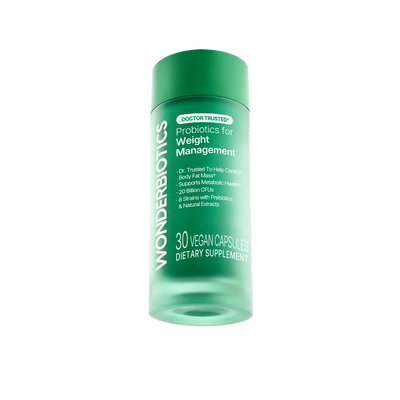
WONDERBIOTICS Probiotics for Weight Management uses ingredient-level evidence in adjacent populations.It is one option to consider within those evidence limits.
Why Perimenopause Changes the Weight Management Conversation
Estrogen decline in perimenopause is associated with redistribution of body fat toward the abdomen and a decline in insulin sensitivity, though the mechanisms are complex and not solely explained by estrogen. Sleep quality often degrades during this window, and disrupted sleep has been linked to poorer metabolic health and altered hunger regulation, though the pathway is multifactorial. Cortisol patterns may be associated with central fat distribution, though the evidence in postmenopausal women specifically is mixed.
These overlapping changes mean that the same caloric deficit that produced weight loss in one's thirties may produce smaller results in one's forties or fifties. The body's defense of its energy stores is not perimenopause-specific. A 1-year follow-up study in adults who had completed a low-energy diet found that hormonal adaptations to weight loss persist long after the diet ends: hunger-promoting hormone levels remained elevated and fullness-signaling hormone levels remained suppressed compared to baseline.<sup>1</sup> Overlay this on a perimenopausal hormonal background and the difficulty of sustained weight loss has both a general physiological component and a life-stage-specific one.
This is not a reason for despair. It is a reason to read the evidence carefully and to set expectations honestly when considering any supplement category.
Terms to Know!
- Visceral adiposity: fat stored deep within the abdomen surrounding internal organs, distinguished from subcutaneous fat that sits just under the skin; visceral fat is more metabolically active and more strongly associated with insulin resistance and cardiovascular risk than subcutaneous fat at the same total weight.
- Vasomotor symptoms: hot flashes and night sweats experienced during the menopausal transition; the established clinical indication for hormone replacement therapy in selected patients, distinct from weight management.
The Supplement Categories With Adjacent Evidence
Each of the following categories has at least one published human RCT or systematic review with weight-related findings. None has perimenopause-specific finished-product validation as a category default. Adjacent informativeness varies by how close the studied population is to the perimenopausal context.
Soluble fiber (glucomannan). Glucomannan is a soluble fiber from konjac root with an EFSA-authorized health claim for weight reduction. The use conditions are specific: at least 3g daily in three doses of 1g each, taken with 1-2 glasses of water before meals, in the context of an energy-restricted diet, in overweight adults.<sup>2</sup> The mechanism is satiety through gel formation in the stomach. The studied population is overweight adults of mixed sex, which overlaps with but is not specific to perimenopause.
Targeted probiotic strains. Probiotic effects depend on the specific strain, and evidence from one strain does not transfer to another.<sup>3</sup> The strain with the most established weight-endpoint RCT data is Bifidobacterium animalis subsp. lactis B420™. A 6-month randomized, placebo-controlled trial enrolled 225 overweight and obese adults aged 18-65, with body fat mass differing by -4.0% versus placebo (P=0.002), waist circumference dropping 2.4 cm more than placebo, and daily energy intake reduced by approximately 300 kcal compared to placebo.<sup>4</sup> The trial enrolled mixed-sex adults; these endpoints are relevant to menopause-related metabolic concerns, but efficacy has not been directly demonstrated in perimenopausal or postmenopausal women.
Citrus flavonoids (Eriomin® lemon extract). Eriomin® (lemon extract) is a citrus flavonoid extract studied in prediabetic adults for effects on appetite-related signaling. Ingredient-level clinical research reports support for natural GLP-1 levels and adiponectin levels.<sup>5</sup> Population: prediabetic adults of both sexes, not perimenopause-specific.
Green tea catechins (EGCG). A 2010 meta-analysis of 15 RCTs (n=1243) found that green tea catechins combined with caffeine produced statistically significant reductions in body weight (-1.38 kg), BMI (-0.55), and waist circumference (-1.93 cm) versus caffeine alone, while green tea catechins without caffeine showed no benefit on any anthropometric measure.<sup>6</sup> The clinical significance of these reductions is modest. Safety concerns include GI side effects and rare but documented cases of liver injury, particularly at higher doses.
Conjugated linoleic acid (CLA). CLA has been studied in some postmenopausal populations, though not in a clearly established perimenopause-specific visceral-fat setting. A 36-week randomized crossover trial in 55 obese postmenopausal women with type 2 diabetes compared CLA (8 g/day) to safflower oil; CLA reduced BMI (P=0.0022) and total adipose mass without altering lean tissue mass.<sup>7</sup> The trial population is specific (postmenopausal + type 2 diabetes), and the findings should not be generalized to perimenopausal women without diabetes.
5-HTP. 5-hydroxytryptophan is a serotonin precursor studied for appetite effects at approximately 900 mg/day (about 8 mg/kg/day in older trial dosing) in obese adults.<sup>8</sup> 5-HTP cannot be combined with SSRIs because of serotonin syndrome risk. Population: obese adults; perimenopause-specific data has not been established as a separate evidence base.
Chromium picolinate. Chromium picolinate is thought to influence insulin signaling, though the exact mechanism is not fully established. Evidence quality across this category is uneven, and perimenopause-specific data is not well established.
What Marketing Claims Often Miss for Perimenopause
Many "menopause weight loss" supplements rely on category-level marketing rather than ingredient-level evidence on weight endpoints. Patterns to recognize:
- Generic "menopause" multi-ingredient blends without RCT data on the formula or its strains/ingredients.A category-themed label is not a substitute for ingredient-level evidence.
- Soy isoflavones positioned as weight-loss aids. Soy isoflavones are primarily studied in the vasomotor symptoms context, not for weight loss as a primary endpoint.
- Hormone replacement therapy (HRT) marketed for weight management. The Menopause Society positions HRT as the standard treatment for vasomotor symptoms in selected patients, prescribed under medical supervision. HRT is not positioned as a weight-loss intervention.
- "Hormone-balancing" supplements without specified mechanism or evidence. This phrase is rhetorical, not evidential.
Beyond Supplements: The Foundation That Most Affects Outcome
Supplements operate within a larger context of food, sleep, movement, and stress regulation. The Menopause Society recommends regular aerobic activity plus strength training as part of midlife health maintenance. Protein intake in the range of 1.0-1.2 g/kg of body weight as a baseline, or 1.2-1.6 g/kg during active weight management, is drawn from older-adult and weight-loss literature; these are not menopause-specific consensus targets. Sleep regularity and stress management reach a different layer of biology than what any supplement can engage.
How WONDERBIOTICS Fits the Perimenopause Conversation
WONDERBIOTICS Probiotics for Weight Management is built on ingredient-level human evidence rather than perimenopause-specific finished-product evidence. The honest accounting:
- B420™ is the probiotic strain in the formula. The published 6-month RCT enrolled 225 overweight and obese adults aged 18-65, with body fat mass differing by -4.0% versus placebo (P=0.002), waist circumference dropping 2.4 cm more than placebo, and daily energy intake reduced by approximately 300 kcal compared to placebo.<sup>4</sup> These endpoints are relevant to menopause-related metabolic concerns (visceral adiposity, energy balance), though efficacy has not been directly demonstrated in perimenopausal or postmenopausal women.
- Eriomin® (lemon extract) is a citrus flavonoid extract studied for its effects on appetite-related signaling. Ingredient-level clinical research in prediabetic adults reports support for natural GLP-1 levels and adiponectin levels.<sup>5</sup> These results are in prediabetic adults, not in a perimenopause-specific population.
- Dihydroberberine is a modified version of berberine that achieves higher plasma berberine exposure at lower doses. It supports maintaining healthy blood sugar levels already within the normal range. Direct human evidence at the dihydroberberine level remains limited; its role here is to deliver berberine more effectively, with the active end-form remaining berberine in tissue.
The formula also features CraveLock™ Technology, a proprietary synergistic approach to appetite management and Food Noise.
WONDERBIOTICS uses PolarSeal Technology to help protect the probiotic blend. In testing, 99.9% of the bacterial strain survived gut-like acidic conditions, and 98.2% of the bacteria remained alive through to the point of consumption.
The core ingredients in the formula are backed by 624 clinical studies covering 44,692 participants. The formula was developed by PhD scientists and industry experts.
Perimenopause-specific weight-management data remains limited across the supplement category.WONDERBIOTICS is built on ingredient-level human evidence, and our team has also conducted clinical trials on other products with very similar ingredients. Working with our scientific advisory board, we are planning finished-product studies to further evaluate and confirm the formula's clinical effects in defined populations.
We recommend taking it consistently for 3-6 months alongside a balanced diet and regular movement, to give your gut time to adapt and your body time to respond. The timeline reflects how the underlying biology actually works.
FAQ
Should I use a "menopause supplement" or a regular weight-management supplement during perimenopause?
Read the strain and ingredient identifiers, not the marketing. A "menopause supplement" without strain-level or ingredient-level RCT evidence on weight-relevant endpoints is a marketing category, not an evidence category. A weight-management supplement built on named ingredients with human RCT data in adjacent populations may have stronger evidence backing than a perimenopause-themed blend without it.
Is HRT helpful for weight loss during perimenopause?
Hormone replacement therapy is positioned by the Menopause Society as the standard treatment for vasomotor symptoms in selected patients, not as a weight-loss intervention. Weight effects of HRT are not the basis for prescribing it. If you are considering HRT for vasomotor symptoms, that is a conversation with your clinician.
How long do I need to take a probiotic to see body composition changes during perimenopause?
The published B420™ trial captured changes over 6 months in general overweight/obese adults. We recommend taking WONDERBIOTICS for 3-6 months alongside a balanced diet and regular movement, to give your gut time to adapt and your body time to respond. The trial was not perimenopause-specific, so individual responses may vary.
Adjacent Evidence, Honest Limits
Perimenopause weight management is a context where most supplement evidence is adjacent rather than population-specific. Reading the adjacent evidence honestly means knowing what each ingredient was studied for, in whom, and at what dose, and whether your situation is close enough to that population to warrant consideration.
A weight-management formula built on ingredients with RCT evidence in adjacent overweight/obese, prediabetic, or postmenopausal populations is what evidence-backed looks like for a category where perimenopause-specific finished-product data is still being built. WONDERBIOTICS Probiotics for Weight Management is one such option, with the limits stated openly.
This article is for educational purposes only and is not medical advice. It is not intended to diagnose, treat, cure, or prevent any disease. If you have symptoms, a medical condition, are pregnant or breastfeeding, or take medications, talk with a licensed clinician before making health changes or starting supplements.
References
- Sumithran P, Prendergast LA, Delbridge E, et al. Long-term persistence of hormonal adaptations to weight loss. N Engl J Med. 2011;365(17):1597-1604. https://www.nejm.org/doi/full/10.1056/NEJMoa1105816
- EFSA Panel on Dietetic Products, Nutrition and Allergies (NDA). Scientific Opinion on the substantiation of health claims related to konjac mannan (glucomannan) and reduction of body weight. EFSA Journal. 2010;8(10):1798. https://efsa.onlinelibrary.wiley.com/doi/10.2903/j.efsa.2010.1798
- Hill C, Guarner F, Reid G, et al. Expert consensus document. The International Scientific Association for Probiotics and Prebiotics consensus statement on the scope and appropriate use of the term probiotic. Nat Rev Gastroenterol Hepatol. 2014;11(8):506-514. https://www.nature.com/articles/nrgastro.2014.66
- Stenman LK, Lehtinen MJ, Meland N, et al. Probiotic with or without fiber controls body fat mass, associated with serum zonulin, in overweight and obese adults: randomized controlled trial. EBioMedicine. 2016;13:190-200. https://www.sciencedirect.com/science/article/pii/S2352396416304972
- Ribeiro CB, Ramos FM, Manthey JA, Cesar TB. Effectiveness of Eriomin® in managing hyperglycemia and reversal of prediabetes condition: A double-blind, randomized, controlled study. Phytother Res. 2019;33(7):1921-1933. https://onlinelibrary.wiley.com/doi/10.1002/ptr.6386
- Phung OJ, Baker WL, Matthews LJ, Lanosa M, Thorne A, Coleman CI. Effect of green tea catechins with or without caffeine on anthropometric measures: a systematic review and meta-analysis. Am J Clin Nutr. 2010;91(1):73-81. https://pubmed.ncbi.nlm.nih.gov/19906797/
- Norris LE, Collene AL, Asp ML, et al. Comparison of dietary conjugated linoleic acid with safflower oil on body composition in obese postmenopausal women with type 2 diabetes mellitus. Am J Clin Nutr. 2009;90(3):468-476. https://pmc.ncbi.nlm.nih.gov/articles/PMC2728639/
- Cangiano C, Ceci F, Cascino A, et al. Eating behavior and adherence to dietary prescriptions in obese adult subjects treated with 5-hydroxytryptophan. Am J Clin Nutr. 1992;56(5):863-867. https://pubmed.ncbi.nlm.nih.gov/1384305/


