


Probiotics, Prebiotic Fiber, and Synbiotics for Menopause Weight Management

Probiotics, Prebiotic Fiber, and Synbiotics for Menopause Weight Management
Weight changes during menopause involve the gut more directly than most people expect. The gut microbiome shifts alongside estrogen levels, and those microbial changes are now understood to influence fat distribution, appetite signaling, and metabolic inflammation. Whether probiotics, prebiotic fiber, or synbiotics can meaningfully support weight management during this transition depends on which specific products and strains you are evaluating, at what dose, and for which endpoint. This article separates what the evidence supports by outcome, so you can evaluate options with accurate expectations.

Three Concepts That Are Often Conflated
Probiotics, prebiotic fiber, and synbiotics are frequently grouped together in supplement marketing, but they work through different mechanisms and have distinct evidence profiles.
A probiotic is a live microorganism that, when administered in adequate amounts, confers a health benefit on the host. Effects are strain-specific: evidence from one strain does not transfer to another in the same species or genus.
A prebiotic is a substrate that is selectively utilized by host microorganisms and confers a health benefit. Dietary fibers such as beta-glucan, inulin, and resistant starch are prebiotics when they selectively feed beneficial bacteria. Not all fibers are prebiotic; not all prebiotics are weight-relevant.
A synbiotic combines a probiotic and a prebiotic in a single formulation, designed to enhance the survival and activity of the probiotic. A synbiotic is not automatically more effective than its components separately; the clinical evidence has to be evaluated for the specific combination.
These distinctions matter because the evidence base for each is different, and the marketing frequently treats them as interchangeable.
Terms to Know!
- Estrobolome: The collection of gut bacterial genes capable of metabolizing estrogens. Changes in the estrobolome during the menopause transition may affect circulating estrogen levels and downstream metabolic effects including fat distribution.
- Metabolic endotoxemia: A state of low-grade systemic inflammation driven by bacterial components, particularly lipopolysaccharides, leaking through a gut barrier with compromised integrity. This state is associated with insulin resistance and visceral fat accumulation.
How the Gut Microbiome Connects to Menopause Weight Changes
Declining estrogen affects the gut microbiome. A 2025 systematic review found that GLP-1 analogues, which mimic one of the gut hormones influenced by microbial activity, are associated with notable changes in gut microbiome composition, richness, and diversity.1 The reverse relationship is also relevant: gut microbial activity influences GLP-1 secretion from intestinal L-cells, which in turn affects satiety signaling and energy intake.
Changes in the estrobolome during perimenopause may reduce the efficiency with which estrogens are recycled and reactivated in circulation. Greater diversity of gut bacteria has been linked to more favorable estrogen regulation in some observational data, though the causal direction of this relationship is not fully established.
On the weight side, a 2024 meta-analysis of 200 randomized controlled trials involving 12,603 participants found that probiotic and synbiotic supplementation was associated with modest but statistically significant reductions in body weight, BMI, and waist circumference in the general adult population.2 The effect sizes were modest, heterogeneity across trials was substantial, and the subgroup of menopausal women was not analyzed separately. This is the category-level evidence floor: real but not precise enough to make product-level recommendations without strain-specific data.2
Mayo Clinic notes that menopause weight gain is driven by multiple intersecting factors including muscle loss, metabolic rate decline, and changes in fat distribution from estrogen decline.3 Gut-targeted interventions address one layer of this picture, not the whole.
Evidence by Endpoint: What Each Approach Actually Supports
Gut Comfort and Bloating
Bloating is among the most commonly reported GI symptoms during perimenopause, driven by a combination of hormonal effects on gut motility, microbiome shifts, and dietary changes. For bloating specifically, the strongest evidence comes from multi-strain synbiotics with finished-product clinical trial data.
Prebiotic fibers can initially worsen bloating in some people, particularly fermentable fibers like inulin and FOS. If bloating is the primary concern, non-fermentable or slowly fermentable options like psyllium and oat beta-glucan are better tolerated starting points than highly fermentable chicory-derived prebiotics.
At the strain level, Bifidobacterium animalis subsp. lactis HN019 has ingredient-level evidence on abdominal pain and GI comfort endpoints in some trials, though results on stool frequency have been mixed in the most rigorous recent data.
Regularity
Constipation and irregular bowel habits are common during perimenopause and menopause, partly from the same gut motility effects that drive bloating. Psyllium husk has consistent evidence for stool regularity and is one of the few fiber types with FDA-authorized structure/function claim language for bowel regularity. Beta-glucan supports regularity through viscosity and fermentation effects.
For probiotic strains, regularity evidence is strain-specific. HN019 has been studied across multiple trials; results on complete spontaneous bowel movements specifically have been less consistent than earlier smaller studies suggested. The NIH ODS notes that fiber supplements like glucomannan are generally well tolerated for regularity support but show limited evidence on weight loss specifically.4
Satiety
Fiber-based satiety mechanisms work through two pathways: mechanical slowing of gastric emptying from viscous gel formation (beta-glucan, psyllium), and stimulation of GLP-1 and peptide YY from gut L-cells via short-chain fatty acid production from fermentation. The NIH ODS confirms that beta-glucans may increase satiety and delay GI transit, which is relevant to appetite management during menopause when appetite dysregulation is driven by hormonal shifts.4
Probiotic contributions to satiety are indirect: through short-chain fatty acid production that stimulates GLP-1 secretion, and through vagal nerve signaling from the gut. No probiotic strain has established direct appetite suppression in a well-powered menopause-specific RCT. The framing supported by available evidence is gut-environment support for the satiety hormone pathways, not appetite suppression.
Weight Management and Body Fat
This is the endpoint with the narrowest strain-specific evidence and the most important distinction between evidence levels.
At the ingredient level, Bifidobacterium animalis subsp. lactis 420 (B420™) has the most directly relevant human RCT data. A 6-month double-blind, placebo-controlled trial in 225 overweight adults (BMI 28-34.9, aged 18-65) found B420 associated with a 4.0% relative reduction in body fat mass vs. placebo, reductions in waist circumference, and reduced energy intake in a post-hoc factorial analysis.5 The B420 plus prebiotic fiber combination showed stronger effects than B420 alone, which is the synbiotic principle in practice.5
A comprehensive review of B420 research found that the strain may reduce metabolic endotoxemia by improving gut barrier integrity, modulating the microbiome toward metabolically favorable species including Akkermansia muciniphila, and reducing inflammatory markers associated with obesity.6 These mechanistic findings are primarily from animal and in vitro models; causation in humans has not been fully established.
These are ingredient-level findings. The trial population was overweight adults, not specifically menopausal women. They are not finished-product claims for any commercial supplement.
What "Synbiotic" Adds and What It Requires
A synbiotic is only better than a standalone probiotic when the prebiotic component is selected to support the specific probiotic strain's survival and activity, and when the combination has been tested together. Generic combinations of any probiotic strain with any fiber do not automatically constitute an evidence-backed synbiotic.
For weight management specifically, the B420 RCT data is directly relevant: the combination of B420 with a prebiotic dietary fiber showed a 4.5% relative reduction in body fat mass vs. placebo, compared to 4.0% for B420 alone.5 This is a modest incremental effect that supports the synbiotic principle for this specific strain-prebiotic pairing. It does not generalize to other strain-fiber combinations.
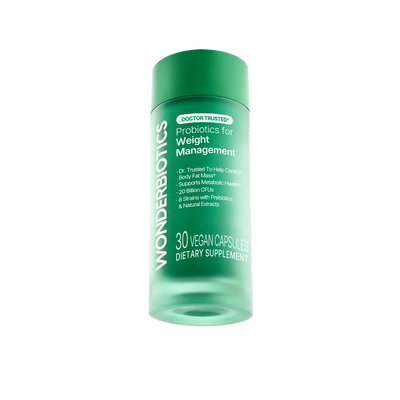
WONDERBIOTICS: Endpoint-Specific Evidence Map
WONDERBIOTICS was formulated with midlife women as the primary target population, with each ingredient selected for a defined endpoint role. The following maps each ingredient to its evidence tier.
B420™ (Bifidobacterium animalis subsp. lactis 420). Primary endpoint: body fat management and waist circumference. Evidence: 6-month RCT in overweight adults, post-hoc factorial analysis, ingredient-level. Population note: overweight adults aged 18-65, not menopause-specific. Dose: aligns with clinically studied range.
HN019 (Bifidobacterium animalis subsp. lactis HN019). Primary endpoint: gut comfort and regularity support. Evidence: multiple RCTs on gut transit and GI symptoms; most recent large RCT showed no significant difference in stool frequency vs. placebo but favored HN019 for abdominal pain. Role: GI comfort layer within the formula.
Eriomin® (lemon extract) and CraveLock™. Primary endpoint: satiety and appetite awareness via GLP-1 pathway. Evidence: ingredient-level clinical research on natural GLP-1 secretion. Mechanism: supports the gut hormone system involved in satiety and food intake regulation through nutritional means. Not a GLP-1 receptor agonist drug.
5X Dihydroberberine. Primary endpoint: blood sugar regulation and insulin sensitivity support. Evidence: ingredient-level metabolic data on a more bioavailable form of berberine. Relevant to the insulin resistance component of menopause weight management. Safety note: discuss with clinician if taking glucose-lowering medications.
WONDERBIOTICS uses PolarSeal Technology to protect the probiotic blend. In testing, 99.9% of the bacterial strain survived gut-like acidic conditions, and 98.2% of the bacteria remained alive through the point of consumption. CFU is guaranteed at expiration, not just at manufacture.
The key ingredients are backed by 624 clinical studies involving 44,692 participants at the ingredient level. The finished product has not been studied in a dedicated menopause-specific clinical trial. Each ingredient role is based on standalone clinical evidence, not on WONDERBIOTICS as a finished product.
We recommend 3-6 months of consistent use, to give your gut time to adapt, and your body time to respond, alongside adequate dietary protein, resistance training, and fiber-rich food intake.
Explore the WONDERBIOTICS formula.
This article is for educational purposes only and is not medical advice. It is not intended to diagnose, treat, cure, or prevent any disease. If you are experiencing menopausal symptoms, have a medical condition, or take medications, talk with a licensed clinician before making health changes or starting supplements.
Related reading: Probiotics for perimenopause weight gain — the evidence-based breakdown.
References
- Gofron KK, Wasilewski A, Małgorzewicz S. Effects of GLP-1 Analogues and Agonists on the Gut Microbiota: A Systematic Review. Nutrients. 2025;17(8):1303. https://pubmed.ncbi.nlm.nih.gov/40284168/
- Saadati S, Naseri K, Asbaghi O, Yousefi M, Golalipour E, de Courten B. Beneficial effects of the probiotics and synbiotics supplementation on anthropometric indices and body composition in adults: A systematic review and meta-analysis. Obes Rev. 2024;25(3):e13667. https://pubmed.ncbi.nlm.nih.gov/38030409/
- Mayo Clinic. Menopause weight gain: Stop the middle age spread. https://www.mayoclinic.org/healthy-lifestyle/womens-health/in-depth/menopause-weight-gain/art-20046058
- National Institutes of Health, Office of Dietary Supplements. Dietary Supplements for Weight Loss: Health Professional Fact Sheet. Updated 2024. https://ods.od.nih.gov/factsheets/WeightLoss-HealthProfessional/
- Stenman LK, Lehtinen MJ, Meland N, et al. Probiotic With or Without Fiber Controls Body Fat Mass, Associated With Serum Zonulin, in Overweight and Obese Adults-Randomized Controlled Trial. EBioMedicine. 2016;13:190-200. https://pubmed.ncbi.nlm.nih.gov/27810310/
- Uusitupa HM, Rasinkangas P, Lehtinen MJ, et al. Bifidobacterium animalis subsp. lactis 420 for Metabolic Health: Review of the Research. Nutrients. 2020;12(4):892. https://pmc.ncbi.nlm.nih.gov/articles/PMC7230722/


