
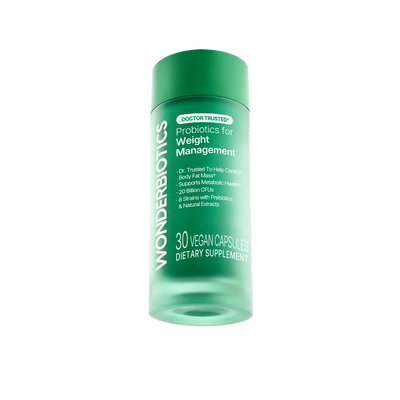


Menopause Weight Gain and Gut Health: Where Probiotics May Fit

Menopause Weight Gain and Gut Health: Where Probiotics May Fit
Menopause weight gain is one of the most frequently discussed topics in women's midlife health communities, and the pattern of what actually helps is remarkably consistent across clinical guidance and real-world experience. Protein, resistance training, sleep, and stress management form the backbone of any approach that works. Gut health is a supporting dimension that many women find meaningful but that does not replace the basics. This article explains the connection between gut health and menopause weight changes, where probiotics specifically fit, and how to think about supplementation without overstating what it can do.

What Actually Drives Menopause Weight Gain
Mayo Clinic describes menopause weight gain as driven by a cluster of interconnected factors: declining estrogen shifting fat toward the abdomen, muscle mass loss slowing metabolic rate, reduced physical activity, poor sleep increasing hunger hormones, and the general caloric needs of an aging body.1 Hormone replacement therapy, when appropriate, can help manage some of these through symptom relief and improved sleep quality, but it is not recommended as a weight loss treatment.2 A GLP-1 receptor agonist medication, prescribed for metabolic indications, addresses appetite and insulin sensitivity through pharmacological means but is a prescription drug, not a lifestyle supplement.
What works at the foundational level, consistently across clinical guidance and women's experience:
Adequate dietary protein (1.0-1.2 g/kg/day) to preserve muscle mass and support satiety. Resistance training at least twice a week to rebuild metabolic tissue. Dietary fiber to support gut health, blood sugar stability, and GI regularity. Sleep quality, which directly governs ghrelin and leptin, the hunger and fullness hormones. Stress management, because elevated cortisol drives abdominal fat storage independently of caloric intake.
These are not new recommendations. They are consistently supported by the evidence, they interact with each other, and none of them is substitutable.
The Gut Health Connection to Menopause Weight
The gut microbiome changes during the menopause transition through a pathway called the estrobolome: the collection of gut bacterial genes that metabolize estrogens. Changes in this microbial community may affect how efficiently estrogens are recycled into circulation, with downstream effects on fat distribution and metabolic function.
Separately, the gut microbiome influences insulin sensitivity, systemic inflammation, and appetite signaling through short-chain fatty acid production and GLP-1 secretion from intestinal L-cells. A gut environment with reduced microbial diversity, compromised barrier integrity, or altered fermentation patterns is associated with worse metabolic outcomes.
This is a real biological connection. What it does not support is the conclusion that taking a probiotic will cause weight loss in menopausal women. The evidence is mechanistic, indirect, and population-level, not validated in menopause-specific weight management trials.
What Probiotics Can and Cannot Do Here
Probiotics cannot replicate the effects of strength training on muscle mass or metabolic rate. They cannot reverse the hormonal drivers of visceral fat redistribution. They cannot substitute for adequate dietary protein or consistent sleep.
What specific strains may contribute is support for the gut environment that influences one layer of the metabolic picture: barrier integrity, fermentation-derived satiety signals, and the microbiome changes associated with midlife hormonal transition.
The strain with the most directly relevant human clinical evidence for body fat management is Bifidobacterium animalis subsp. lactis 420 (B420™). A 6-month double-blind RCT in 225 overweight adults found B420 associated with a 4.0% relative reduction in body fat mass vs. placebo and approximately 2.4 cm waist circumference reduction.3 These are ingredient-level findings in overweight adults, not menopause-specific. The endpoints are directly relevant to the menopause weight concern even though the population is not identical.
This is what "where probiotics may fit" actually looks like: a modest, gradual, gut-level contribution to the metabolic environment, working alongside the foundational approaches rather than instead of them.
Terms to Know!
- Estrobolome: The collection of gut bacterial genes capable of metabolizing estrogens, influencing their reabsorption into circulation. Changes in the estrobolome during perimenopause may contribute to the fat redistribution and metabolic shifts of the menopause transition.
- Short-chain fatty acids (SCFAs): Compounds produced when gut bacteria ferment dietary fiber, including butyrate, acetate, and propionate. SCFAs stimulate GLP-1 and peptide YY from intestinal cells, supporting satiety signaling and metabolic health.
What Women Report Helps (and Why It Aligns with the Evidence)
In community discussions about menopause weight management, the approaches women consistently describe as helpful match the clinical evidence closely: strength training, protein increase, reducing ultra-processed food, managing sleep, and often adding fiber. Many women also describe adding a probiotic or focusing on gut health as a meaningful part of their routine, particularly for managing bloating and regularity during the transition.
These experiences are consistent with what the evidence supports, even without formal clinical trials in menopausal women specifically for probiotics. They reflect the same mechanistic logic: support the gut environment, address appetite regulation, maintain muscle, and reduce the metabolic disruption driven by hormonal change.
How WONDERBIOTICS Fits This Picture
WONDERBIOTICS is designed as a non-hormonal gut-metabolic support supplement for midlife women. It is not HRT, not a GLP-1 drug, and not a weight loss guarantee. It supports the gut-metabolic layer of a weight management approach.
B420™ (Bifidobacterium animalis subsp. lactis 420): Ingredient-level evidence on body fat management and waist circumference in overweight adults. The formula's primary metabolic strain. Dose aligns with the clinically studied range; CFU guaranteed at expiration.
HN019 (Bifidobacterium animalis subsp. lactis HN019): Gut comfort and regularity support. Addresses the bloating and GI discomfort dimension of perimenopause.
Eriomin® and CraveLock™: Ingredient-level clinical research on natural GLP-1 secretion support. Supports appetite awareness and cravings management through a nutritional gut-hormone pathway, not pharmaceutical action.
5X Dihydroberberine: Supports healthy blood sugar levels already within the normal range. Addresses the insulin resistance component of midlife metabolic change. Note: discuss with your clinician if you take glucose-lowering medications.
WONDERBIOTICS uses PolarSeal Technology to protect the probiotic blend. In testing, 99.9% of the bacterial strain survived gut-like acidic conditions and 98.2% remained alive through the point of consumption. CFU is guaranteed at expiration.
The formula supports midlife metabolic wellness. It works best within a routine that includes the foundational elements above: protein, resistance training, fiber, and sleep. Alone, a probiotic supplement will not produce the changes that protein and resistance training produce. Together, it adds the gut-metabolic support layer that the foundational elements do not directly address.
We recommend 3-6 months of consistent use.
Read the WONDERBIOTICS Review for a full look at the formula.
This article is for educational purposes only and is not medical advice. It is not intended to diagnose, treat, cure, or prevent any disease. If you are experiencing menopausal symptoms or take medications, talk with a licensed clinician before starting supplements.
References
- Mayo Clinic. Menopause weight gain: Stop the middle age spread. https://www.mayoclinic.org/healthy-lifestyle/womens-health/in-depth/menopause-weight-gain/art-20046058
- Kapoor E, Collazo-Clavell ML, Faubion SS. Weight Gain in Women at Midlife: A Concise Review of the Pathophysiology and Strategies for Management. Mayo Clin Proc. 2017;92(10):1552-1558. https://pubmed.ncbi.nlm.nih.gov/28982486/
- Stenman LK, Lehtinen MJ, Meland N, et al. Probiotic With or Without Fiber Controls Body Fat Mass, Associated With Serum Zonulin, in Overweight and Obese Adults-Randomized Controlled Trial. EBioMedicine. 2016;13:190-200. https://pubmed.ncbi.nlm.nih.gov/27810310/


