


Best Menopause Supplements for Belly Fat and Bloating

Which Menopause Supplements Are Best for Belly Fat and Bloating Together?
Belly fat and bloating both show up around menopause, and both get rolled together under the label "menopause belly." They are two different problems with two different biological mechanisms, and a supplement that addresses one does not automatically address the other. Belly fat reflects a change in fat distribution driven by declining estrogen. Bloating reflects fluid retention, slowed gut motility, and shifts in gut sensitivity, also driven by hormonal change but through a different pathway. The honest question is which supplements have defensible evidence on either of these layers, and which are being marketed for an effect they were never studied on.
This article covers what changes mechanically at menopause for belly fat versus bloating, the supplement categories with the most defensible evidence on each, and the popular "menopause supplements" with weaker direct data than the labels suggest.

At a Glance
Belly fat and bloating respond to different supplement layers. No single product has strong direct evidence on both endpoints together, and the well-known "menopause supplements" (black cohosh, soy isoflavones) have their evidence in vasomotor symptoms rather than in belly fat or bloating.
The categories with the most relevant evidence by layer:
- For visceral and abdominal fat: targeted probiotic strains with body-fat-mass and waist-circumference outcomes
- For bloating linked to fluid retention: magnesium has some evidence on premenstrual fluid retention, with caveats
- For bloating linked to gut motility or IBS-type symptoms: certain probiotic strains have meta-analysis evidence on abdominal bloating, with formal guideline tension
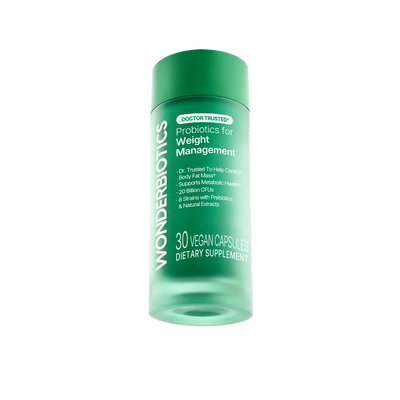
WONDERBIOTICS Probiotics for Weight Management uses B420™ as its named strain, with the published trial showing body fat mass and waist circumference effects in overweight and obese adults. It is not formulated as a menopause-specific product, and its evidence base is in general adult populations.
What Changes at Menopause for Belly Fat Versus Bloating
The two endpoints map onto different biology.
Belly fat: fat redistribution driven by declining estrogen
A 4-year longitudinal study in 156 initially premenopausal women, with annual measurements of fat distribution by computed tomography, reported that body fat and weight increased significantly only in women who transitioned to postmenopause during the study; women who remained premenopausal showed no comparable change.[1] Visceral adipose tissue (the fat surrounding internal organs) and abdominal subcutaneous fat both increased with menopause, alongside a measurable decrease in 24-hour energy expenditure. The pattern is consistent across multiple studies: estrogen decline shifts fat storage away from hips and thighs toward the abdomen, and resting energy expenditure drops, so the same eating pattern that maintained weight in the 30s no longer maintains it in the 50s.
The implication for supplements: anything claiming to address menopause belly fat needs evidence on body composition, waist circumference, or visceral fat mass. Vasomotor-symptom evidence does not transfer to fat distribution.
Bloating: fluid retention, slowed gut motility, and gut sensitivity
Estrogen and progesterone both influence the renin-angiotensin-aldosterone system, the body's main regulator of sodium and water balance. Progesterone has a high affinity for the mineralocorticoid receptor and competes with aldosterone, which is the mechanism by which it normally helps the kidneys release sodium and water. When estrogen and progesterone fluctuate or decline at menopause, this balance is disrupted, and the kidneys retain more sodium and water than they did pre-transition.[2] The same hormonal changes slow gastric and intestinal motility, which compounds the bloated feeling, and gut sensitivity often increases.
The implication for supplements: bloating evidence needs to come from trials measuring abdominal bloating or distension as an endpoint, not from trials measuring weight, hot flashes, or general PMS symptom scores.
Terms to Know!
- Visceral adipose tissue (VAT): the fat stored deep in the abdominal cavity around internal organs, distinct from subcutaneous fat under the skin; visceral fat is more metabolically active and more strongly linked to cardiovascular and metabolic risk than subcutaneous fat.
- Vasomotor symptoms: hot flashes, night sweats, and related thermoregulatory disturbances; the menopause symptoms that most popular "menopause supplements" have been studied for, distinct from belly fat or bloating endpoints.
Supplements With Defensible Evidence on Belly Fat
The probiotic literature offers the strongest non-prescription evidence on body composition at the strain level, though none of the cited trials selected for menopausal populations specifically.
B420™ (Bifidobacterium animalis subsp. lactis 420). A 6-month randomized, placebo-controlled trial in 225 overweight and obese adults aged 18-65 reported body fat mass differed by -4.0% versus placebo (P=0.002), waist circumference dropped 2.4 cm more than placebo, and daily energy intake was reduced by approximately 300 kcal compared to placebo (post-hoc factorial analysis).[3] The trial population was general overweight and obese adults, not a menopausal cohort, so the endpoints inform the rationale for inclusion in a weight-management formula and are not a direct demonstration in menopausal women specifically.
Strain specificity matters here. The international consensus statement on probiotics is explicit: probiotic effects are tied to specific strains and specific endpoints, and evidence from one strain does not transfer to another.[4] A formula that lists "Lactobacillus" without strain codes cannot be matched to the published evidence behind named strains like B420™.
Ingredient-level adjuncts. Ingredients with mechanistic relevance to menopausal metabolic shifts include Eriomin® (lemon extract), studied at the ingredient level for support of natural GLP-1 and adiponectin levels in prediabetic adults.[5] Both endpoints intersect with the appetite-and-metabolism biology that shifts at menopause; the evidence is ingredient-level in a specific population, not finished-product evidence in menopausal women.
Supplements With Defensible Evidence on Bloating
Bloating evidence sits in two camps, which can pull in opposite directions.
Magnesium for fluid-retention-related bloating. A 1998 double-blind, placebo-controlled, crossover trial in 38 women used 200 mg/day of magnesium oxide for two menstrual cycles, with symptoms grouped into six PMS categories including PMS-H (fluid retention). The trial reported significant reductions in PMS-H symptoms (weight gain, swelling of extremities, breast tenderness, abdominal bloating) in the second month of supplementation compared to placebo, with no significant effect on PMS-C (craving).[6] The population was women with PMS, not menopausal women, but the underlying fluid-retention biology is shared. The dose is modest, the safety profile is reasonable, and the evidence is directly on the bloating endpoint.
Targeted probiotic strains for IBS-type bloating. A 2023 systematic review and meta-analysis of randomized controlled trials in irritable bowel syndrome examined abdominal bloating or distension as a separate endpoint. Several specific strains and multistrain combinations showed efficacy on this endpoint, though the field has substantial heterogeneity across trials, and the analysis could not draw definitive recommendations on the best individual strain.[7] This is genuinely useful evidence for menopause bloating that has IBS-like features (gas, distension, motility-driven symptoms), with one important caveat: the American College of Gastroenterology 2021 IBS guideline issued a conditional recommendation against the use of probiotics for global IBS symptoms, citing very low overall quality of evidence.[8] The tension is real: the meta-analysis finds positive signals on the bloating-specific endpoint, while the formal clinical guideline is conservative on probiotics as a whole-IBS treatment. The honest reading is that probiotics may help bloating specifically while not being a guideline-recommended treatment for IBS overall.
Popular "Menopause Supplements" That Don't Have Belly Fat or Bloating Evidence
The supplements most strongly associated with the menopause-supplement category have their evidence elsewhere. Two examples worth reading past the marketing on.
Black cohosh (Cimicifuga racemosa). Studied for vasomotor symptoms (hot flashes, night sweats) and general menopausal symptom scores; the published clinical trial literature does not include belly fat, visceral fat, or abdominal bloating as primary endpoints in human studies. A systematic review of adverse events found no clear link between black cohosh and weight gain or body composition changes either direction. If hot flashes are the target, black cohosh has plausible evidence; for belly fat or bloating, it does not.
Soy isoflavones. Studied for vasomotor symptoms and bone density in postmenopausal women. The body composition evidence is mixed and primarily in animal models or in trials where body composition was a secondary endpoint with inconsistent results. The label proximity between "menopause support" and "menopause belly" obscures the fact that these are different evidence pools.
The pattern across both: a supplement with evidence on one menopause symptom is marketed as if it addresses all of them. A label that says "menopause support" should prompt the question of which specific symptom the cited evidence actually measured.
How to Evaluate a Menopause Supplement Label
A small set of questions cuts through most marketing in this category.
Which endpoint does the cited trial measure? Vasomotor symptoms, mood, sleep, bone density, body composition, fat distribution, and abdominal bloating are different endpoints with different evidence. A trial on hot flashes does not transfer to belly fat.
Was the trial in menopausal women, or in another population? Probiotic and ingredient trials are often in general overweight or obese adult populations. The biology overlaps with menopausal metabolic shifts but is not identical. The relevance of an adjacent-population trial depends on how close the mechanism is.
Are the marketed claims at the right level? A formula that addresses metabolic biology at the ingredient level may genuinely help with belly fat without having direct data on bloating, or vice versa. Stack the marketed claim against the endpoint the trial actually used.
Strain identity for probiotics. A label that names the strain (genus, species, strain code such as B420™ or HN019) is the prerequisite for matching evidence. An unnamed "Lactobacillus blend" cannot inherit the evidence behind specific strains.
How WONDERBIOTICS Fits This Picture
WONDERBIOTICS Probiotics for Weight Management was formulated around the role of the gut microbiome in metabolic health, with each named ingredient assigned a defined role.
- B420™ is the probiotic strain in the formula, and the published 6-month RCT in overweight/obese adults provides ingredient-level human evidence on body fat mass, waist circumference, and energy intake. The trial did not select for menopausal status, and the published endpoints do not include menopause-specific fluid retention or abdominal bloating. The available evidence is at the ingredient-level human evidence tier in a general adult population.
- Eriomin® (lemon extract) is a citrus flavonoid extract with ingredient-level RCT data on natural GLP-1 levels and adiponectin levels in prediabetic adults. Elevated GLP-1 is the same broad signaling category engaged by prescription GLP-1 receptor agonists, though the magnitude of effect from an oral flavonoid is much smaller. The evidence is ingredient-level in a specific population, not finished-product evidence in a menopausal cohort.
- Dihydroberberine is a modified version of berberine that achieves higher plasma berberine exposure at lower doses. It supports maintaining healthy blood sugar levels already within the normal range. Direct human evidence at the dihydroberberine level remains limited; its role here is to deliver berberine more effectively, with the active end-form remaining berberine in tissue.
The formula also features CraveLock™ Technology, a proprietary synergistic approach to appetite management and Food Noise.
WONDERBIOTICS uses PolarSeal Technology to help protect the probiotic blend. In testing, 99.9% of the bacterial strain survived gut-like acidic conditions, and 98.2% of the bacteria remained alive through to the point of consumption.
The core ingredients in the formula are backed by 624 clinical studies covering 44,692 participants. The formula was developed by PhD scientists and industry experts.
We recommend taking it consistently for 3-6 months alongside a balanced diet and regular movement, to give your gut time to adapt and your body time to respond. The timeline reflects how the underlying biology actually works.
FAQ
Can one supplement address both belly fat and bloating in menopause?
No single product has strong direct evidence on both endpoints together in a menopausal population. The biology of the two endpoints is different, and the best evidence for each comes from different supplement categories. A practical approach is to match the supplement to the more troubling endpoint, or to stack categories with awareness of what each is doing.
Will hormone replacement therapy work better than supplements?
For belly fat redistribution and fluid-retention-related bloating, hormone replacement therapy (HRT) directly addresses the underlying hormonal driver and has stronger evidence than any supplement in this category. HRT is a clinical decision with risks and benefits that need to be weighed with a clinician. Supplements are reasonable adjuncts; they are not equivalent to HRT in magnitude.
How long before I notice a difference?
Effects on metabolic biology unfold over weeks to months. The relevant trials ran from 8 weeks to 6 months. We recommend 3-6 months of consistent use to give your gut time to adapt and your body time to respond. Bloating responses may be visible sooner than body composition responses.
Match the Symptom, Read the Endpoint
Menopause belly is two problems wearing one label. The supplements with defensible evidence on belly fat sit in the body-composition literature; the supplements with defensible evidence on bloating sit in the fluid-retention and IBS-bloating literature. Stacking them requires knowing which is which, and a "menopause supplement" without endpoint specifics is doing the marketing work for both.
A probiotic formulated around a named strain with strain-level human evidence on body composition endpoints, paired with non-probiotic ingredients chosen for adjacent metabolic biology, is one defensible piece of a broader strategy. WONDERBIOTICS Probiotics for Weight Management is one option built on that logic.
References
- Lovejoy JC, Champagne CM, de Jonge L, Xie H, Smith SR. Increased visceral fat and decreased energy expenditure during the menopausal transition. Int J Obes (Lond). 2008;32(6):949-958. https://www.nature.com/articles/ijo200825
- Stachenfeld NS. Hormonal changes during menopause and the impact on fluid regulation. Reprod Sci. 2014;21(5):555-561. https://link.springer.com/article/10.1177/1933719113518992
- Stenman LK, Lehtinen MJ, Meland N, et al. Probiotic with or without fiber controls body fat mass, associated with serum zonulin, in overweight and obese adults: randomized controlled trial. EBioMedicine. 2016;13:190-200. https://www.sciencedirect.com/science/article/pii/S2352396416304972
- Hill C, Guarner F, Reid G, et al. Expert consensus document. The International Scientific Association for Probiotics and Prebiotics consensus statement on the scope and appropriate use of the term probiotic. Nat Rev Gastroenterol Hepatol. 2014;11(8):506-514. https://www.nature.com/articles/nrgastro.2014.66
- Ribeiro CB, Ramos FM, Manthey JA, Cesar TB. Effectiveness of Eriomin® in managing hyperglycemia and reversal of prediabetes condition: A double-blind, randomized, controlled study. Phytother Res. 2019;33(7):1921-1933. https://onlinelibrary.wiley.com/doi/10.1002/ptr.6386
- Walker AF, De Souza MC, Vickers MF, Abeyasekera S, Collins ML, Trinca LA. Magnesium supplementation alleviates premenstrual symptoms of fluid retention. J Womens Health. 1998;7(9):1157-1165. https://www.liebertpub.com/doi/10.1089/jwh.1998.7.1157
- Goodoory VC, Khasawneh M, Black CJ, Quigley EMM, Moayyedi P, Ford AC. Efficacy of probiotics in irritable bowel syndrome: systematic review and meta-analysis. Gastroenterology. 2023;165(5):1206-1218. https://www.sciencedirect.com/science/article/pii/S0016508523048382
- Lacy BE, Pimentel M, Brenner DM, et al. ACG Clinical Guideline: Management of Irritable Bowel Syndrome. Am J Gastroenterol. 2021;116(1):17-44. https://journals.lww.com/ajg/fulltext/2021/01000/acg_clinical_guideline__management_of_irritable.11.aspx


