


Best Supplements for Stubborn Menopause Belly Fat

What Are the Best Supplements for Stubborn Menopause Belly Fat?
The midlife belly that no longer responds to the strategies that worked at 35 has a real biological signature. Estrogen decline, visceral fat redistribution, shifts in insulin sensitivity, and changes in gut microbial composition all overlap in a way that makes "just eat less and move more" less effective than the same advice used to be. The supplement aisle's response to this experience is loud, and the evidence behind individual products is uneven.
This article maps the supplement categories that have published human evidence relevant to menopause belly fat, what the evidence actually shows, and how to read a label across categories. The "best" supplement is the one whose mechanism and trial evidence match the specific biology you are trying to engage.

The Gist
There is no single supplement clinically validated as a finished product for menopause belly fat specifically. The categories with relevant human RCT evidence in postmenopausal women, ranked by directness of body-composition effects:
- Protein at adequate intake plus resistance training: helps protect lean mass during weight loss, which keeps metabolic rate higher; "more is better" is not strongly supported
- Creatine combined with resistance training: improves lean tissue mass and strength in older women
- Soluble fiber (psyllium, glucomannan): meta-analysis evidence for body weight, BMI, and waist circumference reductions in overweight adults
- Targeted probiotics with strain-level data: significant effects on insulin, HOMA-IR, and inflammatory markers in postmenopausal women; body adiposity effects observed but not statistically significant in pooled analyses
- Vitamin D: improves glucose and insulin markers in postmenopausal women but does not reduce body weight, BMI, or waist circumference
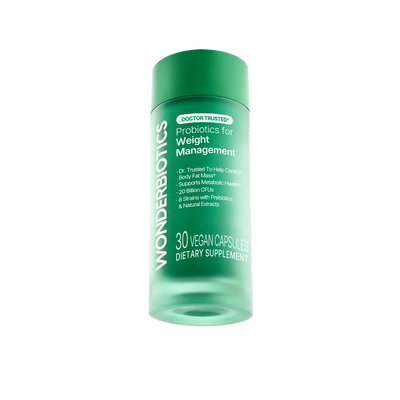
WONDERBIOTICS Probiotics for Weight Management is one option within the targeted-probiotic category.
Why Menopause Belly Fat Behaves Differently
Two biological shifts make midlife belly fat resistant to general weight-loss strategies.
Estrogen decline changes where fat is stored. As ovarian estrogen production falls during perimenopause and after the final menstrual period, fat distribution shifts from peripheral (hips, thighs) to central and visceral. Visceral fat is more metabolically active than subcutaneous fat and is associated with insulin resistance, low-grade inflammation, and shifts in appetite-related signaling. The fat itself is doing different things metabolically than the fat of a younger body.
The gut microbiome shifts during this transition. Population-scale research in a large cohort of Hispanic/Latino women showed that the postmenopausal gut microbiome is more similar to the male gut microbiome than to the premenopausal female microbiome, with reduced hormone-related metabolic potential.[1] This shift overlaps with declining estrogen and with the metabolic changes many women experience.
Layered on top of these, restriction-based dieting itself drives hormonal adaptations that increase hunger and decrease fullness signals, and these adaptations can persist for at least a year after weight loss.[2] The combination is a body that defends central fat more vigorously than it did a decade earlier.
Terms to Know!
- Sarcopenia: age-related loss of skeletal muscle mass, strength, and function; accelerates after menopause due to estrogen decline, and increases risk for both weight regain and physical impairment.
- Visceral adiposity: fat stored inside the abdominal cavity around internal organs, distinct from subcutaneous fat under the skin; more responsive to insulin sensitivity and inflammation than to total calorie balance alone.
Category-by-Category: What the Evidence Actually Shows
Protein at adequate intake (with resistance training)
Higher-than-RDA protein intake is often marketed as essential for postmenopausal weight management. The evidence for "higher is better" is weaker than the marketing suggests. In a randomized trial of postmenopausal women on a 10-week resistance training program, women consuming 1.2 g/kg/day of protein gained lean body mass equivalent to women consuming 0.8 g/kg/day (the RDA recommendation), with no significant difference between groups.[3] Both groups gained lean mass; adding more protein on top of training did not produce more lean mass.
The honest reading: adequate protein paired with resistance training matters, and the threshold for "adequate" in trained postmenopausal women may be lower than supplement marketing implies. Protein powder makes adequate intake easier to hit for many people; it is not pharmacologically active beyond that.
Creatine combined with resistance training
Creatine has the strongest evidence among muscle-supporting supplements in this population. A 2021 systematic review and meta-analysis examining creatine supplementation combined with resistance training in older females reported significant benefits on muscle strength and muscle mass compared to training alone.[4] The dose used in most trials is 3-5 g/day, and the benefit is most consistent in programs lasting at least 12-24 weeks.
The key qualifier: creatine does not reduce body fat or belly fat directly. Its mechanism is supporting the lean mass and strength gains from resistance training. By preserving and adding lean tissue, it can support the underlying metabolic rate that influences long-term fat balance, but it is not a fat-loss supplement in itself.
Soluble fiber (psyllium and glucomannan)
Both psyllium and glucomannan have published evidence relevant to body weight and waist circumference. A 2023 systematic review and meta-analysis of 6 RCTs (354 participants) reported that psyllium dosed before meals at an average of 10.8 g/day for an average of 4.8 months produced reductions of approximately 2.1 kg in body weight, 0.8 kg/m² in BMI, and 2.2 cm in waist circumference in overweight and obese populations.[5] The mechanism is mechanical: psyllium forms a viscous gel that increases chyme viscosity and slows nutrient absorption. The trials were not specifically in postmenopausal women, and the meta-analysis authors disclosed employment by the maker of a commercial psyllium product.
Glucomannan has an EFSA-authorized health claim for weight loss under specific use conditions: 3 g/day in three 1 g doses, taken with 1-2 glasses of water before meals, in the context of an energy-restricted diet, in overweight adults.[6] The mechanism is satiety through gel formation in the stomach.
Both categories work as meal-time aids supporting calorie reduction rather than as direct fat-burning agents.
Targeted probiotics with strain-level RCT data
This is the category where the evidence is real but specific to certain endpoints. A 2023 systematic review and meta-analysis covered 5 RCTs with 281 postmenopausal overweight or obese women. Compared with placebo, probiotic supplementation produced statistically significant reductions in fasting insulin, HOMA-IR, and TNF-α. Improvements in body adiposity and lipid profile were observed but did not reach statistical significance in the pooled analysis.[7] The plain reading: probiotics in postmenopausal women specifically show clearer evidence for metabolic and inflammatory markers than for body weight or fat mass at the meta-analysis level.
For the broader adult population, specific named strains have published RCT data on weight-related endpoints. B420™ (Bifidobacterium animalis subsp. lactis 420) was studied in a 6-month randomized, placebo-controlled trial in 225 overweight and obese adults aged 18-65, with post-hoc factorial analysis showing body fat mass differed by -4.0% versus placebo (P=0.002), waist circumference dropped by 2.4 cm more than placebo, and daily energy intake was reduced by approximately 300 kcal compared to placebo.[8] The trial enrolled general overweight/obese adults, not a postmenopausal-specific cohort, so the data sits at the ingredient-level human evidence tier rather than at a population-specific validation tier for menopause.
Vitamin D
Vitamin D is often grouped with menopause weight management because vitamin D deficiency is common in midlife and is associated with metabolic risk. The evidence on weight outcomes is more limited than the popular framing suggests. A meta-analysis of RCTs in postmenopausal women found that vitamin D supplementation produced significant reductions in fasting blood glucose, HOMA-IR, insulin, and HbA1c. The same analysis found that vitamin D was not associated with body mass index, body weight, or waist circumference in postmenopausal women.[9]
The honest reading: vitamin D supplementation may be appropriate for women with documented deficiency, and may improve glucose and insulin markers, but published evidence does not support framing it as a weight or belly-fat supplement specifically.
What "Best" Actually Means Here
The evidence does not crown a single supplement. The right question is: which biological lever is this supplement pulling, and how strongly does the evidence support that lever in the population I'm in?
Across these categories, the supplements worth considering share a few traits.
Mechanism transparency. The product should be able to tell you what biology it engages and through which named ingredient. Vague language about "supporting menopause weight" without an identified mechanism is a flag.
Human RCT evidence on a relevant endpoint. The endpoint that matters is the one closest to what you care about: lean mass, body weight, waist circumference, energy intake, insulin sensitivity, appetite ratings. A supplement studied for one endpoint cannot be assumed to work on another.
Named, identified ingredients for probiotics. Strain identifiers (such as B420™ or HN019) are the prerequisite for matching the product against human evidence. An anonymous lactobacillus blend is a category, not a formula.
Realistic expectations and time frames. None of these supplements produce rapid changes. Trial durations run 10-24 weeks at minimum, and effect sizes are modest even when statistically significant.
How WONDERBIOTICS Fits in the Probiotic Category
WONDERBIOTICS Probiotics for Weight Management is built around named ingredients with defined roles.
- B420™ is the probiotic strain in the formula, with the 6-month RCT in overweight/obese adults described above. The energy intake reduction (~300 kcal/day vs placebo) is the most appetite-relevant readout from that trial.
- Eriomin® (lemon extract) is a citrus flavonoid extract studied at the ingredient level. Clinical research in prediabetic adults reports support for natural GLP-1 levels and adiponectin levels, both of which intersect with appetite-related signaling.[10] These are ingredient-level results in a specific population, not finished-product results in WONDERBIOTICS users or in menopausal women specifically.
- Dihydroberberine is a modified version of berberine that achieves higher plasma berberine exposure at lower doses. It supports maintaining healthy blood sugar levels already within the normal range, which is relevant given the shifts in insulin sensitivity associated with menopause. Direct human evidence at the dihydroberberine level remains limited; its role here is to deliver berberine more effectively, with the active end-form remaining berberine in tissue.
The formula also features CraveLock™ Technology, a proprietary synergistic approach to appetite management and Food Noise.
WONDERBIOTICS uses PolarSeal Technology to help protect the probiotic blend. In testing, 99.9% of the bacterial strain survived gut-like acidic conditions, and 98.2% of the bacteria remained alive through to the point of consumption.
The core ingredients in the formula are backed by 624 clinical studies covering 44,692 participants. The formula was developed by PhD scientists and industry experts.
We recommend taking it consistently for 3-6 months alongside a balanced diet and regular movement, to give your gut time to adapt and your body time to respond. The timeline reflects how the underlying biology actually works.
FAQ
Can I stack creatine, protein, fiber, and a probiotic together?
The four categories work through different mechanisms (lean mass support, dietary adequacy, mechanical satiety, gut-microbiome-mediated signaling) and there is no known interaction that would make one cancel another. Practically, layering all four is a lot of products and a lot of dose-tracking. Most women find that picking one or two categories aligned with their primary issue is more sustainable than running the full stack.
Is there anything that works without exercise?
The supplements with the strongest evidence on body composition in this population (creatine, protein) work in combination with resistance training. The supplements with effects independent of structured training (fiber, probiotics) tend to produce smaller body-composition changes, with their evidence more often on metabolic or appetite-related markers than on belly fat directly.
How long until I see a change?
Trial durations across these categories run 10-24 weeks. We recommend at least 3-6 months of consistent use for any single supplement, paired with a balanced diet and regular movement. Rapid changes in either direction are not realistic with this biology.
Match the Mechanism, Not the Marketing
Stubborn menopause belly fat has multiple overlapping biological drivers, and no single supplement engages all of them. The strongest version of "best" is honest about which lever a given supplement pulls and how directly the evidence supports it. Protein with training preserves lean mass. Creatine with training adds lean mass and strength. Fiber supports satiety mechanically. Probiotics with named, strain-level evidence engage gut-microbiome-mediated metabolic and appetite signaling. Vitamin D improves glucose markers but does not reduce body weight in this population. The product worth your money is the one whose mechanism matches the lever you are trying to pull.
For gut-microbiome-mediated metabolic and appetite biology specifically, WONDERBIOTICS Probiotics for Weight Management is one option built on that logic.
References
- Peters BA, Lin J, Qi Q, et al. Menopause is associated with an altered gut microbiome and estrobolome, with implications for adverse cardiometabolic risk in the Hispanic Community Health Study/Study of Latinos. mSystems. 2022;7(3):e00273-22. https://journals.asm.org/doi/10.1128/msystems.00273-22
- Sumithran P, Prendergast LA, Delbridge E, et al. Long-term persistence of hormonal adaptations to weight loss. N Engl J Med. 2011;365(17):1597-1604. https://www.nejm.org/doi/full/10.1056/NEJMoa1105816
- Rossato LT, Nahas PC, de Branco FMS, et al. Higher protein intake does not improve lean mass gain when compared with RDA recommendation in postmenopausal women following resistance exercise protocol: a randomized clinical trial. Nutrients. 2017;9(9):1007. https://www.mdpi.com/2072-6643/9/9/1007
- dos Santos EEP, de Araújo RC, Candow DG, et al. Efficacy of creatine supplementation combined with resistance training on muscle strength and muscle mass in older females: a systematic review and meta-analysis. Nutrients. 2021;13(11):3757. https://www.mdpi.com/2072-6643/13/11/3757
- Pal S, Khossousi A, Binns C, et al. Psyllium is a natural nonfermented gel-forming fiber that is effective for weight loss: a comprehensive review and meta-analysis. J Am Assoc Nurse Pract. 2023;35(8):457-464. https://journals.lww.com/jaanp/fulltext/2023/08000/psyllium_is_a_natural_nonfermented_gel_forming.4.aspx
- EFSA Panel on Dietetic Products, Nutrition and Allergies (NDA). Scientific Opinion on the substantiation of health claims related to konjac mannan (glucomannan) and reduction of body weight. EFSA Journal. 2010;8(10):1798. https://efsa.onlinelibrary.wiley.com/doi/10.2903/j.efsa.2010.1798
- Li Z, Li Y, Pan B, et al. The effects of oral probiotic supplementation in postmenopausal women with overweight and obesity: a systematic review and meta-analysis of randomized controlled trials. Probiotics Antimicrob Proteins. 2023;15(6):1567-1582. https://link.springer.com/article/10.1007/s12602-022-10037-3
- Stenman LK, Lehtinen MJ, Meland N, et al. Probiotic with or without fiber controls body fat mass, associated with serum zonulin, in overweight and obese adults: randomized controlled trial. EBioMedicine. 2016;13:190-200. https://www.sciencedirect.com/science/article/pii/S2352396416304972
- Yao Y, Zhu L, He L, et al. The effects of vitamin D on markers of glucose and obesity in postmenopausal women: a meta-analysis of randomized controlled trials. Clin Ther. 2017;39(6):1264-1276.e4. https://www.sciencedirect.com/science/article/abs/pii/S0149291823002606
- Ribeiro CB, Ramos FM, Manthey JA, Cesar TB. Effectiveness of Eriomin® in managing hyperglycemia and reversal of prediabetes condition: A double-blind, randomized, controlled study. Phytother Res. 2019;33(7):1921-1933. https://onlinelibrary.wiley.com/doi/10.1002/ptr.6386


