


Best Probiotics for Women Trying to Lose Weight: What the Research Shows

What Are the Best Probiotics for Women Trying to Lose Weight?
If you're a woman searching for probiotics that might support weight loss, the honest place to
start is with the literature itself. Most published probiotic-and-weight-management RCTs enrolled mixed-sex populations and reported pooled results. One trial is the exception, and it matters. A 24-week study explicitly testing both sexes found the weight-loss effect concentrated in women, with no comparable signal in men. That single sex-stratified finding shapes most of what can honestly be said about probiotics specifically for women trying to lose weight.
This article covers the published evidence at the strain level, why mixed-sex trial data still matters here, and how to read a probiotic label when sex-specific data is limited.

Quick Answer
The strongest published RCT signal for probiotics and weight loss in women comes from a single 24-week trial.Mixed-sex trials in overweight and obese adults add context for B420 and other named strains. They do not isolate a women-specific effect.
The relevant strain landscape:
- Lactobacillus rhamnosus CGMCC1.3724 (LPR): published weight-loss signal concentrated in women, single trial
- Bifidobacterium animalis subsp. lactis B420: body fat mass, waist circumference, and energy intake in mixed-sex overweight/obese adults
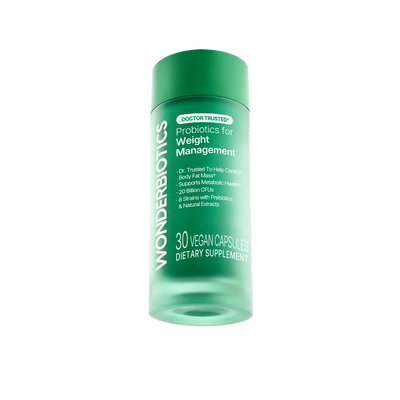
WONDERBIOTICS Probiotics for Weight Management uses B420™, a strain with mixed-sex RCT data on body composition. It is not marketed as women-specific.
Why the Question Has a Sex-Specific Answer
Probiotic effects are tied to specific strains, and evidence from one strain does not transfer to another.<sup>1</sup> Probiotic effects can also be tied to specific populations within a trial. When a randomized study reports an effect overall, the average can mask subgroup differences (men versus women, older versus younger, higher versus lower BMI). When a study specifically tests for sex-by-treatment interaction, that subgroup analysis becomes informative in its own right.
The category-level meta-analyses on probiotics for weight management have generally pooled men and women. A 2019 meta-analysis of 12 RCTs covering 821 overweight or obese adults reported modest pooled reductions of approximately -0.55 kg in body weight, -0.30 kg/m² in BMI, and -1.20 cm in waist circumference compared to placebo, with substantial heterogeneity across studies.<sup>2</sup> The meta-analysis did not perform a sex-stratified subanalysis. The pooled signal exists but does not isolate a women-specific effect.
The sex-specific evidence sits in a single 24-week RCT. That trial design and that finding carry most of the weight when the question is specifically about probiotics and weight loss in women.
Terms to Know!
- Sex-by-treatment interaction: in a clinical trial, a finding that the treatment effect differs significantly between men and women, often presented as an interaction P-value; when present, it indicates the overall pooled result may not represent either sex accurately.
- Subgroup analysis: a secondary analysis looking at how a treatment effect varies across pre-specified groups such as sex, age, or baseline BMI; subgroup findings are exploratory unless the trial was specifically powered to detect them.
The Strain With the Strongest Female-Specific RCT Signal
CGMCC1.3724 (LPR, Lactobacillus rhamnosus CGMCC1.3724). A 24-week double-blind, placebo-controlled trial in 125 obese adults paired probiotic capsules with energy restriction for the first 12 weeks and a maintenance phase for the next 12 weeks. Mean weight loss in women in the LPR group was significantly higher than in women in the placebo group (P=0.02) after the first 12 weeks. The effect persisted into the maintenance phase, with women in the LPR group continuing to lose body weight and fat mass while opposite changes occurred in the placebo group. No comparable effect was observed in men in either phase.<sup>3</sup>
The trial's authors noted associations between the women-specific weight loss and reductions in fat mass, circulating leptin, and shifts in the relative abundance of Lachnospiraceae family bacteria in stool. The mechanism behind why this strain produced an effect in women but not men is not definitively established. Hormonal modulation of gut microbiota response is one hypothesis the literature has discussed, though a 125-person single trial cannot resolve the mechanism on its own.
One trial is one trial. The CGMCC1.3724 finding has not been independently replicated in a comparably designed RCT focused on women. It remains the strongest published signal in this specific question and should be read with that caveat.
The Strain Most Studied in Mixed-Sex Adult Populations
B420™ (Bifidobacterium animalis subsp. lactis 420). A 6-month randomized, placebo-controlled trial enrolled 225 overweight and obese adults aged 18-65, with post-hoc factorial analysis showing body fat mass differed by -4.0% versus placebo (P=0.002), waist circumference dropped by 2.4 cm more than placebo, and daily energy intake was reduced by approximately 300 kcal compared to placebo.<sup>4</sup> The trial enrolled both sexes and did not report a sex-by-treatment interaction as a primary or pre-specified secondary analysis. The published findings, therefore, apply to the trial population as a whole, including the women within it.
For women considering a probiotic backed by mixed-sex weight-endpoint data, B420™ has the most established profile on body composition outcomes (body fat mass, waist circumference) and energy intake. These endpoints are directly relevant to weight loss, while remaining distinct from the weight-loss endpoint Sanchez et al. measured.
Beyond the Strain: Other Factors That Influence Weight Loss in Women
Probiotics are one input among many. The literature, the lived experience of weight management, and basic physiology all converge on the same point: a probiotic can support specific endpoints, while the larger context of food intake, sleep, movement, and stress regulation remains decisive.
Sleep and circadian regularity. Sleep restriction influences appetite hormones and food choices in both sexes, and sleep patterns frequently shift with the menstrual cycle and across reproductive life stages.
Stress and cortisol. Chronic stress affects appetite, food preferences, and central fat distribution. Stress-management practices alongside any supplement strategy reach a different layer of biology than what a probiotic can engage.
Hormonal life stage. Probiotics for general weight management are different in framing from probiotics considered alongside perimenopause or menopause, where additional metabolic shifts come into play. The evidence relevant to those scenarios is its own conversation.
Iron and other nutrient status. Women who menstruate have different iron requirements than men, and weight-loss diets that drop overall food volume can compound nutrient gaps. None of this is probiotic-specific, though a complete picture of weight-loss support has to acknowledge it.
How WONDERBIOTICS Fits This Picture
WONDERBIOTICS Probiotics for Weight Management uses named ingredients with defined roles. It is formulated for adult use and is not specifically marketed to women.
- B420™ is the probiotic strain in the formula, with the published 6-month RCT in overweight/obese adults (described above) as the ingredient-level evidence behind its inclusion.<sup>4</sup> The trial enrolled both sexes; the finding applies to the trial population overall, including the women in it. WONDERBIOTICS does not claim B420™ as women-specific.
- Eriomin® (lemon extract) is a citrus flavonoid extract studied for its effects on appetite-related signaling. Ingredient-level clinical research in prediabetic adults reports support for natural GLP-1 levels and adiponectin levels.<sup>5</sup> The cited research enrolled prediabetic adults of both sexes, not a women-specific population.
- Dihydroberberine is a modified version of berberine that achieves higher plasma berberine exposure at lower doses. It supports maintaining healthy blood sugar levels already within the normal range. Direct human evidence at the dihydroberberine level remains limited; its role here is to deliver berberine more effectively, with the active end-form remaining berberine in tissue.
The formula also features CraveLock™ Technology, a proprietary synergistic approach to appetite management and Food Noise.
WONDERBIOTICS uses PolarSeal Technology to help protect the probiotic blend. In testing, 99.9% of the bacterial strain survived gut-like acidic conditions, and 98.2% of the bacteria remained alive through to the point of consumption.
The core ingredients in the formula are backed by 624 clinical studies covering 44,692 participants. The formula was developed by PhD scientists and industry experts.
We recommend taking it consistently for 3-6 months alongside a balanced diet and regular movement, to give your gut time to adapt and your body time to respond. The timeline reflects how the underlying biology actually works.
FAQ
Should I look for a probiotic specifically marketed to women?
Marketing labels and weight-loss RCT evidence are different things. Probiotics marketed to women often emphasize urinary or vaginal-microbiome strains rather than weight-related ones. Look at the named strains on the label, then check whether any of those strains have human RCT data on weight-related endpoints. The marketing target population and the studied population are separate questions.
Why did one trial show weight-loss effects in women but not in men?
The mechanism is not definitively established. The Sanchez et al. trial proposed possible roles for hormonal modulation and shifts in gut microbiota composition, though the finding has not been independently replicated in a similarly designed RCT focused on women. The honest reading is: the published positive signal is real and is in women, with the mechanism still under investigation.
What about pregnancy or breastfeeding?
Probiotic supplements during pregnancy or breastfeeding sit outside the scope of weight-loss research and have their own safety considerations. If you are pregnant, breastfeeding, or planning either, talk with your clinician before starting any supplement.
Read the Strain, Not the Marketing
The strongest published evidence on probiotics and weight loss specifically in women rests on a single 24-week RCT of one strain. Mixed-sex trials add context, while not isolating a women-specific effect. "Best for women" as a marketing category does not map onto "weight-relevant strain studied in women" as an evidence category.
A probiotic formulated around a strain with strain-level RCT data on weight-relevant endpoints, with delivery technology that protects live cultures, is what evidence-backed looks like for adult use, regardless of sex. WONDERBIOTICS Probiotics for Weight Management is one such option.
This article is for educational purposes only and is not medical advice. It is not intended to diagnose, treat, cure, or prevent any disease. If you have symptoms, a medical condition, are pregnant or breastfeeding, or take medications, talk with a licensed clinician before making health changes or starting supplements.
References
- Hill C, Guarner F, Reid G, et al. Expert consensus document. The International Scientific Association for Probiotics and Prebiotics consensus statement on the scope and appropriate use of the term probiotic. Nat Rev Gastroenterol Hepatol. 2014;11(8):506-514. https://www.nature.com/articles/nrgastro.2014.66
- Wang ZB, Xin SS, Ding LN, et al. The potential role of probiotics in controlling overweight/obesity and associated metabolic parameters in adults: a systematic review and meta-analysis. Evid Based Complement Alternat Med. 2019;2019:3862971. https://onlinelibrary.wiley.com/doi/10.1155/2019/3862971
- Sanchez M, Darimont C, Drapeau V, et al. Effect of Lactobacillus rhamnosus CGMCC1.3724 supplementation on weight loss and maintenance in obese men and women. Br J Nutr. 2014;111(8):1507-1519. https://www.cambridge.org/core/journals/british-journal-of-nutrition/article/effect-of-lactobacillus-rhamnosus-cgmcc13724-supplementation-on-weight-loss-and-maintenance-in-obese-men-and-women/7C9810D79528C4ADC77A22EE45F9CA8E
- Stenman LK, Lehtinen MJ, Meland N, et al. Probiotic with or without fiber controls body fat mass, associated with serum zonulin, in overweight and obese adults: randomized controlled trial. EBioMedicine. 2016;13:190-200. https://www.sciencedirect.com/science/article/pii/S2352396416304972
- Ribeiro CB, Ramos FM, Manthey JA, Cesar TB. Effectiveness of Eriomin® in managing hyperglycemia and reversal of prediabetes condition: A double-blind, randomized, controlled study. Phytother Res. 2019;33(7):1921-1933. https://onlinelibrary.wiley.com/doi/10.1002/ptr.6386


