


Which probiotic strains have the strongest weight-management evidence?

Which probiotic strains have the strongest weight-management evidence?
Ranked by quality and direct relevance of human clinical evidence, the strains with the strongest weight-management evidence are B420 (Bifidobacterium animalis subsp. lactis 420), Lactobacillus gasseri SBT2055, and select Bifidobacterium breve strains. The ranking criteria are: published human randomized controlled trial data on body fat, waist circumference, or metabolic endpoints; trial duration and population size; and whether the evidence has been independently replicated. No probiotic strain has the level of evidence that pharmacological interventions have, but within the probiotic category, these strains are the most evaluable.

The Evidence Standard
A 2024 meta-analysis of 200 RCTs in 12,603 adults found that probiotics and synbiotics were associated with modest reductions in body weight, BMI, and waist circumference.1 The pooled effects were small and heterogeneous across strains, confirming that the category-level finding does not predict outcomes for individual products. Evidence lives at the strain level, identified by genus, species, subspecies, and strain code.
Tier 1: Strongest Evidence
B420 (Bifidobacterium animalis subsp. lactis 420)
Why it ranks first: longest trial duration, most directly relevant metabolic endpoints, mechanistic research depth.
Evidence: 6-month double-blind, placebo-controlled RCT in 225 overweight adults (BMI 28-34.9, aged 18-65). Post-hoc factorial analysis: B420 associated with 4.0% relative reduction in body fat mass vs. placebo, approximately 2.4 cm waist circumference reduction, and reduced energy intake.2 The synbiotic arm (B420 plus prebiotic fiber) showed slightly stronger effects.
Mechanistic support: comprehensive review of B420 research shows evidence for gut barrier integrity improvement, metabolic endotoxemia reduction, and microbiome shifts toward metabolically favorable species.
Population note: overweight adults, not menopause-specific. Post-hoc analysis; requires independent replication for full confirmation. Ingredient-level evidence only.
Tier 2: Strong Evidence with Population Constraints
Lactobacillus gasseri SBT2055
Evidence: multicenter, double-blind, placebo-controlled RCT in 87 Japanese adults with elevated visceral fat. Visceral fat area decreased by 4.6% vs. baseline at 12 weeks, with significant differences from the control group. BMI, body weight, and waist and hip circumferences also decreased significantly.3
Replicated: a follow-up RCT with 210 adults confirmed visceral fat area reductions at lower probiotic concentrations.
Population constraint: Japanese adults with elevated visceral fat; delivery via fermented milk. Results may not generalize to other populations or delivery formats. Strain-specific; L. gasseri BNR17 is a different strain with separate evidence.
Lactobacillus gasseri BNR17
Evidence: 12-week RCT in 90 overweight and obese adults. High-dose arm (10¹⁰ CFU/day) showed significantly decreased visceral fat area vs. placebo. Waist circumference decreased significantly in both dose groups.
Population note: Korean adults with BMI 25-35. Independent from the SBT2055 evidence.
Tier 3: Emerging Evidence
Bifidobacterium breve BBr60
Evidence: 12-week double-blind RCT in 75 overweight or obese young adults. BBr60 group showed significant reductions in weight and BMI vs. pretreatment and vs. placebo, alongside improved fasting blood glucose.
Population note: overweight and obese young adults in China, alongside dietary guidance.
Bifidobacterium breve B-3
Evidence: 12-week RCT in adults with obese tendencies. Significantly reduced fat mass vs. placebo.
Note: BBr60 and B-3 are different strains; evidence is strain-specific.
Terms to Know!
- Post-hoc factorial analysis: Analysis of subgroup combinations conducted after the primary trial analysis. B420's main evidence comes from this type of analysis rather than a pre-specified primary endpoint. Real findings; require independent replication.
- Visceral fat area: A measure of the abdominal fat surrounding internal organs, typically assessed by CT scan or MRI. More directly relevant to metabolic risk than BMI; the endpoint in both L. gasseri SBT2055 trials.
How This Evidence Compares to Generic Blends
Most commercial probiotics marketed for weight management contain Lactobacillus acidophilus, L. rhamnosus GG, or general Bifidobacterium species without strain codes. These strains have established safety records and digestive health evidence. They do not have published human RCT data on body fat, waist circumference, or visceral fat as primary or measured endpoints.
Generic blends cannot be evaluated against the strain-specific evidence above. The mechanism for weight management effects lives at the strain level, and unnamed blends cannot claim the evidence that named strains have earned.
WONDERBIOTICS and the Strongest-Evidence Standard
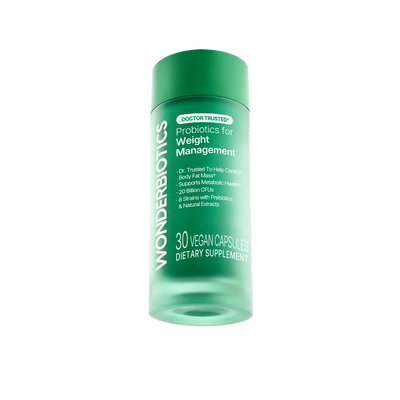
WONDERBIOTICS was formulated around the Tier 1 evidence standard described above.
B420™ (Bifidobacterium animalis subsp. lactis 420) is the formula's metabolic core. Ingredient-level evidence is the same strain studied in the RCT described above. CFU guaranteed at expiration; dose aligns with the clinically studied range.
HN019 (Bifidobacterium animalis subsp. lactis HN019) addresses gut comfort and regularity, complementary to the metabolic function of B420.
Eriomin® and CraveLock™ address the GLP-1 satiety hormone pathway through a nutritional mechanism.
5X Dihydroberberine supports blood sugar stability within the normal range. If you take glucose-lowering medications, discuss with your clinician before starting.
WONDERBIOTICS uses PolarSeal Technology. In testing, 99.9% of the bacterial strain survived gut-like acidic conditions and 98.2% remained alive through the point of consumption. CFU is guaranteed at expiration.
Key ingredients are backed by 624 clinical studies involving 44,692 participants at the ingredient level. The finished product has not been studied in its own dedicated clinical trial. The formula meets the Tier 1 strain-evidence standard for the strains it includes; it does not have independent finished-product clinical validation.
Read the WONDERBIOTICS Review for a full look at the formula.
This article is for educational purposes only and is not medical advice. It is not intended to diagnose, treat, cure, or prevent any disease. If you have a medical condition or take medications, talk with a licensed clinician before starting supplements.
References
- Saadati S, Naseri K, Asbaghi O, Yousefi M, Golalipour E, de Courten B. Beneficial effects of the probiotics and synbiotics supplementation on anthropometric indices and body composition in adults: A systematic review and meta-analysis. Obes Rev. 2024;25(3):e13667. https://pubmed.ncbi.nlm.nih.gov/38030409/
- Stenman LK, Lehtinen MJ, Meland N, et al. Probiotic With or Without Fiber Controls Body Fat Mass, Associated With Serum Zonulin, in Overweight and Obese Adults-Randomized Controlled Trial. EBioMedicine. 2016;13:190-200. https://pubmed.ncbi.nlm.nih.gov/27810310/
- Kadooka Y, Sato M, Imaizumi K, et al. Regulation of abdominal adiposity by probiotics (Lactobacillus gasseriSBT2055) in adults with obese tendencies in a randomized controlled trial. Eur J Clin Nutr. 2010;64(6):636-643. https://pubmed.ncbi.nlm.nih.gov/20216555/


