


Supplements for Constant Hunger and Cravings

Which Supplements Help With Constant Hunger and Cravings?
If you're hungry between meals, distracted by food thoughts, and feeling like willpower alone is not enough, that experience is biology, not weakness. Constant hunger and persistent cravings sit at the intersection of appetite hormones, blood sugar variability, gut microbial signaling, and the body's defense of its energy stores. The supplement aisle answers this experience with dozens of products. Most of them are not backed by direct human evidence on the endpoints they advertise.
This article covers which supplement categories have published human evidence on hunger or cravings, what the evidence actually shows, and how to evaluate any product whose label promises appetite control.

Up Front
No single supplement will reliably eliminate constant hunger. The categories with relevant human trial evidence:
- Soluble fiber (glucomannan): EFSA-authorized weight-loss health claim under specific conditions
- 5-HTP: small, older RCTs in obese adults showing reduced energy intake and weight loss
- Berberine: meta-analyses show modest, mixed effects on body weight, BMI, and waist circumference
- Targeted probiotics with strain-level data: category-level meta-analysis shows favorable effects on leptin and adiponectin, with mixed effects on subjective desire to eat
- Adequate protein: makes meals more filling and supports lean mass during weight loss
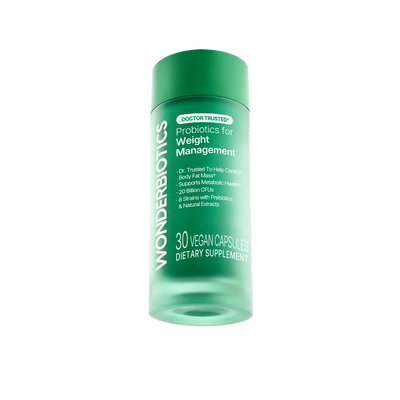
WONDERBIOTICS Probiotics for Weight Management is one option within the targeted-probiotic category, paired with non-probiotic ingredients chosen for appetite-related signaling.
Why Hunger Doesn't Quiet Down With Willpower
The biology that drives constant hunger is real and persistent. When energy intake drops, the body responds with coordinated hormonal adjustments that defend its energy stores. Hunger hormones (like ghrelin) rise, fullness signals (like leptin) fade, and the felt experience of hunger intensifies. In a one-year follow-up study of obese adults who lost weight on a structured program, these hormonal adaptations persisted at 52 weeks, well after weight loss ended.1 The body keeps signaling hunger long after a person stops actively dieting.
Cravings layer onto this baseline. Persistent thoughts about food, sometimes called Food Noise, often run in parallel with hunger but are not the same thing. Hunger is a stomach-level signal that can usually be addressed by eating. Cravings are a signaling-level phenomenon driven by the gut-brain axis, appetite hormones, and the brain's reward circuits, and they can persist even after a full meal.
Supplements that address hunger and cravings work on different layers. A fiber supplement works mechanically at the stomach level. A probiotic engages microbiome-mediated signaling. 5-HTP and berberine work on different metabolic pathways. The question is not "which supplement is best" in general; it is "which biological layer am I trying to engage."
Terms to Know!
- Ghrelin: the primary hunger hormone, produced mainly in the stomach; rises before meals and during energy restriction, signaling the brain to eat.
- Leptin: a hormone produced by fat cells that signals satiety to the brain; circulating levels drop during weight loss, contributing to persistent hunger even after weight stabilizes.
Supplement Categories With Human Trial Evidence
Soluble fiber (glucomannan and similar)
Glucomannan is a soluble fiber from konjac root that forms a viscous gel in the stomach, slowing gastric emptying and increasing satiety. It has an EFSA-authorized health claim for weight loss under specific use conditions: 3 g/day in three 1 g doses, taken with 1-2 glasses of water before meals, in the context of an energy-restricted diet, in overweight adults.2
The mechanism is mechanical: gel formation in the stomach. The effect is on meal-time fullness rather than on the brain's appetite signaling layer. Practical limitations include the need to take it before each meal with adequate water, and the requirement that an energy-restricted diet provides the actual calorie deficit.
5-HTP (5-hydroxytryptophan)
Important caveats: the supporting evidence sits in small, older trials with sample sizes under 25 per arm; the doses studied (typically 750-900 mg/day) are higher than commonly sold consumer doses; and 5-HTP cannot be combined with SSRIs or other serotonergic medications because of serotonin syndrome risk. The evidence base is real but limited, and the safety considerations are significant.
Berberine
Berberine is a plant alkaloid with effects on glucose and lipid metabolism. A 2020 systematic review and meta-analysis of 12 RCTs found that berberine supplementation produced a modest but statistically significant reduction in body weight (weighted mean difference -2.07 kg), BMI (-0.47 kg/m²), and waist circumference (-1.08 cm) compared to controls.[4] Doses studied were typically 1000-1500 mg/day, in trials lasting 8-24 weeks.
The honest reading: other meta-analyses on the same supplement have produced mixed results, with some finding no significant effect on body weight at all. Berberine works primarily through metabolic pathways (insulin sensitivity, AMPK activation) rather than as a direct appetite suppressant. The effect on cravings specifically has not been a primary endpoint in most published trials.
Dihydroberberine is a modified version of berberine that achieves higher plasma berberine exposure at lower doses, with the active end-form remaining berberine in tissue. Direct human evidence at the dihydroberberine level remains limited.
Targeted probiotics with strain-level data
Probiotic strains can engage appetite-related signaling through gut-microbiome-mediated pathways. A 2023 meta-analysis of 26 RCTs covering 1,536 participants found that probiotic and synbiotic supplementation produced a significant decrease in serum leptin (standardized mean difference -0.38) and a trending increase in adiponectin levels. The same meta-analysis found a slight statistically significant increase in self-reported desire to eat at the category level (SMD 0.34, P=0.030).[5]
The honest reading: hormonal markers move in a direction associated with better appetite regulation, while subjective desire to eat moves slightly in the opposite direction at the category level. Heterogeneity across trials was substantial. The category-level data smooths out what individual strain trials show more clearly, which is why strain-level evidence matters more than the broad "probiotics" label.
Among named strains, B420™ (Bifidobacterium animalis subsp. lactis 420) has the most appetite-relevant direct readout: in a 6-month RCT in 225 overweight and obese adults, daily energy intake in the B420™ group was reduced by approximately 300 kcal compared to placebo.[6] Energy intake reduction is a behavioral marker of altered appetite signaling, and reflects participants spontaneously eating less without a prescribed calorie target.
Adequate protein and other foundations
Two practical foundations sit upstream of any supplement decision. Adequate protein at each meal increases meal-time fullness and supports lean mass during weight loss. Stable blood sugar (achievable through balanced meals, adequate fiber, and avoiding long gaps between eating) reduces hunger spikes. No supplement substitutes for these foundations; supplements that work tend to layer on top of them.
How to Evaluate Any Appetite Supplement
Four traits separate supplements worth considering from generic blends.
Named active ingredient. The label discloses the specific compound or named strain. For probiotics, this means strain identifiers (B420™, HN019). For botanicals, this means standardized extracts at studied doses.
Human RCT evidence on a relevant endpoint. The endpoint that matters is the one closest to what you care about: subjective hunger ratings, food craving frequency, energy intake, body weight. A supplement studied for one endpoint cannot be assumed to work on another.
Mechanism transparency. The product should be able to tell you what biology it engages and through which ingredient. Vague language about "appetite support" without an identified mechanism is a flag.
Realistic time frames. Effects on appetite biology unfold over weeks to months. Trials in this space typically run 8-24 weeks. A supplement promising rapid appetite changes is not matched to how the biology actually works.
How WONDERBIOTICS Fits This Picture
WONDERBIOTICS Probiotics for Weight Management is built around named ingredients each with a defined role in appetite and metabolic biology.
- B420™ is the probiotic strain in the formula. The 6-month RCT described above showed body fat mass differing by -4.0% versus placebo (P=0.002), waist circumference 2.4 cm lower than placebo, and daily energy intake reduced by approximately 300 kcal. The trial enrolled general overweight/obese adults, so the data sits at the ingredient-level human evidence tier rather than at a finished-product validation tier.
- Eriomin® (lemon extract) is a citrus flavonoid extract studied for its effects on appetite-related signaling. Ingredient-level clinical research in prediabetic adults reports support for natural GLP-1 levels and adiponectin levels, both of which intersect with appetite biology.[7] These are ingredient-level results in a specific population, not finished-product results in WONDERBIOTICS users.
- Dihydroberberine is a modified version of berberine that achieves higher plasma berberine exposure at lower doses, with the active end-form remaining berberine in tissue. It supports maintaining healthy blood sugar levels already within the normal range, which intersects with the blood-sugar-stability layer of appetite control.
The formula also features CraveLock™ Technology, a proprietary synergistic approach to appetite management and Food Noise.
WONDERBIOTICS uses PolarSeal Technology to help protect the probiotic blend. In testing, 99.9% of the bacterial strain survived gut-like acidic conditions, and 98.2% of the bacteria remained alive through to the point of consumption.
The core ingredients in the formula are backed by 624 clinical studies covering 44,692 participants. The formula was developed by PhD scientists and industry experts.
We recommend taking it consistently for 3-6 months alongside a balanced diet and regular movement, to give your gut time to adapt and your body time to respond. The timeline reflects how the underlying biology actually works.
FAQ
Can I take 5-HTP and a probiotic together?
The two work through different mechanisms (serotonin precursor versus gut-microbiome-mediated signaling) with no known direct interaction. The bigger concern with 5-HTP is its interaction with SSRIs, SNRIs, MAOIs, and other serotonergic medications because of serotonin syndrome risk. Talk with your clinician before combining 5-HTP with anything that affects serotonin signaling.
Which one works fastest?
None of these supplements produce rapid changes. The biology behind hunger and cravings unfolds over weeks. Trials in this space typically run 8-24 weeks at minimum. We recommend at least 3-6 months of consistent use for any single supplement to give the body time to respond.
Is willpower really the wrong frame?
Hunger that persists despite a good diet, and cravings that survive a full meal, are signals from biology that is doing what it was designed to do. Willpower has limits because the underlying drive is hormonal, not motivational. Supplements that engage the relevant biology can support behavioral effort; they don't replace it.
Match the Biology, Read the Evidence Honestly
Constant hunger and cravings are real biological experiences with overlapping drivers. No single supplement engages all of them. The strongest version of "what helps" is honest about which biological lever a given supplement pulls and how directly the evidence supports it. Soluble fiber adds mechanical satiety. 5-HTP engages serotonergic appetite signaling (with safety considerations). Berberine engages metabolic pathways with modest, mixed evidence on body composition. Targeted probiotics engage gut-microbiome-mediated appetite signaling. Adequate protein and stable blood sugar sit upstream of all of these.
A probiotic formulated around a strain with strain-level human evidence on energy intake, paired with non-probiotic ingredients chosen for adjacent appetite biology, is one honest option built on the gut-microbiome layer. WONDERBIOTICS Probiotics for Weight Management is built on that logic.
References
- Sumithran P, Prendergast LA, Delbridge E, et al. Long-term persistence of hormonal adaptations to weight loss. N Engl J Med. 2011;365(17):1597-1604. https://www.nejm.org/doi/full/10.1056/NEJMoa1105816
- EFSA Panel on Dietetic Products, Nutrition and Allergies (NDA). Scientific Opinion on the substantiation of health claims related to konjac mannan (glucomannan) and reduction of body weight. EFSA Journal. 2010;8(10):1798. https://efsa.onlinelibrary.wiley.com/doi/10.2903/j.efsa.2010.1798
- Cangiano C, Ceci F, Cascino A, et al. Eating behavior and adherence to dietary prescriptions in obese adult subjects treated with 5-hydroxytryptophan. Am J Clin Nutr. 1992;56(5):863-867. https://academic.oup.com/ajcn/article-abstract/56/5/863/4715513
- Asbaghi O, Ghanbari N, Shekari M, et al. The effect of berberine supplementation on obesity parameters, inflammation and liver function enzymes: a systematic review and meta-analysis of randomized controlled trials. Clin Nutr ESPEN. 2020;38:43-49. https://www.sciencedirect.com/science/article/abs/pii/S2405457720300802
- Noormohammadi M, Ghorbani Z, Löber U, et al. The effect of probiotic and synbiotic supplementation on appetite-regulating hormones and desire to eat: a systematic review and meta-analysis of clinical trials. Pharmacol Res. 2023;187:106614. https://www.sciencedirect.com/science/article/pii/S1043661822005606
- Stenman LK, Lehtinen MJ, Meland N, et al. Probiotic with or without fiber controls body fat mass, associated with serum zonulin, in overweight and obese adults: randomized controlled trial. EBioMedicine. 2016;13:190-200. https://www.sciencedirect.com/science/article/pii/S2352396416304972
- Ribeiro CB, Ramos FM, Manthey JA, Cesar TB. Effectiveness of Eriomin® in managing hyperglycemia and reversal of prediabetes condition: A double-blind, randomized, controlled study. Phytother Res. 2019;33(7):1921-1933. https://onlinelibrary.wiley.com/doi/10.1002/ptr.6386


