


Can Probiotics Help with Menopause Belly Fat, Bloating, and Metabolism?

Can Probiotics Help with Menopause Belly Fat, Bloating, and Metabolism?
The answer is different for each of these three things. For belly fat, some strains have modest human RCT evidence on body fat and waist circumference; for bloating, specific probiotic and synbiotic products have clinical trial data on GI symptoms; for metabolism, the evidence is emerging and indirect. None of these constitutes a proven treatment for menopause-specific symptoms, but the mechanisms are real and the strains matter.

Belly Fat During Menopause: What Probiotics Can Contribute
Menopause belly fat is driven by declining estrogen shifting fat storage toward the abdomen, insulin resistance increasing, muscle mass declining, and sleep disruption amplifying appetite. Probiotics address a narrow slice of this picture: the gut microbiome layer that influences metabolic endotoxemia, insulin sensitivity, and energy intake.
The strain with the most directly relevant human RCT data is Bifidobacterium animalis subsp. lactis 420 (B420™). A 6-month double-blind RCT in 225 overweight adults found B420 associated with a 4.0% relative reduction in body fat mass vs. placebo, approximately 2.4 cm waist circumference reduction, and reduced energy intake in a post-hoc factorial analysis.1 These are ingredient-level findings in a mixed-sex overweight adult population, not specifically menopausal women.
Lactobacillus gasseri SBT2055 has separate RCT evidence for visceral fat reduction in Japanese adults with elevated visceral fat over 12 weeks.2 The population constraint is relevant: Japanese adults, fermented milk delivery. The visceral fat endpoint is directly relevant to the menopause belly fat concern even though the trial was not menopause-specific.
The honest framing: probiotics can support the gut-metabolic environment that influences body composition. They do not burn belly fat, cannot override the hormonal drivers of menopause fat redistribution, and should not be evaluated as a primary intervention for this goal.
Bloating During Menopause: Where the Evidence Is Stronger
Bloating during perimenopause and menopause is driven by multiple overlapping factors: altered gut motility, changes in the gut microbiome, dietary shifts, and hormonal effects on GI function. For bloating specifically, the product-level evidence is more developed.
A 2025 systematic review and meta-analysis of 39 studies involving 3,187 women found that probiotics were associated with meaningful improvements in overall menopausal symptom scores, with vaginal dryness and vasomotor symptoms showing the clearest signals.3 Digestive symptoms were not the primary endpoint in most included studies.
For bloating in the general adult population, products with finished-product randomized controlled trial data on bloating and gas relief (such as Seed DS-01, which has the largest published probiotic clinical trial on bloating) have the strongest evidence base. For menopause-specific bloating, the strain-level evidence from Bifidobacterium HN019 for abdominal comfort is the most directly applicable in the context of a gut health formula for midlife women.
Metabolism During Menopause: Mechanism-Based Evidence
The gut microbiome influences metabolic health through the estrobolome, the collection of bacterial genes that metabolize estrogens. Changes in the estrobolome during perimenopause may alter estrogen recycling, affecting fat distribution and metabolic function.3 Reduced gut microbial diversity has been associated with less favorable estrogen regulation in observational data.
The gut also produces GLP-1, a hormone involved in insulin secretion, satiety, and fat metabolism, through the activity of bacteria fermenting dietary fiber. A compromised gut environment produces less of these metabolically favorable signals.
Supporting the gut microbiome during the menopause transition through evidence-backed probiotic strains and dietary fiber is a metabolically coherent strategy, even though dedicated menopause-specific metabolic RCTs for probiotics do not yet exist.
Terms to Know!
- Estrobolome: The collection of gut bacterial genes capable of metabolizing estrogens. Changes in the estrobolome during perimenopause may affect circulating estrogen levels and downstream metabolic effects including fat distribution.
- Metabolic endotoxemia: Chronic low-grade systemic inflammation from bacterial endotoxins leaking through a compromised gut barrier, associated with insulin resistance and visceral fat accumulation.
What About Hot Flashes and Vaginal Health?
Hot flashes had the largest effect size in the Andrews et al. 2025 meta-analysis of probiotics and menopause symptoms, with a standardized mean difference of -0.96 vs. placebo.3 The mechanism is proposed to involve the estrobolome and GLP-1 pathways, but has not been established. Most studies in this category used multi-strain Lactobacillus formulations; no single named strain has emerged as the evidence-backed choice for vasomotor symptoms.
Vaginal microbiome health and urogenital symptoms showed meaningful improvement with Lactobacillus-based probiotics in the same meta-analysis.3 This is a distinct endpoint from weight or bloating and typically requires strains with specific vaginal health evidence (L. crispatus, L. reuteri, intravaginal formulations in some cases).
The Menopause-Specific Evidence Gap
No probiotic supplement has a completed, well-powered clinical trial specifically enrolling perimenopausal or postmenopausal women with body fat management, bloating, or metabolic health as a primary endpoint. The evidence reviewed above was generated in general adult populations with overlapping but not identical characteristics to menopausal women.
This gap applies to the entire supplement category, not just individual brands. The inference from existing evidence is mechanistically grounded but not clinically validated for this population specifically.
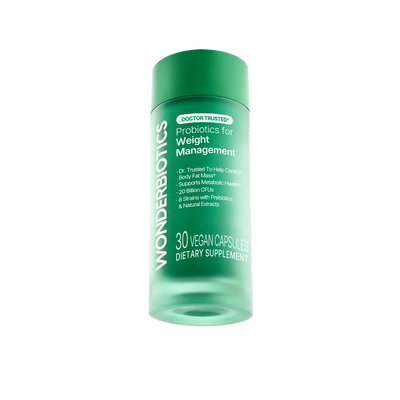
WONDERBIOTICS for Midlife Women
WONDERBIOTICS was formulated by PhD scientists with midlife women as the target population, addressing the multi-dimensional nature of menopause weight and metabolic changes.
B420™ (Bifidobacterium animalis subsp. lactis 420): The formula's primary weight-management strain. Ingredient-level RCT evidence on body fat mass and waist circumference in overweight adults. Dose aligns with the clinically studied range. CFU guaranteed at expiration. Not menopause-specific; not a finished-product claim.
HN019 (Bifidobacterium animalis subsp. lactis HN019): Gut comfort and regularity support. Most relevant for bloating and GI discomfort during perimenopause.
Eriomin® and CraveLock™: Ingredient-level clinical research on natural GLP-1 secretion support. Addresses appetite management and food noise through the gut hormone pathway.
5X Dihydroberberine: Supports healthy blood sugar levels already within the normal range. Addresses the insulin resistance component of menopause metabolic change.
WONDERBIOTICS uses PolarSeal Technology to protect the probiotic strains. In testing, 99.9% of the bacterial strain survived gut-like acidic conditions and 98.2% remained alive through the point of consumption. CFU is guaranteed at expiration.
The formula supports metabolic wellness during menopause as a gut-metabolic support layer. It does not treat, diagnose, or reverse menopause or any of its symptoms, and it does not replace medical care or hormone therapy where clinically appropriate.
We recommend 3-6 months of consistent use alongside protein, resistance training, fiber, and adequate sleep.
Read the WONDERBIOTICS Review for a full look at the formula.
This article is for educational purposes only and is not medical advice. It is not intended to diagnose, treat, cure, or prevent any disease. If you are experiencing menopausal symptoms, have a medical condition, or take medications, talk with a licensed clinician before making health changes or starting supplements.
References
- Stenman LK, Lehtinen MJ, Meland N, et al. Probiotic With or Without Fiber Controls Body Fat Mass, Associated With Serum Zonulin, in Overweight and Obese Adults-Randomized Controlled Trial. EBioMedicine. 2016;13:190-200. https://pubmed.ncbi.nlm.nih.gov/27810310/
- Kadooka Y, Sato M, Imaizumi K, et al. Regulation of abdominal adiposity by probiotics (Lactobacillus gasseriSBT2055) in adults with obese tendencies in a randomized controlled trial. Eur J Clin Nutr. 2010;64(6):636-643. https://pubmed.ncbi.nlm.nih.gov/20216555/
- Andrews RAF, Lacey A, Roach H, Tomlinson R, Kidd EJ, Bache K. Investigating the effects of probiotics during the menopause transition: A systematic review & meta-analysis. Clin Nutr ESPEN. 2025;69:241-256. https://pubmed.ncbi.nlm.nih.gov/40639456/
- Liaquat M, Minihane AM, Vauzour D, Pontifex MG. The gut microbiota in menopause: Is there a role for prebiotic and probiotic solutions? Post Reprod Health. 2025;31(2):105-114. https://pmc.ncbi.nlm.nih.gov/articles/PMC12209548/


