


Best Supplements for Menopause Belly Fat by Biology

Best Supplements for Menopause Belly Fat: Matching Ingredients to the Biology
Menopause belly fat resists approaches that work at other life stages. Caloric restriction alone produces less effect on central adiposity when the gut microbiome has shifted, appetite hormones have changed, and insulin sensitivity has declined. The supplement question in this context is more precise than "what helps with weight loss": it is which ingredients address the specific biological drivers at work. That distinction determines whether a supplement does anything meaningful or merely adds to the pile.

The Biological Drivers Worth Addressing
Menopause belly fat accumulates through several intersecting pathways, and a useful supplement framework maps to at least some of them. The primary ones that current evidence connects to targeted intervention are:
Gut microbiome composition shifts. Postmenopausal women show altered gut microbiome diversity and composition compared to premenopausal women, changes that are associated with adverse cardiometabolic outcomes including increased visceral fat.<sup>1</sup> This pathway is addressable through clinically researched probiotic strains.
Appetite and GLP-1 signaling. Glucagon-like peptide-1 (GLP-1), a gut hormone involved in appetite regulation and blood glucose response, becomes a more active management target as hormonal balance shifts. Appetite dysregulation contributes significantly to why belly fat is hard to shift after menopause.
Blood glucose and insulin sensitivity. Postmenopausal women show changes in insulin sensitivity that affect how and where the body stores fat. Ingredients that support healthy glucose metabolism address this driver.
Most individual supplements target one of these pathways. A formula that engages more than one provides broader coverage.
Probiotics: The Gut Composition Layer
Probiotic research for belly fat is strain-specific. Most commercial probiotics have never been studied against body composition endpoints, making strain identity the essential first filter.
The strain with the most directly relevant human evidence is Bifidobacterium animalis ssp. lactis B420 (B420™). In a 6-month, double-blind, randomized controlled trial (RCT) involving 225 overweight and obese adults aged 18 to 65 (body mass index (BMI) 28.0–34.9), post-hoc factorial analysis found a body fat mass change of −4.0% vs. placebo and a 2.4 cm reduction in waist circumference vs. placebo.<sup>2</sup> The trial population was not menopause-specific, though these endpoints are precisely the ones most relevant to midlife belly fat concerns.
The gut composition layer is where B420™ operates: reinforcing gut barrier integrity, influencing energy extraction, and shifting the gut environment in ways that connect to body fat outcomes.
The GLP-1 and Metabolic Layer
Beyond the gut microbiome, menopause belly fat responds to what happens at the appetite and blood glucose level. Two ingredients have ingredient-level clinical evidence for these pathways.
Eriomin® (lemon extract) is a standardized flavonoid complex with clinical research in prediabetic populations reporting support for natural GLP-1 levels.<sup>3</sup> A separate clinical trial also found Eriomin® supplementation was associated with changes in microbiome composition, including shifts in bacterial families linked to glycemic profile.<sup>4</sup> In a context where appetite regulation has changed and gut composition has shifted, an ingredient that addresses the GLP-1 pathway adds coverage that a probiotic alone cannot provide.
Berberine has a documented metabolic profile. A systematic review and meta-analysis of randomized clinical trials found that berberine significantly reduced triglycerides, total cholesterol, low-density lipoprotein, fasting plasma glucose, and insulin resistance markers (homeostasis model assessment-insulin resistance, or HOMA-IR).<sup>5</sup> The evidence is strongest for glycemic and lipid parameters; direct evidence for visceral fat reduction specifically is more limited. In the context of menopause belly fat, berberine's value is through its metabolic support role, particularly blood glucose dynamics. Dihydroberberine (DHB) is a modified form that achieves higher plasma berberine exposure at lower doses, making it the more bioavailable delivery route.
WONDERBIOTICS: Three Pathways in One Formula
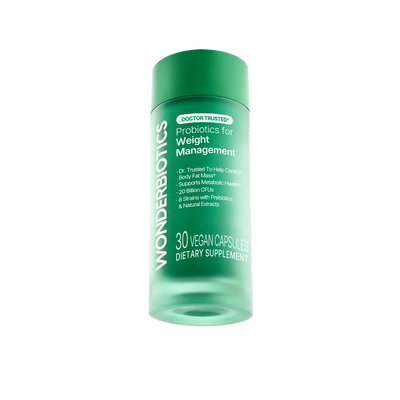
WONDERBIOTICS is formulated to address all three layers described above in a single daily supplement. The Probiotics for Weight Management formula brings together B420™ for gut composition and body fat evidence, Eriomin® (lemon extract) for natural GLP-1 level support, and Dihydroberberine for metabolic and blood glucose support. The formula also features CraveLock™ Technology, a proprietary approach to appetite management and Food Noise, a dimension that becomes particularly relevant as appetite signaling shifts during midlife.
For delivery, WONDERBIOTICS uses PolarSeal Technology to help protect the probiotic blend. In testing, 99.9% of the bacterial strain survived conditions simulating gut-like acidity, and 98.2% of the bacteria remained alive through the point of consumption.
The key ingredients behind the formula are backed by 624 clinical studies and 44,692 participants. The formula was developed by a team of PhD scientists and industry experts.
Putting the Full Picture Together
Other supplements are commonly discussed in the menopause belly fat conversation: omega-3 polyunsaturated fatty acids, vitamin D, and magnesium each have metabolic roles. For these, the direct evidence for a specific belly fat effect is limited. They are better understood as general metabolic support. A probiotic-GLP-1-berberine combination addresses the three pathways with the strongest current evidence.
We recommend a usage period of 3 to 6 months, to give your gut time to adapt and your body time to respond, alongside a nutritious diet and regular physical activity. The biology behind menopause belly fat is multifactorial; the supplements most worth taking are the ones mapped to the pathways actually involved.
Explore WONDERBIOTICS Probiotics for Weight Management
References
- Peters BA, Lin J, Qi Q, et al. Menopause is associated with an altered gut microbiome and estrobolome, with implications for adverse cardiometabolic risk in the Hispanic Community Health Study/Study of Latinos. mSystems. 2022;7(3):e00273-22. https://journals.asm.org/doi/10.1128/msystems.00273-22
- Stenman LK, Lehtinen MJ, Meland N, et al. Probiotic with or without fiber controls body fat mass, associated with serum zonulin, in overweight and obese adults: randomized controlled trial. EBioMedicine. 2016;13:190-200. https://www.sciencedirect.com/science/article/pii/S2352396416304972
- Cesar TB, Manzini Ramos FM, Ribeiro CB. Nutraceutical Eriocitrin (Eriomin) Reduces Hyperglycemia by Increasing Glucagon-Like Peptide 1 and Downregulates Systemic Inflammation: A Crossover-Randomized Clinical Trial. J Med Food. 2022;25(11):1087-1094. https://www.ncbi.nlm.nih.gov/pmc/articles/PMC9700344/
- Ramos FMM, Cesar TB, et al. Lemon flavonoids nutraceutical (Eriomin®) attenuates prediabetes intestinal dysbiosis: a double-blind randomized controlled trial. Food Sci Nutr. 2023;11(12):7574-7587. https://www.ncbi.nlm.nih.gov/pmc/articles/PMC10630820/
- Ye Y, Liu X, Wu N, et al. Efficacy and safety of berberine alone for several metabolic disorders: a systematic review and meta-analysis of randomized clinical trials. Front Pharmacol. 2021;12:653887. https://pmc.ncbi.nlm.nih.gov/articles/PMC8107691/


