


WonderBiotics vs Supergut: Probiotic or Fiber?

WonderBiotics vs Supergut GLP-1 Booster: Probiotic or Prebiotic Fiber for Appetite Support?

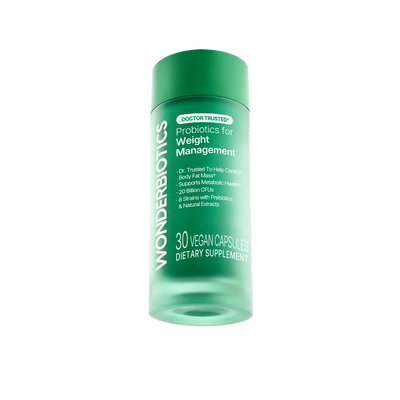
WonderBiotics Probiotics for Weight Management delivers eight live bacterial strains plus a berberine-and-citrus metabolic blend in a capsule. Supergut's GLP-1 Booster, now sold as GLP-1 Daily Support, is a resistant-starch prebiotic fiber powder you mix into a drink. Both are marketed around "supporting natural GLP-1," but they work through different biology, and neither has been shown to match a prescription GLP-1 drug.
Probiotic Strains vs. Prebiotic Fiber: What's Actually Different
A probiotic supplies live microorganisms, in WonderBiotics' case eight named strains totaling 20 billion CFU, including Bifidobacterium animalis subsp. lactis B420 and HN019.1 The idea is that these specific strains, once ingested, can influence your gut community or produce metabolites of their own while passing through.
A prebiotic is not alive. It is a fermentable substrate, in Supergut's case a blend of soluble corn fiber, green banana resistant starch, Solnul resistant potato starch, and oat beta-glucan, that feeds the bacteria you already have.2 The idea is that your existing microbes ferment that fiber into short-chain fatty acids like butyrate, which is what actually signals your gut's L-cells.
Neither approach adds a drug. Both are trying to nudge a normal digestive process, from two different starting points, live bacteria versus bacterial fuel. Some products, including our capsule, combine a small amount of both by including a prebiotic (polydextrose) alongside the probiotic strains, which is worth knowing before you assume "probiotic" and "prebiotic" are mutually exclusive categories.1
What Does "Supports Natural GLP-1" Actually Mean?
GLP-1 is a hormone your gut's L-cells release on their own after you eat, well before anyone invented semaglutide or tirzepatide. Both WonderBiotics and Supergut invoke this hormone, but the mechanism they're describing is indirect and modest compared to the drugs that share its name.
The best-supported piece of biology here is that short-chain fatty acids like butyrate can activate FFAR2/FFAR3 receptors on L-cells and stimulate GLP-1 release, but a 2026 scoping review of 49 publications covering 52 human and animal studies found that this receptor-level pathway has mainly been confirmed in rodents, not people.3 Among the human fiber trials in that same review, studies that reported a GLP-1 increase were more likely to also report higher satiety, but that pattern did not reach statistical significance (odds ratio 2.95, 95% CI 0.87–9.98, P=0.077).3 That is a real, biologically plausible signal, not a proven appetite effect.
It also helps to see the difference in scale. Steady-state blood levels of oral semaglutide (Rybelsus, 40 mg/day) have been described in the pharmacology literature as "over a thousand times higher" than the concentration needed to saturate its own receptor, an exposure no food-based ingredient is designed to replicate.4 "Supports natural GLP-1" is a fair way to describe nudging a hormone you already make. Reading it as a claim that either product mimics a GLP-1 receptor agonist would be a stretch the evidence doesn't support.
The Evidence Behind Each Product
WonderBiotics: the B420 Trial and the Metabolic Blend
Our headline strain, B420, was tested in a 225-person, six-month randomized trial funded by DuPont Nutrition & Health, the company that owned the strain at the time (the brand now sits under IFF).1, 5 The trial's prespecified primary endpoint, relative change in DXA-measured body fat across all four arms, was not statistically significant (P=0.46).1
In the predefined per-protocol population, B420 combined with a 12 g/day polydextrose fiber supplement did lose more body fat than placebo (−4.5%, P=0.02); B420 taken alone did not reach significance (−3.0%, P=0.28).1 A secondary, self-reported finding is closer to what "appetite support" usually means to readers: in a 5-day food diary kept by a smaller per-protocol subset, people taking B420 alone reported eating about 320 fewer calories a day than the placebo group (P<0.05).1 That number describes self-reported energy intake. The trial itself never measured ghrelin, PYY, or GLP-1, so the honest claim is that B420 was linked to lower reported intake in this subset, and any specific appetite-hormone pathway is an inference, not something the trial tested directly.
Our capsule also includes a Metabolic Blend of dihydroberberine and a citrus extract standardized to eriocitrin (marketed as Eriomin).1 The eriocitrin extract has its own small human trial showing a 17% rise in GLP-1 in people with elevated blood sugar.6 That result speaks to the ingredient on its own; it was measured in a hyperglycemic population rather than a weight-management one, and it doesn't stand in for a trial of the finished capsule.
Supergut: the Frias 2023 Diabetes Trial
Supergut's fiber blend has genuine trial-level backing, and it deserves credit for that: it's rarer for a prebiotic fiber brand to publish in a peer-reviewed journal than to rely only on ingredient-level citations. The trial, run by physician-researcher Juan Frias together with Supergut's own team and Stanford microbiome researchers, randomized 192 adults with type 2 diabetes (HbA1c 7.5–10.5%, BMI 27–50) 2:1:1 to a fiber-enriched meal-replacement shake, a fiber-free but calorie-matched placebo shake, or diet advice alone, over 12 weeks.7
The prespecified primary endpoint, a diabetes-distress score, improved significantly more with the active shake than with the control arms (P=0.03).7 A secondary endpoint, HbA1c, improved significantly more with the active shake than the placebo shake (−0.66 percentage points, P=0.009).7 Body weight is the outcome most relevant to "appetite support," and here the picture is more mixed: the active shake beat the no-shake diet arm (−1.36 kg vs. −0.54 kg, P=0.03), but it was not reported as significantly better than the fiber-free placebo shake (−0.64 kg).7 In other words, most of the weight difference showed up against people who got no meal-replacement shake at all, which makes it hard to credit the fiber itself, rather than simply replacing a meal with a controlled-calorie shake, for the full effect.
That trial also never measured GLP-1 directly. The paper cites the butyrate-to-GLP-1 pathway as the proposed mechanism behind the diabetes-distress and HbA1c findings, not as something it confirmed with a hormone assay.7 It's also worth noting that the tested product was a 15 g-fiber, 15 g-protein meal-replacement shake, a different format and fiber dose than the 6-7 g-per-scoop stick-pack powder currently sold as GLP-1 Daily Support (the product line previously marketed as GLP-1 Booster).2, 8 On tolerability, the trial's own GI symptom scores improved similarly in both shake arms with no significant difference and no dropouts from GI intolerance, which is a genuinely reassuring result for a fermentable-fiber product.7
Like the B420 trial, this study was funded by the company whose product it tested, and several authors are Supergut employees or consultants.7 That doesn't invalidate the results, but it belongs in the same disclosure bucket as WonderBiotics' DuPont-funded B420 data: read both as sponsor-funded, single-trial evidence, not independent replication.
Ingredients and Formula, Side by Side
| WonderBiotics Probiotics for Weight Management | Supergut GLP-1 Daily Support | |
|---|---|---|
| Category | Multi-strain probiotic + metabolic blend capsule | Prebiotic fiber powder |
| Core content | 8 strains, 20 billion CFU (incl. B420, HN019), plus dihydroberberine and Eriomin citrus extract1 | Soluble corn fiber, green banana resistant starch, Solnul resistant potato starch, oat beta-glucan; 6–7 g fiber/serving2 |
| Prebiotic present? | Yes, polydextrose is blended in with the strains1 | Yes, this is entirely a prebiotic-fiber product2 |
| Format & dose | 1 capsule/day | 1 scoop in water or a smoothie, building to 2–3 servings/day2 |
| Headline human trial | Stenman 2016, B420, 225 adults with overweight/obesity, 6 months1 | Frias 2023, 192 adults with type 2 diabetes, 12 weeks7 |
| Trial funded by | DuPont Nutrition & Health (now IFF)1, 5 | Supergut7 |
Who Should Choose Which for Appetite Support
WonderBiotics Probiotics for Weight Management is the better fit if you want a once-daily capsule that pairs a well-studied probiotic strain with a separate metabolic-support blend, without adding more fermentable fiber to a diet that's already fiber-heavy. It's also the more sensible pick if you know fiber powders give you gas, since it delivers most of its ingredients in a low-bulk capsule rather than a multi-gram fermentable fiber dose.
Supergut's GLP-1 Daily Support is the better fit if your actual gap is fiber intake itself. Most adult women need roughly 21–25 g of fiber a day depending on age, and most men need 30–38 g;9 a product built to help you climb toward 25–30 g/day of total fiber is solving a real, common shortfall. It's also the more evidence-appropriate pick if you have type 2 diabetes or prediabetes, since that's the population its own published trial actually studied, rather than a general weight-management population.
Neither product is the right choice if what you're really looking for is a substitute for a prescription GLP-1 medication, or a way to avoid starting one your doctor has recommended. Both are food-derived, indirect nudges to a hormone system; the drugs work through sustained, high-level receptor activation that these categories aren't designed or dosed to reproduce.4
Can You Combine a Probiotic and a Prebiotic Fiber?
Yes, and it's a common enough combination that it has a name: synbiotic, a probiotic and a prebiotic used together on purpose. Our capsule already reflects this logic on a small scale, since its blend includes polydextrose alongside the eight strains.1
If you want more fiber than one capsule's worth of polydextrose provides, our WonderBiotics Daily Fiber Mix is built for that, with a five-fiber blend that includes Fibersol soluble corn fiber and partially hydrolyzed guar gum, both of which ferment more slowly than faster fibers like inulin in laboratory fermentation models.10, 11 That doesn't mean any fermentable fiber product, including Supergut's, is guaranteed to be gas-free; Supergut's own instructions recommend starting with one serving and increasing gradually for exactly this reason, which is standard, sensible guidance for any resistant-starch or beta-glucan product.2
Price and Practical Considerations
WonderBiotics Probiotics for Weight Management runs roughly $44–55 for a 30-capsule, one-month supply.12 Supergut's GLP-1 Daily Support lists at $60 per canister, with subscription discounts bringing it closer to $48, and the per-serving cost also depends on whether you buy the 15-, 20-, or 40-serving size.2 A capsule is easier to travel with and doesn't require mixing; a powder lets you control exactly how much fiber you're adding and can double as a fiber top-up on days your diet falls short.
Safety, GI Tolerance, and When to Call Your Doctor
Any new fermentable fiber product is worth starting slowly, including Supergut's resistant starch and beta-glucan blend; fermentable fibers commonly cause gas and bloating for the first one to two weeks, which is part of why Supergut builds a gradual on-ramp into its own directions.2 Our Daily Fiber Mix uses slower-fermenting fibers for exactly this reason, though a partial serving to start is still sensible with any new fiber source. Probiotic capsules are typically better tolerated on day one, but people who are immunocompromised, critically ill, or have a central venous catheter should talk to a doctor before starting any live-bacteria product.13
If you're on a GLP-1 medication or a diabetes medication, treat either of these products as an add-on to discuss with your prescriber, not a reason to change your dose or stop your medication on your own. Neither product is intended to diagnose, treat, cure, or prevent any disease. Upper-abdominal pain lasting several hours, fever or chills, jaundice, or dark urine are gallbladder warning signs that call for prompt medical attention regardless of what supplements you're taking.14
Bottom Line
WonderBiotics and Supergut's GLP-1 Booster are solving related but genuinely different problems. WonderBiotics leans on named probiotic strains, most notably B420, backed by a single sponsor-funded RCT with a mixed primary result but a real self-reported appetite signal, alongside a separate metabolic blend. Supergut leans on a resistant-starch and beta-glucan prebiotic fiber blend, backed by its own sponsor-funded RCT in adults with type 2 diabetes, with a clean primary endpoint but a weight result that didn't clearly beat its own placebo shake. If your priority is a low-bulk capsule with a well-characterized probiotic strain, WonderBiotics Probiotics for Weight Management is the more direct fit; if your priority is closing an actual fiber gap, Supergut's approach makes sense on its own terms. Either way, treat both as supportive additions to, not replacements for, medical care.
References
- Stenman LK, Lehtinen MJ, Meland N, et al. Probiotic With or Without Fiber Controls Body Fat Mass, Associated With Serum Zonulin, in Overweight and Obese Adults: Randomized Controlled Trial. EBioMedicine. 2016;13:190-200. PMID 27810310
- GLP-1 Daily Support: Prebiotic Fiber for Appetite Support. Supergut
- Dietary fibers to boost endogenous GLP-1 secretion and satiety: a scoping review. Frontiers in Endocrinology. 2026. DOI: 10.3389/fendo.2026.1880500
- Liu QK. Mechanisms of action and therapeutic applications of GLP-1 and dual GIP/GLP-1 receptor agonists. Frontiers in Endocrinology. 2024;15:1431292. PMC11304055
- HOWARU B420. IFF Health Sciences
- Cesar TB, Ramos FMM, Ribeiro CB. Nutraceutical Eriocitrin (Eriomin®) Reduces Hyperglycemia by Increasing Glucagon-Like Peptide 1 and Downregulates Systemic Inflammation: A Crossover-Randomized Clinical Trial. J Med Food. 2022;25(11):1050-1058. PMID 35796695
- Frias JP, Lee ML, Carter MM, et al. A microbiome-targeting fibre-enriched nutritional formula is well tolerated and improves quality of life and haemoglobin A1c in type 2 diabetes: a double-blind, randomized, placebo-controlled trial. Diabetes Obes Metab. 2023;25(5):1203-1212. PMID 36594522
- supergut® - GLP-1 Booster Gut Healthy Prebiotic Mix. GNC
- Dietary Reference Intakes: Macronutrients Summary Table. NCBI Bookshelf NBK545442
- Daily Fiber Mix. WonderBiotics
- Noack J, Timm D, Hospattankar A, Slavin J. Fermentation Profiles of Wheat Dextrin, Inulin and Partially Hydrolyzed Guar Gum Using an In Vitro Digestion Pretreatment and In Vitro Batch Fermentation System Model. Nutrients. 2013;5(5):1500-1510. PMC3708332
- WonderBiotics Weight Management Probiotics 30-Count Bottle. Amazon
- Doron S, Snydman DR. Risk and Safety of Probiotics. Clin Infect Dis. 2015;60(Suppl 2):S129-S134. PMID 25922398
- Gallstones: Symptoms & Causes. NIDDK


