


What Causes Food Noise? 6 Real Drivers Explained

What Causes Food Noise? The Real Drivers Behind Constant Food Thoughts

Food noise rarely traces back to one cause, which is part of why it resists a single fix. Hunger and fullness hormones that aren't well regulated, meals too light on protein or fiber, chronic stress, poor sleep, hormonal shifts like perimenopause, and your gut's own role can all stack together at once. Untangling which of those is doing the most in your case matters more than reaching for any one solution first.
What Is Food Noise, Exactly?
Food noise is a fairly new term for an old experience: food-related thoughts that show up uninvited and won't quiet down, even when you're not physically hungry. The most widely cited academic definition, from a 2023 conceptual model in Nutrients, describes it as "heightened and/or persistent manifestations of food cue reactivity, often leading to food-related intrusive thoughts and maladaptive eating behaviors."1
This definition separates food noise from two things it often gets confused with: hunger and cravings. Hunger is your body's homeostatic signal that you need fuel.2 A craving is an intense urge to eat that can hit regardless of how hungry you actually are; it doesn't have to be about one specific food, and it isn't always food noise.1 Food noise is the broader, more persistent layer sitting on top of both: intrusive thoughts about food that keep resurfacing throughout the day.
Researchers have started building tools to measure this rather than just describe it. A 2025 validation study in Obesity tested a five-item Food Noise Questionnaire on 396 adults (average age 51.5, average BMI 31) and found it held up with strong internal consistency.3 "Food noise" isn't just a buzzword at this point: it's now a construct with a validated way to measure it, even if the field is young.
Is It Hunger, a Craving, or Food Noise?
Addressing food noise starts with knowing what you're actually dealing with.
True hunger builds gradually, is tied to how long it's been since you ate, and eases once you've eaten enough, regardless of what you eat. It's driven by your hypothalamus reading signals like ghrelin (which rises before meals) and leptin (which should signal fullness after).2
A craving is sharper and more specific in the moment. It can strike an hour after a full meal and doesn't necessarily fade once you eat something else.1 Cravings are tied more to your brain's reward circuitry than to your stomach.
Food noise is the least tied to a single meal or moment. It's the running commentary: thinking about your next meal while eating the current one, replaying what you "should" have eaten, or feeling like food is competing for mental bandwidth you'd rather spend elsewhere. This is the pattern the research above is trying to name and measure.1 3
Why Satiety Signaling Misfires
A lot of food noise traces back to appetite regulation not working the way it's supposed to. A 2025 review in Current Obesity Reports lays out the two systems involved: the hypothalamic arcuate nucleus, which handles homeostatic hunger and fullness (via ghrelin, leptin, and related signals), and a separate limbic circuit, including the ventral tegmental area and nucleus accumbens, that drives "hedonic," reward-based eating that has little to do with actual energy need.2 When either system is out of balance, food thoughts get louder.
Diet structure plays into this directly. Meals low in protein or fiber don't trigger as much of the gut's own satiety signaling: hormones like GLP-1 and PYY that tell your brain you've had enough. In a small randomized crossover study of 19 adults, a 10-gram dose of soluble fiber (Fibersol-2) taken with a meal significantly raised GLP-1 and PYY and reduced reported hunger through roughly 1.5 to 2 hours after the meal compared to no fiber.4 That's mechanism-level, small-sample evidence, not a guarantee for any specific fiber product, but it illustrates the biological lever.
A larger 2026 scoping review pooled 49 publications (52 studies, about 1,085 people total) looking at whether dietary fiber intake was linked to both higher endogenous GLP-1 and greater reported satiety in the same study.5 The association leaned in that direction but didn't reach statistical significance (odds ratio 2.95, P=0.077): an early signal worth watching, not proof that fiber reliably quiets food noise.5
Ultra-processed, low-satiety foods work against you on both fronts: they under-trigger fullness hormones and over-trigger the reward circuit described above, which is part of why food noise tends to get louder on a diet heavy in these foods rather than lighter.
Stress, Cortisol, and the Sleep Connection
Stress hormones don't just affect your mood; they affect appetite signaling directly. Ghrelin, the hormone that ramps up hunger, rises during both fasting and acute stress, not only when your stomach is empty.2 That overlap is one reason a stressful day can produce food thoughts that feel a lot like hunger even when your last meal wasn't that long ago.
Sleep loss compounds this. In a small but frequently cited crossover study, 12 healthy young men slept two nights at 4 hours versus two nights at 10 hours; the short-sleep nights produced an 18% drop in leptin, a 28% rise in ghrelin, a 24% jump in subjective hunger, and a 33-45% increase in appetite for high-calorie, high-carbohydrate foods.6 It's a small mechanistic study in young men, so the effect size shouldn't be extrapolated directly to a 50-year-old woman's biology, but the direction (less sleep, more hunger signaling) is notable.
A 2025 meta-analysis pooling five sleep-restriction studies (105 participants total) found the overall picture murkier: ghrelin and leptin changes across studies didn't reach statistical significance, and the individual studies didn't even agree on direction: three found ghrelin rising after sleep restriction, two found it falling.7 Poor sleep clearly changes appetite-related behavior, but the exact hormonal mechanism isn't as clean or consistent as the single dramatic study above might suggest.
What does look more consistent is the behavioral outcome. In a controlled sleep-restriction trial, adults who slept less ate about 308 more calories a day than during their well-rested baseline, the study's prespecified primary outcome, with a related secondary increase in visceral fat over time.8 That's one trial, not a universal law, but it's a concrete behavioral link between less sleep and more eating, whatever the exact hormonal mechanism turns out to be.
Does Perimenopause Turn Up the Volume?
If food noise feels newly louder in your 40s or 50s, sleep disruption during the menopause transition is a reasonable place to look first. Data from the SWAN cohort found that at baseline, 28.0% of premenopausal women and 34.3% of early-perimenopausal women reported at least one of three sleep difficulties: different women at different stages, not the same group getting steadily worse.9 Hot flashes and night sweats were strongly linked to worse sleep: women reporting frequent vasomotor symptoms had roughly two to three times the odds of trouble falling asleep, waking repeatedly, or waking too early.9
Combined with the sleep-and-appetite research above, a plausible chain emerges: hot flashes disrupt sleep, disrupted sleep nudges appetite hormones and behavior, and food noise gets louder as a downstream effect. Published randomized trials have not directly tested whether treating perimenopausal sleep disruption lowers food noise or hunger scores, so this chain is a reasonable inference from separate pieces of evidence, not a tested finding.
Could Your Gut Play a Role?
Probably yes, but the human evidence is still early, and it's a piece most food noise explainers skip. Gut bacteria produce short-chain fatty acids from fermented fiber, and in rodent studies those short-chain fatty acids activate receptors (FFAR2/FFAR3) that stimulate the same GLP-1 and PYY release described above.5 That mechanism hasn't been confirmed the same way in humans, but it explains why gut health and appetite signaling are so tightly linked biologically: they share the same hormonal messengers.
Published studies have not directly tested whether shifting gut bacteria composition changes food noise scores in people. What does exist is human evidence that fiber intake and endogenous satiety hormone release track together, even though the effect on reported fullness hasn't cleared statistical significance in the larger pooled review above.5 For now, treat your gut as sitting upstream of the same hormonal pathway that drives, or quiets, food noise: a supporting factor worth building a daily habit around, which is exactly the logic behind the formula we describe below.
When Food Noise Needs More Than Diet Changes
Occasional food noise that responds to eating enough protein, sleeping better, and managing stress is common and usually not a medical concern. But persistent, distressing food noise, especially if it comes with a sense of losing control around food, eating in secret, or shame afterward, can also be a marker of something clinical, not just a habit to troubleshoot.10 The NIDDK defines binge eating disorder as recurring episodes of loss-of-control eating at least once a week for three months, alongside marked distress about the pattern.11 If any of that sounds familiar, a conversation with a doctor or registered dietitian trained in disordered eating is the right next step, not another diet change.
If you're currently on a GLP-1 medication like semaglutide, know that quieter food noise is part of how these drugs work. In a STEP 5 sub-analysis, participants on semaglutide 2.4 mg reported significantly better Control of Eating Questionnaire scores, including craving control, at weeks 20, 52, and 104 compared with placebo.12 That's measuring craving control on a validated questionnaire, not "food noise" by name, but it's the closest prescription-drug data point to this experience. None of this is a reason to adjust or stop a prescribed dose on your own; any change to a GLP-1 medication should go through the prescribing provider.
How WonderBiotics Fits the Gut-and-Satiety Side of the Picture
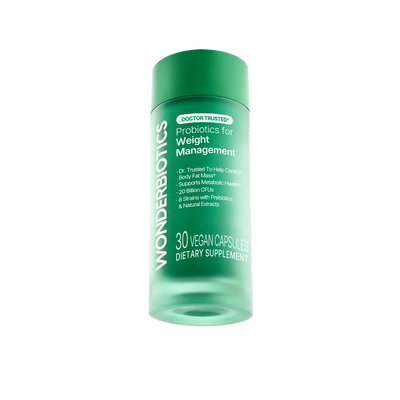
Because gut health and satiety signaling run on the same hormonal wiring, we built WonderBiotics Probiotics for Weight Management around both sides of that equation instead of just one. The formula pairs eight named probiotic strains, including B. animalis B420 (the strain behind a 225-person randomized trial), with a metabolic blend of dihydroberberine and a standardized lemon extract (Eriomin® (lemon extract)) designed to support the same appetite-and-metabolism pathways this article has been describing.
The signal that made us build around B420 in the first place: participants taking it alone logged roughly 300 fewer calories a day in their food diaries than the placebo group did, over six months.13 That's a secondary, self-reported finding rather than the trial's prespecified primary endpoint (six-month body fat by DXA, where B420 alone didn't separate from placebo), and the trial didn't measure hunger, ghrelin, GLP-1, or any satiety hormone directly. We treat it as exactly what it is, a real, appetite-relevant signal worth building a formula around, not proof that any product quiets food noise on its own.
We position this formula as a daily gut-and-satiety support layer, meant to sit alongside the protein, fiber, sleep, and stress habits in this article rather than replace them. If you're managing food noise on top of a GLP-1 prescription, think of it as support for your gut and everyday appetite signaling, not a substitute for your medication or your doctor's guidance.
Where to Start
Food noise rarely has one cause. It's usually satiety hormones under-firing, a diet light on protein and fiber, stress and short sleep pushing ghrelin up, hormonal shifts like perimenopause disrupting sleep further, and a gut environment that either supports or works against all of the above. Start with the levers you can control (meals, sleep, stress), and loop in a doctor if the thoughts feel out of proportion to what you're eating or start interfering with daily life.
References
- Hayashi D, Edwards C, Emond JA, Gilbert-Diamond D, Butt M, Rigby A, Masterson TD. What Is Food Noise? A Conceptual Model of Food Cue Reactivity. Nutrients. 2023;15(22):4809. PMID: 38004203
- Garutti M, Sirico M, Noto C, Foffano L, Hopkins M, Puglisi F. Hallmarks of Appetite: A Comprehensive Review of Hunger, Appetite, Satiation, and Satiety. Curr Obes Rep. 2025;14:12. PMID: 39849268
- Diktas HE, Cardel MI, Foster GD, LeBlanc MM, Dickinson SL, Ables EM, Chen X, Nathan R, Shapiro D, Martin CK. Development and Validation of the Food Noise Questionnaire. Obesity (Silver Spring). 2025;33(2):289-297. PMID: 39828656
- Ye Z, Arumugam V, Haugabrooks E, Williamson P, Hendrich S. Soluble Dietary Fiber (Fibersol-2) Decreased Hunger and Increased Satiety Hormones in Humans When Ingested with a Meal. Nutr Res. 2015;35(5):393-400. PMID: 25823991
- de Jong JCBC, Lentjes MGW, Pietersma KF, Pasman WJ, Wopereis S, Hoevenaars FPM. Dietary fibers to boost endogenous GLP-1 secretion and satiety: a scoping review. Front Endocrinol. 2026;17. DOI: 10.3389/fendo.2026.1880500
- Spiegel K, Tasali E, Penev P, Van Cauter E. Brief Communication: Sleep Curtailment in Healthy Young Men Is Associated with Decreased Leptin Levels, Elevated Ghrelin Levels, and Increased Hunger and Appetite. Ann Intern Med. 2004;141(11):846-850. PMID: 15583226
- Gresser D, McLimans K, Lee S, Morgan-Bathke M. The Impact of Sleep Deprivation on Hunger-Related Hormones: A Meta-Analysis and Systematic Review. Obesities. 2025;5(2):48. DOI: 10.3390/obesities5020048
- Covassin N, Singh P, McCrady-Spitzer SK, et al. Effects of Experimental Sleep Restriction on Energy Intake, Energy Expenditure, and Visceral Obesity. J Am Coll Cardiol. 2022;79(13):1254-1265. PMID: 35361348
- Kravitz HM, Zhao X, Bromberger JT, et al. Sleep Disturbance During the Menopausal Transition in a Multi-Ethnic Community Sample of Women. Sleep. 2008;31(7):979-990. PMID: 18652093
- What Is "Food Noise"? And How to Know if It Signals an Eating Disorder. National Alliance for Eating Disorders. allianceforeatingdisorders.com
- Definition & Facts for Binge Eating Disorder. National Institute of Diabetes and Digestive and Kidney Diseases (NIDDK). niddk.nih.gov
- Wharton S, Batterham RL, Bhatta M, Buscemi S, Christensen LN, Frias JP, Jódar E, Kandler K, Rigas G, Wadden TA, Garvey WT. Two-Year Effect of Semaglutide 2.4 mg on Control of Eating in Adults with Overweight/Obesity: STEP 5. Obesity (Silver Spring). 2023;31(3):703-715. PMID: 36655300
- Stenman LK, Lehtinen MJ, Meland N, Christensen JE, Yeung N, Saarinen MT, Courtney M, Burcelin R, Lähdeaho ML, Linros J, Apter D, Scheinin M, Smerud HK, Rissanen A, Lahtinen S. Probiotic With or Without Fiber Controls Body Fat Mass, Associated With Serum Zonulin, in Overweight and Obese Adults-Randomized Controlled Trial. EBioMedicine. 2016;13:190-200. PMID: 27810310


