


Probiotics for Weight Loss: Evidence Beyond the Label

Probiotics for Weight Loss: Reading the Evidence Past the Label
Probiotics have become a mainstream supplement category, and weight management ranks among their most searched applications. The gap between how probiotics are marketed and what the clinical evidence actually supports is significant. Most commercial probiotics were developed with digestive health in mind. Body composition outcomes are a different target, requiring a different design.
That gap is rooted in biology, and in a property of probiotics that most labels and marketing materials leave unaddressed.

Why Your Gut Bacteria Matter for Body Weight
The gastrointestinal (GI) tract hosts trillions of microorganisms, a community that influences far more than digestion. Research over the past two decades has consistently linked the composition and diversity of this community, known as the gut microbiome, to metabolic function: how the body extracts energy from food, how it manages insulin sensitivity, and how it handles low-grade inflammation.1
Microbiome composition differs between individuals with and without obesity. Shifts in the relative abundance of dominant bacterial phyla are associated with increased energy extraction from food and altered signaling in pathways connected to fat storage. The gut microbiome also contributes to the production of short-chain fatty acids (SCFAs), molecules that communicate with hunger-related hormones, including GLP-1 (glucagon-like peptide-1), a gut hormone involved in appetite and blood glucose regulation.
The microbiome is one variable among many. Genetics, diet, sleep, and physical activity all interact with it. For people working to manage their weight, gut composition is a variable worth understanding.
What Category-Level Research Can't Tell You
Systematic reviews and meta-analyses on probiotics and weight management have produced inconsistent findings. This inconsistency makes biological sense. A 2024 meta-analysis spanning 200 trials and 12,603 participants found statistically significant reductions in body weight, body mass index (BMI), and waist circumference with probiotic supplementation. The absolute effects were modest in each case.2 These analyses pool trials using different strains, doses, populations, and intervention lengths. Evidence from one strain does not apply to another, even within the same species.
Most commercial probiotics identify strains at the species level, if at all. Knowing that a product contains Bifidobacterium tells you almost nothing about what to expect. The clinical outcomes depend entirely on which specific strain was tested, at what dose, and in which population.
Terms to Know!
- Strain specificity: the principle that probiotic effects are tied to individual, identified strains and specific health endpoints. Evidence from one strain does not transfer to another strain, even within the same species or genus.
Where the Human Evidence Gets Specific
Among the probiotic strains with the most detailed weight-management data in humans is Bifidobacterium animalis ssp. lactis B420 (B420™), with over 30 clinical trial publications in its research record. The core weight-management study is a 6-month, double-blind, randomized, placebo-controlled trial involving 225 adults aged 18 to 65 with overweight or obesity (BMI 28.0–34.9).3
Post-hoc factorial analysis from that trial reported:
- Body fat mass change of −4.0% vs. placebo (P=0.002)
- Waist circumference 2.4 cm smaller vs. placebo (~0.94 inch)
- Daily energy intake approximately 300 kcal less vs. placebo
The trial population is worth noting. Participants were overweight and obese adults in a broad age range. Body fat mass, waist circumference, and energy intake are all relevant to weight management broadly, but the data applies to the specific population studied and should not be extrapolated beyond it.
The Metabolic Signaling Layer
Body fat management involves more than bacterial composition alone. Appetite signaling, blood glucose dynamics, and the hormones regulating satiety all interact with how the body manages weight. This is why some weight management formulas extend beyond a single probiotic strain.
Eriomin® (lemon extract) is a standardized flavonoid complex with ingredient-level clinical research reporting support for natural GLP-1 levels in prediabetic populations.4 A separate randomized trial found that Eriomin® supplementation was associated with changes in microbiome composition, including shifts in bacterial families linked to glycemic profile.5
Dihydroberberine is a modified version of berberine that achieves higher plasma berberine exposure at lower doses. It offers a more bioavailable berberine-delivery route, and may help reduce the GI burden associated with standard berberine, though that advantage has not been firmly established in large clinical studies.
These are ingredient-level findings in specific research populations. They illuminate formulation design choices. Individual outcomes are determined by the finished product as a whole, taken consistently over time.
Choosing a Probiotic Built for Weight Management
The supplement market has no shortage of general-purpose probiotic blends. Evaluating whether a product has genuine relevance to weight management comes down to a few specific questions: Is the probiotic strain identified at species and strain level? Does that strain have human clinical data on body composition endpoints? How are the strains protected through manufacturing and up to the point of consumption?
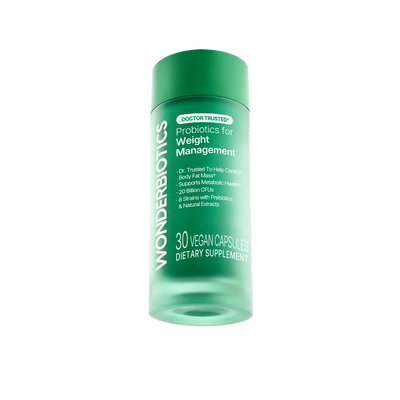
WONDERBIOTICS is formulated specifically around the role the gut microbiome plays in metabolic health. The Probiotics for Weight Management formula assigns every ingredient a defined metabolic role.
- B420™: the core probiotic strain, with over 30 clinical trial publications and body fat mass and waist circumference data from a 6-month randomized controlled trial (RCT) in overweight adults
- Eriomin® (lemon extract): ingredient-level clinical studies reporting natural GLP-1 level support in prediabetic populations
- Dihydroberberine: a more bioavailable berberine-delivery route, providing higher plasma berberine exposure at lower doses
The formula also features CraveLock™ Technology, a proprietary synergistic approach to appetite management and Food Noise.
For delivery, WONDERBIOTICS uses PolarSeal Technology to help protect the probiotic blend. In testing, 99.9% of the bacterial strain survived gut-like acidic conditions, and 98.2% of the bacteria remained alive through the point of consumption.
The key ingredients behind the formula are backed by 624 clinical studies and 44,692 participants. The formula was developed by a team of PhD scientists and industry experts.
We recommend a usage period of 3 to 6 months, to give your gut time to adapt and your body time to respond, alongside a balanced diet and regular exercise.
Make Biology Work for You
Weight management is genuinely complex. The approaches that hold up over time are ones aligned with the biological systems involved. A probiotic designed around how the gut influences metabolism, with strain-level clinical data behind its core ingredients, can be a meaningful part of that picture.
Explore WONDERBIOTICS Probiotics for Weight Management
References
- Fan Y, Pedersen O. Gut microbiota in human metabolic health and disease. Nat Rev Microbiol. 2021;19(1):55-71. https://www.nature.com/articles/s41579-020-0433-9
- Saadati S et al. Beneficial effects of the probiotics and synbiotics supplementation on anthropometric indices and body composition in adults: a systematic review and meta-analysis. Obes Rev. 2024. doi:10.1111/obr.13667. https://onlinelibrary.wiley.com/doi/10.1111/obr.13667
- Stenman LK, Lehtinen MJ, Meland N, et al. Probiotic with or without fiber controls body fat mass, associated with serum zonulin, in overweight and obese adults: randomized controlled trial. EBioMedicine. 2016;13:190-200. https://www.sciencedirect.com/science/article/pii/S2352396416304972
- Cesar TB, Manzini Ramos FM, Ribeiro CB. Nutraceutical Eriocitrin (Eriomin) Reduces Hyperglycemia by Increasing Glucagon-Like Peptide 1 and Downregulates Systemic Inflammation: A Crossover-Randomized Clinical Trial. J Med Food. 2022;25(11):1087-1094. https://www.ncbi.nlm.nih.gov/pmc/articles/PMC9700344/
- Ramos FMM, Cesar TB, et al. Lemon flavonoids nutraceutical (Eriomin®) attenuates prediabetes intestinal dysbiosis: a double-blind randomized controlled trial. Food Sci Nutr. 2023;11(12):7574-7587. https://www.ncbi.nlm.nih.gov/pmc/articles/PMC10630820/


