


Probiotics for Stubborn Belly Fat: Worth It or Hype?

Probiotic Review for Stubborn Belly Fat: Worth It or Hype?
You've seen the marketing. "Burn belly fat with probiotics." "Target visceral fat with this one strain." "The gut bacteria that melts midsection weight." If you've spent any time researching probiotic supplements for stubborn belly fat, you've waded through claims that sound too good to be confidently believed and others that sound too modest to be exciting. The honest review sits somewhere between hype and dismissal.
This article is a category-level review of probiotics for stubborn belly fat: what the published evidence actually shows, where the marketing has outrun the science, who probiotics may be appropriate for, and who is better served by other approaches. The verdict comes with caveats, because the evidence does.

The Verdict
Probiotics for stubborn belly fat are not hype. They are also not the dramatic intervention that some marketing suggests. The published meta-analysis evidence shows modest effects, the strongest strain-level signals are real but small, and individual response varies considerably.
What the evidence supports:
- Pooled probiotic effects on body composition are statistically significant but modest in magnitude
- Specific named strains have stronger signals than generic blends
- Effects unfold over months rather than weeks
- Probiotics work alongside lifestyle changes, not as substitutes for them
Worth it for: people seeking incremental support alongside foundational habits, particularly with named strains that have human RCT evidence on body composition or waist circumference.
Likely overhyped for: anyone expecting a dramatic transformation, anyone considering a generic blend without strain identifiers, or anyone who hasn't yet established the lifestyle layers that have stronger evidence than any supplement.
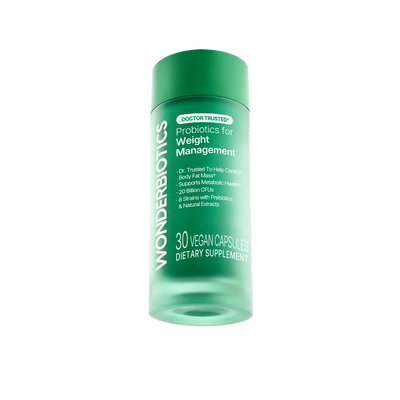
WONDERBIOTICS Probiotics for Weight Management uses B420™, a strain with body composition RCT evidence. It is one option in the strain-level-evidence tier of the category.
What "Stubborn" Belly Fat Usually Means
Belly fat that resists straightforward calorie cutting often involves visceral fat, which is fat stored deep within the abdomen surrounding internal organs. Visceral fat is more metabolically active than subcutaneous fat, more strongly associated with insulin resistance, and more strongly linked to cardiovascular risk than subcutaneous fat at the same total weight.
Visceral fat tends to redistribute in midlife. Longitudinal data from the Study of Women's Health Across the Nation (SWAN) found that visceral fat is significantly associated with the menopausal transition independent of chronological aging.<sup>1</sup> The "stubborn" experience of belly fat in your forties or fifties has documented physiology behind it, beyond age alone. The same pattern in younger adults often reflects insulin resistance, chronic stress, sleep disruption, or restrictive-diet rebound, each contributing to a body composition that doesn't respond proportionally to simple caloric deficit.
The "stubborn" framing matters for evaluating probiotic evidence, because the trials in this category typically used waist circumference and body fat percentage as endpoints, with some measuring visceral fat directly. These are the right endpoints for the question, even when the magnitudes are modest.
Terms to Know!
- Modest effect size: in clinical research, an effect that is statistically significant but small in absolute magnitude; for probiotics on body weight, pooled meta-analyses report differences of approximately 0.5-1 kg versus placebo over study periods, which is real but smaller than what many supplement marketing claims imply.
- Spot reduction: the idea that targeted exercise or supplements can reduce fat in a specific body area; spot reduction through localized interventions is not supported by the evidence, while overall body composition changes do tend to affect visceral fat first in many individuals.
What the Category-Level Evidence Actually Shows
The most rigorous category-level evidence on probiotics and weight comes from systematic reviews and meta-analyses. A 2019 systematic review and meta-analysis of 12 RCTs covering 821 overweight or obese adults reported pooled reductions of approximately -0.55 kg in body weight, -0.30 kg/m² in BMI, and -1.20 cm in waist circumference compared to placebo.<sup>2</sup> The differences were statistically significant. The differences were also substantially smaller than what consumer marketing for "fat-burning probiotics" typically promises.
Equally important: the meta-analysis reported substantial heterogeneity across the included studies. Different strains, different doses, different study durations, different populations. The pooled number reflects an average across this variation, with some trials showing larger effects and others showing little or none. Heterogeneity at this level is itself a finding: it tells you that what strain you choose, at what dose, in what context, matters more than the category-level "probiotics work" headline.
The honest synthesis at the category level: probiotics in general are associated with small reductions in weight and waist circumference compared to placebo in overweight or obese adults, with high variability. The signal is real without being hype-sized.
What Specific Strains Look Like
The International Scientific Association for Probiotics and Prebiotics consensus statement defines the principle: probiotic effects depend on the specific strain, and evidence from one strain does not transfer to another.<sup>3</sup> This means the category-level meta-analysis is one tier of evidence; the strain-level evidence is another, and it tends to be more informative for specific endpoints.
B420™ (Bifidobacterium animalis subsp. lactis 420) is the strain with the most established body-composition profile in the published literature. A 6-month randomized, placebo-controlled trial in 225 overweight and obese adults aged 18-65 showed body fat mass differing by -4.0% versus placebo (P=0.002), waist circumference dropping 2.4 cm more than placebo, and daily energy intake reduced by approximately 300 kcal compared to placebo, in post-hoc factorial analysis.<sup>4</sup> The trial was funded by the strain's manufacturer; this sponsorship is appropriate to note in any review-format read of the evidence. The 6-month duration and the body composition focus make it directly relevant to the "stubborn belly fat" question. The trial enrolled mixed-sex overweight and obese adults rather than a population specifically defined by stubborn belly fat resistance.
LG2055 (Lactobacillus gasseri SBT2055) is another strain with body-composition evidence. A 12-week randomized, double-blind, placebo-controlled trial in 87 Japanese adults with obese tendencies (BMI 24.2-30.7) compared fermented milk with LG2055 to fermented milk without it. The active group showed a 4.6% decrease from baseline in abdominal visceral fat area as measured by computed tomography, with smaller but significant reductions in subcutaneous fat.<sup>5</sup> The trial used fermented milk delivery in a Japanese population; whether the effect transfers to capsule form and to other populations is not directly demonstrated.
CGMCC1.3724 (LPR, Lactobacillus rhamnosus CGMCC1.3724) has a sex-stratified finding. A 24-week double-blind, placebo-controlled trial in 125 obese adults paired probiotic capsules with energy restriction. Mean weight loss in women was significantly higher in the LPR group than placebo (P=0.02); no comparable effect was observed in men.<sup>6</sup> This is one trial with a sex-specific finding, not yet independently replicated in a similarly designed RCT.
The honest reading across these three: the strongest published positive signals at the strain level are real, modest, and tied to specific endpoints in specific populations. Larger or more dramatic claims for any individual strain typically exceed the published evidence.
Where the Hype Outruns the Science
Several common claims in probiotic marketing for belly fat sit beyond what the evidence supports.
"Burns belly fat" or "melts visceral fat." Probiotic effects on visceral fat in published trials, where measured, are modest. The verb choices in much marketing imply an active fat-burning mechanism that the evidence does not support. The actual mechanism, where one is documented, involves shifts in appetite signaling and energy intake, with body composition changes following from caloric balance over months.
"This one strain is the answer." Single-strain marketing simplifies a literature that consistently shows variability across studies even of the same strain. Some named strains have stronger evidence than others, with no strain having the level of evidence that "the answer" implies.
"Works in 7 days." / "Visible results in 2 weeks." Daily-use probiotics affect biology that adjusts over weeks to months. The published RCTs typically run 12 weeks or longer for body composition endpoints. Anything promising rapid visible belly-fat changes from a daily probiotic is selling something other than evidence.
"Generic gut health blends help with weight." Generic blends without strain identifiers cannot be matched to the published strain-specific evidence. A label naming "Lactobacillus acidophilus" without a strain code is naming a species, not a strain, and species-level marketing borrows credibility from research conducted on specific strains within that species.
"Probiotics replace the need for diet and exercise." No published evidence supports this framing. Probiotic effects in trials are layered on top of diet and lifestyle context, not as substitutes for it.
Worth It For Whom
Probiotic supplements for stubborn belly fat sit in a "modest but real" tier of evidence. They are likely worth considering for some people and likely overhyped for others.
Likely worth a try if:
- You have already established consistent dietary patterns, sleep, and movement, and you're looking for incremental support
- You are willing to commit to 3-6 months of daily use to give the underlying biology time to shift
- You are choosing a product with named, deposited strain identifiers (not anonymous blends)
- You can match those strains to published human RCT data on body composition, waist circumference, or related endpoints
Likely overhyped if:
- You are expecting transformative results without other lifestyle changes
- You are choosing a generic "gut health" blend without strain identifiers
- You are looking for results in days or weeks rather than months
- You haven't yet addressed sleep, stress, or basic dietary patterns that have stronger evidence than any supplement
Better served by other approaches if:
- You have an underlying medical condition affecting weight (thyroid issues, insulin resistance, PCOS, hormonal disorders)
- You are at a stage of life where stubborn belly fat is part of a documented hormonal transition (perimenopause, postmenopause), and a clinician-led approach including HRT discussions or other clinical options may be more appropriate
- You are considering pharmacological intervention (GLP-1 receptor agonists), which is its own clinical conversation
How WONDERBIOTICS Stacks Up in This Review
WONDERBIOTICS Probiotics for Weight Management is positioned in the strain-level evidence tier of the category, with named ingredients and disclosed delivery technology. The honest review:
Strain identity: B420™ is named with full strain identifier, in line with the category criterion for evidence-matching.
Strain evidence: B420™ has a published 6-month RCT in 225 overweight and obese adults showing body fat mass, waist circumference, and energy intake endpoints differing significantly from placebo.<sup>4</sup> This evidence is at the strain level rather than the finished-product level; finished-product validation in WONDERBIOTICS users specifically remains part of the road ahead.
Beyond the probiotic: The formula adds Eriomin® (lemon extract), a citrus flavonoid extract studied for natural GLP-1 levels in prediabetic adults, and dihydroberberine, a more bioavailable form of berberine. These are non-probiotic ingredients with their own ingredient-level evidence in their respective populations.
CraveLock™ Technology is a proprietary synergistic approach to appetite management and Food Noise. It is brand positioning rather than an independently validated mechanism.
Delivery technology: PolarSeal Technology testing reports 99.9% bacterial strain survival in gut-like acidic conditions and 98.2% bacterial viability through to the point of consumption.
Honesty on limits: WONDERBIOTICS does not claim to be a finished-product validated belly-fat intervention, nor a substitute for diet and lifestyle, nor a faster-than-biology product. The 3-6 month timeline reflects how the underlying biology actually works.
The core ingredients in the formula are backed by 624 clinical studies covering 44,692 participants. The formula was developed by PhD scientists and industry experts.
FAQ
Will a probiotic alone reduce my belly fat?
Unlikely without other supporting habits. Published trials in probiotics on body composition typically include diet and lifestyle context. Probiotic effects in those trials add to, rather than replace, dietary patterns and movement. Treat any probiotic as one input among several.
How can I tell if a probiotic for belly fat is hype?
Three signs of hype: rapid-result promises (days or weeks rather than months), strain-anonymous blends marketed for weight, and language implying active fat-burning mechanisms. Three signs of evidence-aligned products: full strain identifiers, cited human RCTs on body composition or waist circumference endpoints, and realistic 3-6 month timelines.
Should I expect different results based on my age or sex?
Some published evidence (the Sanchez et al. trial of CGMCC1.3724) reported sex-stratified differences. Most other trials enrolled mixed-sex populations and did not find or report meaningful sex-by-treatment interaction. Age effects are less well-characterized in this literature. Individual response varies for reasons that ingredient-level RCT evidence cannot fully predict.
Worth Considering, Not Worth Hyping
The review-format verdict: probiotics for stubborn belly fat are real but modest. Specific named strains (B420™, LG2055, CGMCC1.3724) have published human RCT evidence on body composition or weight endpoints. Effects are smaller than much marketing implies, larger than the dismissive "probiotics don't do anything" reaction would suggest, and dependent on consistent daily use over months alongside foundational lifestyle layers.
A weight-management probiotic with named, RCT-studied strain B420™, paired with non-probiotic ingredients selected for adjacent biology and delivered with technology designed to protect live cultures, is what the strain-level evidence tier of the category looks like. WONDERBIOTICS Probiotics for Weight Management is one such option, with its evidence positioning stated openly.
This article is for educational purposes only and is not medical advice. It is not intended to diagnose, treat, cure, or prevent any disease. If you have an underlying medical condition (thyroid disorder, insulin resistance, PCOS, or other hormonal conditions), are pregnant or breastfeeding, take prescription medications, or are considering pharmacological options like GLP-1 receptor agonists, talk with a licensed clinician before making health changes or starting supplements.
References
- Janssen I, Powell LH, Kazlauskaite R, Dugan SA. Testosterone and visceral fat in midlife women: the Study of Women's Health Across the Nation (SWAN) Fat Patterning Study. Obesity (Silver Spring). 2010;18(3):604-610. https://onlinelibrary.wiley.com/doi/10.1038/oby.2009.251
- Wang ZB, Xin SS, Ding LN, et al. The potential role of probiotics in controlling overweight/obesity and associated metabolic parameters in adults: a systematic review and meta-analysis. Evid Based Complement Alternat Med. 2019;2019:3862971. https://onlinelibrary.wiley.com/doi/10.1155/2019/3862971
- Hill C, Guarner F, Reid G, et al. Expert consensus document. The International Scientific Association for Probiotics and Prebiotics consensus statement on the scope and appropriate use of the term probiotic. Nat Rev Gastroenterol Hepatol. 2014;11(8):506-514. https://www.nature.com/articles/nrgastro.2014.66
- Stenman LK, Lehtinen MJ, Meland N, et al. Probiotic with or without fiber controls body fat mass, associated with serum zonulin, in overweight and obese adults: randomized controlled trial. EBioMedicine. 2016;13:190-200. https://www.sciencedirect.com/science/article/pii/S2352396416304972
- Kadooka Y, Sato M, Imaizumi K, et al. Regulation of abdominal adiposity by probiotics (Lactobacillus gasseri SBT2055) in adults with obese tendencies in a randomized controlled trial. Eur J Clin Nutr. 2010;64(6):636-643. https://www.nature.com/articles/ejcn201019
- Sanchez M, Darimont C, Drapeau V, et al. Effect of Lactobacillus rhamnosus CGMCC1.3724 supplementation on weight loss and maintenance in obese men and women. Br J Nutr. 2014;111(8):1507-1519. https://www.cambridge.org/core/journals/british-journal-of-nutrition/article/effect-of-lactobacillus-rhamnosus-cgmcc13724-supplementation-on-weight-loss-and-maintenance-in-obese-men-and-women/7C9810D79528C4ADC77A22EE45F9CA8E


