


Best Probiotic Brand Comparison: Strains, Dose and Testing

Probiotic Brand Comparison Database by Named Strain, Dose, Testing, Price, and Health Goal

Probiotic labels tend to look alike even when the products are meaningfully different. Most brands promise similar outcomes, while the Supplement Facts panel compresses the useful distinctions into numbers, Latin names, and abbreviations. That makes a $20 bottle surprisingly difficult to compare with a $65 bottle.
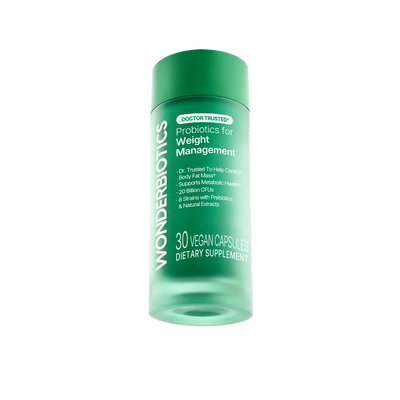
This guide uses five criteria that work across probiotic brands and rely on information found on the label or product page. The same criteria guide formula decisions at WonderBiotics, so WonderBiotics Probiotics for Weight Management serves as a transparent example of the framework in practice.
What Matters Most
The most useful shortcut is this: a probiotic is worth comparing on named strain, disclosed daily dose at expiration, real third-party verification, honest cost per effective day, and a match between the studied strain and your actual health goal. If a brand only lists species names, only guarantees CFU at manufacture, or says "third-party tested" without naming who tested what, the information is not sufficient for a fair comparison. WonderBiotics discloses every organism in its formulas at strain level so each one can be traced to published research.
Criterion 1: Named Strain, Not Just Species
A probiotic is defined by strain, not by species. That distinction is the single most important thing to understand before you buy.
A species name looks like this: Bifidobacterium animalis subsp. lactis. A strain designation looks like this: Bifidobacterium animalis subsp. lactis B420. The last part, the strain code, is what published research attaches to. Different strains within the same species can produce different effects, so evidence generated for one strain does not automatically transfer to another strain that shares only the species name.1
A 2018 evidence-based review of probiotic product selection concluded that matching the strain (or strains) to the target condition is one of the most important factors when choosing a product.2 A separate systematic review found strong evidence that probiotic efficacy is both strain-specific and disease-specific.3
What to look for. On the Supplement Facts panel, each organism should appear with genus, species, and strain identifier (a code, number, or trademarked name). If you only see "Lactobacillus acidophilus" or "Bifidobacterium blend," you cannot link that ingredient to a specific human trial.
WonderBiotics example. WonderBiotics Probiotics for Weight Management lists eight organisms at strain level, including B. animalis subsp. lactis B420, B. animalis subsp. lactis HN019, Lactobacillus acidophilus NCFM, and Lacticaseibacillus rhamnosus GG. Every organism is disclosed with its strain identifier, not only a species name.
Criterion 2: Dose, Disclosed at Expiration
Once a strain is identified, the next question is dose. Two numbers matter, and both need to be on the label to be useful.
Total CFU per serving. Most probiotics list a total daily CFU count in the tens of billions. On its own, this number is not very informative. Higher CFU is not automatically better, and clinical trials have used doses anywhere from about one billion to over a hundred billion, depending on the strain and the condition studied.4
Per-strain CFU. Ideally the label declares the CFU of each named strain, so you can compare it to the dose used in the clinical trial for that strain. The International Scientific Association for Probiotics and Prebiotics (ISAPP) advises manufacturers to list the total CFU for each strain through the product's expiration date.4 In practice, many multi-strain products list only the total, partly because it is technically difficult to quantify individual strains once they are combined.5
At expiration versus at manufacture. This is the detail that often gets missed. Probiotic cell counts decline during storage, so a label that promises "50 billion CFU at time of manufacture" does not tell you what remains alive on the day you actually take it. ISAPP and the Consumer Healthcare Products Association both recommend that the label CFU reflect viable cells at the end of shelf life, not at the time of manufacture.5,6
What to look for. A dose you can defend for your goal is one that (a) matches a studied dose for at least one of the named strains, and (b) is guaranteed at expiration, not at manufacture.
WonderBiotics example. The current WonderBiotics Probiotics for Weight Management label discloses 20 billion CFU total across eight named strains. For the metabolic anchor strain B420, the reference trial used approximately 10 billion CFU per day of the strain alone for six months in overweight adults.7 A total without a per-strain breakdown is a reasonable transparency question for any brand, including WonderBiotics.
Criterion 3: Testing, and Who Actually Did It
"Third-party tested" is one of the most flexible phrases in the supplement aisle. Before you accept it at face value, look at what was tested, who did the testing, and whether a product-level certification appears on the bottle or only a manufacturing site claim.
There are three distinct layers you may see:
- Facility certification. cGMP or NSF-registered facility means the manufacturing site meets a quality-system standard. This says something about the plant, not about your specific bottle.
- Product certification. Programs like USP Verified, NSF Certified, and ConsumerLab.com independently test finished products for identity, potency (does it match the label), and freedom from contaminants such as heavy metals and microbes.8 A product carrying one of these seals has been evaluated at the finished-product level.
- Vendor-arranged lab testing. A brand can pay a third-party lab to test its product without going through a formal certification program. This is legitimate, but you should be able to see a Certificate of Analysis on request, ideally showing which lot was tested and against which specifications.
None of these test whether a supplement is effective for your health goal. Third-party programs verify what is in the bottle, not what it will do inside you.8
What to look for. A seal from USP, NSF, or ConsumerLab is the strongest signal that a finished product has been independently checked. If a brand says only "third-party tested," a good follow-up question is: tested by whom, for what, and can you see the certificate?
WonderBiotics example. WonderBiotics products are manufactured in an NSF cGMP-certified facility in the United States, and the finished products are third-party tested for identity and potency of the named strains. This is facility certification plus vendor-arranged testing, a different tier from a per-product USP Verified or NSF Certified seal. Both approaches are common in the supplement industry, and the distinction matters when bottles are compared side by side.
Criterion 4: Price, Measured Per Effective Day
Sticker price on a 30-count bottle does not tell you what a probiotic actually costs, because bottles differ in serving size, and consistent use is what matters. Cost per day and cost per effective daily dose are more useful.
To compare two brands fairly:
1. Divide bottle price by the number of days it lasts at the recommended serving. That gives you cost per day.
2. Confirm the daily dose matches something you have reason to take. If a product costs $0.50 a day but the strain has no relevant clinical support, low cost per day is not a bargain.
3. Look at consistency incentives. Probiotic trials typically run for weeks to months. A subscription discount that lowers cost per day, combined with a clear return policy, can make longer-term consistency easier.
What to look for. Cost per day, calculated from an actual serving size, is the fair way to compare. Any price analysis that ignores dose is misleading in both directions.
WonderBiotics example. WonderBiotics Probiotics for Weight Management is priced at $55.40 for a 30-day supply, with subscription tiers that reduce the effective daily cost to roughly $1.38 to $1.56 depending on plan length. That number is only meaningful beside the strains and doses discussed above. Higher price does not equal a better outcome, and lower price does not equal a weaker formula.
Criterion 5: Health Goal Match, at the Strain Level
The most common mistake in probiotic shopping is treating "probiotic" as a single category with a shared benefit. It is not. Evidence lives at the strain-plus-condition level. A probiotic with strong data for antibiotic-associated diarrhea has not necessarily been studied for waist circumference, and vice versa.2,3
Different research bases exist for different goals. A shortlist of examples:
| Health goal | What the label needs to show |
|---|---|
| Weight and waist support in overweight adults | A strain with a multi-month human trial in an overweight population, at a dose that matches the trial |
| Digestive comfort and regularity | A strain with human trials measuring bowel frequency, stool form, or gut transit |
| Vaginal or urinary support | A strain studied for the specific tissue and outcome, often Lactobacillus species with vaginal-health data |
| GLP-1 companion use | A strain with digestive-comfort data, plus honesty that the probiotic does not replace or treat medication side effects |
| Perimenopause metabolic support | A strain trial where a meaningful share of participants match the perimenopausal demographic |
Two important limits belong right next to any goal match.
Finished-product versus strain-level evidence. Most probiotic marketing borrows evidence generated on a single strain and applies it to a finished multi-ingredient product. That borrowing is not automatic. Strain-level research supports the ingredient. Finished-product research would test the exact formula. Very few consumer probiotics have finished-product trials, and honest brands say so.
Category-level effects are modest. A 2024 meta-analysis of 200 randomized trials in 12,603 adults found that probiotics and synbiotics were associated with statistically significant but modest reductions in body weight (about 0.91 kg), BMI (about 0.28 kg/m²), and waist circumference (about 1.14 cm), with wide variation across strains and populations.9 In other words, "probiotic" alone predicts very little. The strain is what matters.
WonderBiotics example. WonderBiotics Probiotics for Weight Management is designed for adults, especially women in perimenopause and menopause, who are managing midsection weight, appetite changes, cravings, and digestion, including alongside a GLP-1 routine. The strain-level anchor is B. animalis subsp. lactis B420, studied in a 6-month randomized, placebo-controlled trial in 225 overweight adults with a BMI of 28 to 34.9. The trial observed reductions in body fat, waist circumference, and daily energy intake.7 That evidence sits at the strain level. B420 is included at a dose disclosed on the WonderBiotics label, but the study does not prove that the finished product will produce the same result in every user.
Putting the Five Criteria Together
A probiotic that passes on all five criteria is uncommon. A probiotic that fails on the first two (unnamed strains, or no per-strain dose disclosure) is usually not worth comparing further, because you cannot link it to any specific evidence base.
A practical way to work through a shortlist:
1. Read the Supplement Facts panel. Confirm each organism is listed by genus, species, and strain code.
2. Check whether the CFU is guaranteed at expiration and whether per-strain amounts are disclosed.
3. Look for a product-level third-party seal, or a Certificate of Analysis available on request.
4. Calculate cost per day at the recommended serving.
5. Match at least one named strain and dose to a real human trial in a population that resembles you, for the outcome you actually care about.
If a brand passes step 1 but fails step 5, you have a well-labeled product without evidence for your specific goal. If it passes step 5 but fails step 1, it is making promises the label cannot back up. The value of a five-criteria framework is that it treats every brand on the same terms, ours included.
WonderBiotics uses these criteria because the same information gaps appear throughout the category. A reusable comparison framework is more useful than a fixed brand ranking, which is why the database is structured this way.
Educational note. This article discusses general information about probiotic supplements and mentions GLP-1 medications. It is not medical advice and does not replace guidance from a licensed healthcare professional. If you are pregnant, nursing, taking prescription medication, or managing a diagnosed condition, talk with your clinician before starting any new supplement.
References
- Hill C, Guarner F, Reid G, et al. Expert consensus document: The International Scientific Association for Probiotics and Prebiotics consensus statement on the scope and appropriate use of the term probiotic. Nat Rev Gastroenterol Hepatol. 2014;11(8):506-514. https://www.nature.com/articles/nrgastro.2014.66
- McFarland LV, Evans CT, Goldstein EJC. Strain-Specificity and Disease-Specificity of Probiotic Efficacy: A Systematic Review and Meta-Analysis. Front Med (Lausanne). 2018;5:124. https://www.ncbi.nlm.nih.gov/pmc/articles/PMC5949321/
- McFarland LV, Goh S. Choosing an appropriate probiotic product for your patient: An evidence-based practical guide. PLoS One. 2018;13(12):e0209205. https://www.ncbi.nlm.nih.gov/pmc/articles/PMC6306248/
- National Institutes of Health, Office of Dietary Supplements. Probiotics: Health Professional Fact Sheet. https://ods.od.nih.gov/factsheets/Probiotics-HealthProfessional/
- International Scientific Association for Probiotics and Prebiotics. Decoding a Probiotic Product Label. https://isappscience.org/decoding-a-probiotic-product-label/
- Consumer Healthcare Products Association. Best Practices Voluntary Guidelines for Probiotics. https://www.chpa.org/public-policy-regulatory/voluntary-codes-guidelines/best-practices-voluntary-guidelines-probiotics
- Stenman LK, Lehtinen MJ, Meland N, et al. Probiotic With or Without Fiber Controls Body Fat Mass, Associated With Serum Zonulin, in Overweight and Obese Adults - Randomized Controlled Trial. EBioMedicine. 2016;13:190-200. https://www.sciencedirect.com/science/article/pii/S2352396416304972
- U.S. Pharmacopeial Convention. Dietary Supplements Verification Program. https://www.usp.org/verification-services/dietary-supplements-verification-program. NSF International. Dietary Supplement and Vitamin Certification. https://www.nsf.org/consumer-resources/articles/supplement-vitamin-certification
- Saadati S, Naseri K, Asbaghi O, Yousefi M, Golalipour E, de Courten B. Beneficial effects of the probiotics and synbiotics supplementation on anthropometric indices and body composition in adults: A systematic review and meta-analysis. Obes Rev. 2024;25(3):e13667. https://onlinelibrary.wiley.com/doi/10.1111/obr.13667


