


Do Probiotics and Prebiotics Help With Weight Loss?

Do Probiotics and Prebiotics Help With Weight Loss? The Strain-by-Strain Evidence

Probiotics and prebiotic fiber can each produce modest weight loss in randomized trials, typically under a kilogram over 8 to 12 weeks. What the marketing usually skips is how much that number depends on which specific strain or fiber you picked, and the assumption that combining both into a synbiotic beats either alone doesn't hold up well either: across 97 pooled meta-analyses, synbiotic results were the least consistent of the three.
What's the Difference Between Probiotics, Prebiotics, and Synbiotics?
Probiotics are live microorganisms you swallow: specific, named bacterial strains, each studied (or not studied) on its own merits. Prebiotics aren't alive at all. They're fibers your gut bacteria ferment, defined by an international expert panel as "a substrate that is selectively utilized by host microorganisms conferring a health benefit."1
A synbiotic combines both in the same formula, but the ISAPP panel's definition requires more than just co-packaging: the finished mixture also has to show a demonstrated health benefit in the population it's meant for, not just contain established probiotic and prebiotic components. The same expert panel split the category further in 2020: a "complementary synbiotic" pairs a probiotic strain with any prebiotic fiber, chosen independently of each other; a "synergistic synbiotic" is designed so the fiber specifically feeds the co-administered strain.2 Most commercial products, including our own, are built on the complementary logic, the strains and the fiber weren't co-selected in a lab to metabolize each other, they're combined because each has its own evidence, though that finished-mixture benefit still has to be shown for the specific product, not assumed from its ingredients. A complementary blend doesn't inherit some automatic synergy bonus just from being in the same capsule.
How Strong Is the Strain-by-Strain Probiotic Evidence?
Probiotic weight research doesn't generalize across strains, and product labels rarely make that clear. Here's how the most-cited weight-focused strains compare:
| Strain | Trial | Population | Result |
|---|---|---|---|
| B. animalis subsp. lactis B420 | Stenman 2016, 225 adults, 6 months3 | Overweight/obese adults, both sexes | Pooled-B420-arms post-hoc effect on body fat, P=0.002; B420 alone not significant (P=0.28); DuPont-funded |
| L. gasseri SBT2055 | Kadooka 20104/20135, 87 and 210 adults | Adults with large visceral fat area | Visceral fat dropped from baseline in the active groups (both trials); the placebo/control groups showed no such drop from their own baseline. In the larger 2013 trial, stopping the product for 4 weeks brought measurements back close to baseline; funded by/authors employed by Megmilk Snow Brand |
| L. rhamnosus CGMCC1.3724 (LPR) | Sánchez 2014, 125 analyzed of 153 randomized6 | Obese adults; postmenopausal women excluded | No effect overall; women lost significantly more weight than women on placebo at 12 weeks (P=0.02), men showed none; Nestlé-funded |
| L. gasseri BNR17 | Kim 2018, 90 adults7 | Adults with obesity | Visceral fat down at the higher dose only (P=0.012); waist size improved within-group, not against placebo |
A few patterns stand out. Sex matters: the LPR trial's overall result washed out because it only worked in women, and it deliberately excluded anyone postmenopausal, so you can't assume that finding applies once you're past that transition.6 (The 125-person analysis also excluded 28 of the original 153 randomized participants for dyslipidemia, so treat it as a per-protocol result rather than a strict intention-to-treat one.) "Significant" often means something narrower than it sounds, too: both SBT2055 trials, and BNR17's waist-circumference finding, report the active group's improvement against its own starting point, with the placebo or control group separately shown to have no such improvement, rather than a head-to-head group-versus-group test reported in the same sentence.4 5 7 It's a real pattern, but a softer claim than "beat placebo directly." Dosing and consistency matter too: in the 210-person SBT2055 trial, pausing the product for 4 weeks brought visceral-fat measurements back close to baseline, so whatever benefit exists appears to depend on staying with it.5
How Strong Is the Fiber-Type Prebiotic Evidence?
Prebiotic fiber research is more concentrated on one family: chicory-root inulin and its shorter form, oligofructose. A 2024 meta-analysis of 32 trials and 1,184 people found these fibers reduced body weight by an average of 0.97 kg (95% CI −1.34 to −0.59, P<0.0001), with smaller reductions in waist circumference (−1.03 cm, n=604) and total fat mass (−0.37 kg, n=397).8 That meta-analysis was funded by a chicory-fiber manufacturer, and two of its three authors work for that company, which is worth weighing alongside the numbers.8
A separate trial adds a single-study data point: 48 adults randomized to 21 g/day of oligofructose or a placebo for 12 weeks, with body weight as the pre-specified primary outcome. The fiber group lost 1.03 ± 0.43 kg while the placebo group gained 0.45 ± 0.31 kg (P=0.01).9 Funding was Canadian public/university grants with no author conflicts declared, though the oligofructose itself was donated in kind by a commercial fiber supplier that wasn't otherwise involved in the trial.
Fiber type changes the answer more than the umbrella term "prebiotic" suggests. A broader umbrella review pooling many prebiotic meta-analyses, not just chicory-root fiber specifically, found a murkier picture: only 3 of 5 pooled analyses showed a weight-reducing effect, and only 2 of 5 showed a BMI-reducing effect, with waist circumference and fat mass rated a neutral effect overall.10 That review spans populations from infancy through older adults, not just adults seeking weight loss, so it's a rougher comparison than a head-to-head test. Still, set alongside the chicory-specific numbers above, it points toward chicory-root inulin-type fructans, specifically, having the stronger and more consistent human data among prebiotic fibers. "Prebiotic" as a blanket category predicts far less about what a given fiber will do for your weight than the exact fiber source does.
Do Synbiotics (Combining Both) Work Better?
The intuitive pitch, probiotic plus prebiotic should beat either alone, doesn't hold up as a general rule in the largest available synthesis. That 2024 umbrella review pooled 97 meta-analyses in total, drawing on 62 that assessed probiotics, 16 that assessed prebiotics, and 25 that assessed synbiotics (some individual meta-analyses covered more than one category).10 Within the synbiotic-specific analyses, only 3 of 7 found a significant reduction in body weight and only 2 of 6 found a significant reduction in BMI, a less consistent showing than either single-ingredient category.10
The most detailed head-to-head test of the combination idea is that same B420 trial. Researchers randomized 225 overweight and obese adults into four parallel groups, funded by DuPont Nutrition & Health (which supplied the strain and fiber, with several authors employed by the company): placebo, a prebiotic fiber alone (12 g/day of a polydextrose-based fiber), B420 alone, or B420 plus that fiber together.3 Body fat mass by DXA scan was the trial's pre-specified primary outcome, and across the full analyzed group (199 people with a fat-mass measurement), there was no significant difference among the four arms (P=0.46). In the smaller per-protocol subset (participants with at least 80% product compliance and no major protocol deviations), the combined arm lost more body fat than placebo (−4.5%, P=0.02), while B420 alone did not (−3.0%, P=0.28). The four-arm comparison in that subset also fell short of significance overall, though (P=0.095). A separate analysis, run after the trial was unblinded, pooled both B420-containing arms together against both non-B420 arms and did find a significant difference (−4.0%, P=0.002).3 It's a hypothesis-generating comparison of pooled groups rather than a validated finding that the two ingredients work better together than B420 does by itself, since the trial never directly tested the combined arm against the B420-alone arm as its own pre-specified comparison.
A smaller, open-label trial in Tunisia adds a useful caution about how easy it is to overread these designs, it's often described loosely as a "synbiotic trial," but it didn't include a combined probiotic-plus-prebiotic arm at all. Forty-five adults with obesity were split into diet-only, diet-plus-prebiotic (carob), and diet-plus-probiotic groups for one month, with no blinding and no group receiving diet alone plus a placebo pill.11 All three groups lost weight; the diet-only group actually lost slightly more (2.5 kg) than either the probiotic (1.7 kg) or prebiotic (1.9 kg) group, and the trial didn't statistically compare any of the groups' weight changes against each other.11 On its own, it can't tell you either supplement added anything beyond the diet itself.
The ISAPP panel that defined synbiotics made the same point in plainer terms: they explicitly declined to claim synbiotics are more effective than their individual components, saying any such benefit has to be demonstrated case by case rather than assumed.2 Combining a probiotic and a prebiotic is a reasonable design choice, but it isn't, on its own, a guarantee of a bigger result.
Which Studies Included Women Like You?
If you're past menopause, population matching is worth checking before any single number. The LPR trial excluded postmenopausal women entirely, and its only significant weight result came from the premenopausal women's subgroup, so that finding, whatever its merits, doesn't speak to your stage of life.6 The Tunisian diet-plus-supplement trial above skews closer to this site's core reader: 93% female, average age 48.7 (range 33-63), all with obesity.11 It's a reasonable demographic match, but still a one-month, open-label, 45-person study, a data point, not a verdict. Across this whole comparison, B420, SBT2055, LPR, BNR17, chicory fiber, and the combination trials, dedicated postmenopausal-only randomized trials remain the exception rather than the rule.
How WonderBiotics Pairs Probiotics and Prebiotic Fiber
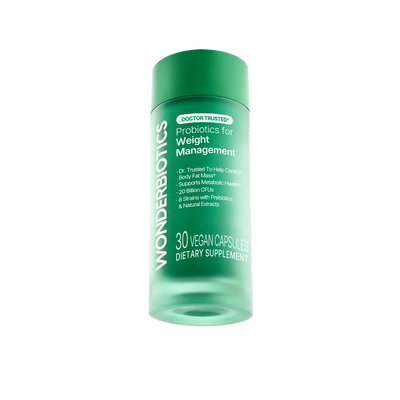
B420 is the strain with the strongest trial signal in the table above, which is exactly why it anchors our flagship formula, WonderBiotics Probiotics for Weight Management, alongside seven other studied probiotic strains and a separate metabolic blend (dihydroberberine and a standardized lemon extract). Our public ingredient listing doesn't break out CFU counts by individual strain, so we can't confirm our B420 dose matches the 10 billion CFU/day used in the trial above, a fair question to ask any brand selling a multi-strain blend, ours included, and one we'd rather you ask than assume.
For people who want to push their fiber intake further than a multi-strain probiotic blend is designed to carry, WonderBiotics Daily Fiber Mix is the separate layer we built for that. Its five named fibers are led by Fibersol and partially hydrolyzed guar gum, both in the same slower-fermenting category as wheat dextrin in an in-vitro fermentation model (funded by Novartis Consumer Health, which had its own wheat-dextrin product at the time), alongside psyllium husk, FOS, and kale fiber.12 That in-vitro model measured gas and pH in isolated fiber samples, not this blend or human symptoms, but it's a reasonable signal that a fast fermenter like straight inulin or FOS can hit harder in the first week or two than a slower fermenter at an equivalent gram amount. The goal is a blend you can dial up gradually, 1 to 3 sachets a day, rather than starting at a full dose of fast-fermenting fiber. Used together, the two products echo the trial logic above: one adds studied strains, the other lets you close your fiber gap at whatever pace your gut tolerates, and neither is sold as a shortcut around the diet and activity changes that still do most of the work.
When to Check In With Your Doctor
Adding fiber or a multi-strain probiotic is low-risk for most healthy adults, but a fast increase in fiber can cause real gas, cramping, and bloating, especially if you have IBS. If you're immunocompromised, critically ill, or have a central line, ask your doctor before starting a probiotic, since bacterial products carry a small bloodstream-infection risk in those groups. If you're on a GLP-1 medication like semaglutide or tirzepatide, talk to your prescriber before adding a new probiotic or fiber supplement, and never adjust your prescribed dose on your own based on how a supplement makes you feel. Seek care right away for severe abdominal pain, persistent vomiting, or blood in your stool.
References
- Gibson GR, Hutkins R, Sanders ME, et al. Expert Consensus Document: The International Scientific Association for Probiotics and Prebiotics (ISAPP) Consensus Statement on the Definition and Scope of Prebiotics. Nat Rev Gastroenterol Hepatol. 2017;14(8):491-502. PMID: 28611480
- Swanson KS, Gibson GR, Hutkins R, et al. The International Scientific Association for Probiotics and Prebiotics (ISAPP) Consensus Statement on the Definition and Scope of Synbiotics. Nat Rev Gastroenterol Hepatol. 2020;17(11):687-701. PMID: 32826966
- Stenman LK, Lehtinen MJ, Meland N, et al. Probiotic With or Without Fiber Controls Body Fat Mass, Associated With Serum Zonulin, in Overweight and Obese Adults-Randomized Controlled Trial. EBioMedicine. 2016;13:190-200. PMID: 27810310
- Kadooka Y, Sato M, Imaizumi K, et al. Regulation of Abdominal Adiposity by Probiotics (Lactobacillus gasseri SBT2055) in Adults With Obese Tendencies in a Randomized Controlled Trial. Eur J Clin Nutr. 2010;64(6):636-643. PMID: 20216555
- Kadooka Y, Sato M, Ogawa A, et al. Effect of Lactobacillus gasseri SBT2055 in Fermented Milk on Abdominal Adiposity in Adults in a Randomised Controlled Trial. Br J Nutr. 2013;110(9):1696-1703. PMID: 23614897
- Sánchez M, Darimont C, Drapeau V, et al. Effect of Lactobacillus rhamnosus CGMCC1.3724 Supplementation on Weight Loss and Maintenance in Obese Men and Women. Br J Nutr. 2014;111(8):1507-1519. PMID: 24299712
- Kim J, Yun JM, Kim MK, Kwon O, Cho B. Lactobacillus gasseri BNR17 Supplementation Reduces Insulin Resistance and Body Fat in a Randomized, Double-Blind, Placebo-Controlled Clinical Trial of Obese Korean Subjects. J Med Food. 2018;21(5):454-461. PMID: 29688793
- Reimer RA, Theis S, Zanzer YC. The Effects of Chicory Inulin-Type Fructans Supplementation on Weight Management Outcomes: Systematic Review, Meta-Analysis, and Meta-Regression of Randomized Controlled Trials. Am J Clin Nutr. 2024;120(5):1245-1258. PMID: 39313030
- Parnell JA, Reimer RA. Weight Loss During Oligofructose Supplementation Is Associated With Decreased Ghrelin and Increased Peptide YY in Overweight and Obese Adults. Am J Clin Nutr. 2009;89(6):1751-1759. PMID: 19386741
- Rasaei N, Heidari M, Esmaeili F, et al. The Effects of Prebiotic, Probiotic or Synbiotic Supplementation on Overweight/Obesity Indicators: An Umbrella Review of the Trials' Meta-Analyses. Front Endocrinol (Lausanne). 2024;15:1277921. PMID: 38572479
- Ben Othman R, Ben Amor N, Mahjoub F, et al. A Clinical Trial About Effects of Prebiotic and Probiotic Supplementation on Weight Loss, Psychological Profile and Metabolic Parameters in Obese Subjects. Endocrinol Diabetes Metab. 2023;6(2):e402. PMID: 36606510
- Noack J, Timm D, Hospattankar A, Slavin J. Fermentation Profiles of Wheat Dextrin, Inulin and Partially Hydrolyzed Guar Gum Using an In Vitro Digestion Pretreatment and In Vitro Batch Fermentation System Model. Nutrients. 2013;5(5):1500-1510. PMID: 23645025


