


Does Berberine Stop Food Noise? What the Evidence Shows

Does Berberine Stop Food Noise? What "Stop" Would Have to Prove

No published trial has tested whether berberine stops food noise, and no berberine study has even used a validated food noise scale. **That gap matters more than it sounds: the word stop is doing a lot of work that blood sugar stability and gut hormone pathways, mechanistically plausible but nowhere near demonstrated in people, haven't earned yet.**
The distance between what stop implies and what the research actually supports is the difference between a claim you can trust and one still borrowing credibility from science in progress. Here's how to read the actual evidence, and what a more realistic plan for managing food noise looks like.
Defining "Food Noise", and What "Stop" Would Have to Prove
Food noise is a specific, defined concept, not just a synonym for hunger. Researchers describe it as "heightened and/or persistent manifestations of food cue reactivity, often leading to food-related intrusive thoughts and maladaptive eating behaviors."1 It's the mental chatter about food that keeps running whether or not your stomach is actually empty.
Because it's a defined construct, it's also measurable. The Food Noise Questionnaire (FNQ), validated in 2025 in a sample of 396 adults, is a 5-item scale that captures how often and how intensely those food-related thoughts intrude.2 For a supplement to legitimately claim it "stops" food noise, a trial would need to give people berberine, give others a placebo, and use a tool like the FNQ to see whether the berberine group's scores actually dropped more. As of this search, no such trial exists for berberine, in any form, at any dose. It's a bounded evidence gap, not proof that berberine can't help, but it does mean the word "stop" is being used well ahead of the data.
What the Berberine Research Has Measured
Most of what gets cited as "berberine reduces food noise" is really a chain of mechanistic studies, none of which measured food noise, hunger, or even food intake in humans.
In rodents, berberine blunted a hunger signal. In one study, researchers injected neuropeptide Y (NPY), a brain chemical that strongly drives eating, directly into the brains of rats and watched food intake jump 39% above control. When berberine was co-injected, that increase reversed into a 48% drop relative to control.3 It's a real, interesting mechanistic finding, and also a rat study using intracranial injections, which is a long way from a woman taking a berberine capsule with breakfast.
In cell cultures, berberine triggered a GLP-1-related signal. Berberine activates a bitter-taste receptor pathway on mouse intestinal cells grown in a dish, which increases GLP-1 output from those cells.4 This is in vitro evidence, isolated cells, not a person's gut, and it sits several rungs below a human trial on the evidence ladder.
In mice and hamsters, berberine raised a satiety-related hormone. A 2025 mechanistic review notes that berberine increased GDF15, a hormone that signals fullness through a brain receptor called GFRAL, in diet-induced obese mice and hamsters given 50-100 mg/kg/day for 10-14 days.5 No published human data confirms this pathway responds the same way at typical supplement doses.
One completed human trial looked at incretin secretion, not appetite. A registered trial in healthy men measured whether berberine promotes incretin (including GLP-1) release in humans, following up on the mouse and cell data.6 It's a genuine step toward human evidence, but its design measured hormone levels, not hunger, cravings, or intrusive food thoughts.
The one WonderBiotics-relevant human data point is a pharmacokinetics pilot, not an appetite study. A small crossover pilot in five healthy men compared dihydroberberine, an enhanced-absorption form of berberine, against standard berberine and found dihydroberberine produced greater plasma berberine exposure. Blood glucose and insulin differences between forms were not statistically significant.7 It tells you dihydroberberine gets into the bloodstream more efficiently; it says nothing about appetite or food noise. That absorption edge is precisely why we built our own formula around dihydroberberine instead of the cheaper, more common berberine HCl, more on that below.
Stack these up and you get a coherent hypothesis: better glucose stability plus gut-hormone signaling could plausibly turn down some drivers of food noise. What you don't get is a single controlled human trial connecting berberine to the actual outcome, quieter food-related thoughts, that the keyword is asking about.
Stop, Reduce, or Support: Why the Verb Matters
These three words aren't interchangeable, and confusing them is where a lot of supplement marketing goes wrong.
- "Stop" implies a switch, food noise present, then absent, demonstrated in a trial with a validated outcome measure. Nothing in the berberine literature clears that bar.
- "Reduce" implies a measured, statistically significant drop in a specific outcome compared to a control group. Berberine has real, reduce-level human evidence for things like fasting glucose and LDL cholesterol, but not, so far, for food noise or subjective hunger scores specifically.
- "Support" is the honest, mechanism-level word: berberine plausibly nudges systems (glucose variability, GLP-1 signaling, GDF15) that are involved in appetite regulation, based on animal and cell studies plus one human hormone trial.
When you see berberine marketed as something that will "quiet the chatter" or "shut off" cravings, that's "support"-tier evidence wearing "stop"-tier language. It's worth asking, for any product making that claim: which of these three words does the cited research actually support?
Safety Considerations Before Adding Berberine
A 2025 meta-analysis of 12 placebo-controlled trials (889 participants) found no statistically significant increase in overall gastrointestinal adverse events with berberine versus placebo (relative risk 1.44, 95% CI 0.85-2.42), though individual reports of diarrhea, constipation, and nausea did occur.8 That's reassuring at the group level, but individual tolerance still varies.
The bigger safety issue is drug interactions, not stomach upset. Berberine can meaningfully decrease the activity of liver enzymes CYP2D6, 2C9, and 3A4, which affects how your body clears many prescription medications.9 It may also affect how sulfonylurea diabetes medications are metabolized (documented in vitro, with clinical relevance not yet established) and can raise blood levels of immunosuppressants like tacrolimus and cyclosporine.9 If you take prescription medications, especially for diabetes, blood pressure, or after an organ transplant, talk with your doctor or pharmacist before adding berberine, and never use it as a reason to adjust or stop a prescribed medication on your own.
A More Sustainable Way to Quiet Food Noise
If berberine's best-supported role is as one input into glucose stability rather than a food-noise off-switch, the more durable strategy is to build the whole plate around that same goal: steadier blood sugar, adequate protein and fiber at each meal, and a gut environment that supports regular GLP-1-related signaling rather than relying on any single ingredient to do the job alone.
Fiber is the most human-trial-backed piece of that picture. In one crossover study, adults who took 10 g of Fibersol-2 (a soluble corn fiber) with a meal had significantly higher GLP-1 and PYY and delayed their next hunger cue by 1.5-2 hours compared to no fiber.10 In postmenopausal women specifically, a soluble fiber preload significantly blunted hunger compared to an insoluble fiber preload, though it didn't outperform having no preload at all, a nuance worth knowing rather than glossing over.11
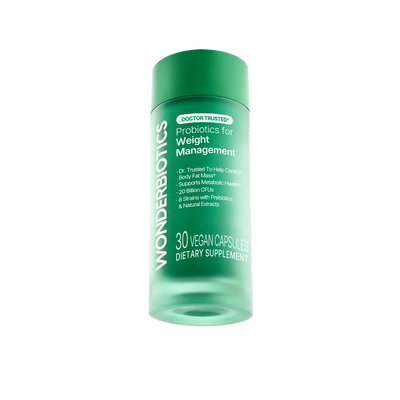
This is the thinking behind WonderBiotics Probiotics for Weight Management: we built its Metabolic Blend around dihydroberberine rather than standard berberine HCl precisely for that absorption advantage, and paired it with a standardized lemon extract (Eriomin® (lemon extract)) that has human data showing a within-group rise in GLP-1 over 12 weeks.7 Layered alongside that is our 8-strain, 20-billion-CFU probiotic blend, including B. animalis subsp. lactis B420, so the formula is working gut ecology and metabolic signaling together, on multiple evidence-backed levers at once, rather than betting everything on one mechanism. B420 pulls its own weight here too: in the largest RCT behind that strain (225 adults, 6 months), people taking B420 alone logged roughly 300 fewer calories a day in their food diaries than the placebo group did, a real, appetite-relevant signal we designed the formula to build on.12 No berberine product on the market today, ours included, has been shown in a trial to switch food noise off, so we don't claim that. What we designed this formula to be is steady, non-stimulant, daily support for the same systems, glucose stability, gut hormone signaling, appetite-related eating behavior, that the evidence above actually moves, meant to pair with the basics that matter most: protein at breakfast, fiber spread through the day, consistent meal timing. If sluggish regularity or fermentable fiber is more your gap, our Daily Fiber Mix is the natural next layer in that same routine.
Support, Not a Switch
Berberine hasn't been shown to stop food noise in any published human trial, and the research that does exist, rat and mouse studies, isolated cells, one human hormone trial, a five-person pharmacokinetics pilot, sits well below the level of evidence that word requires. "Support" is the accurate word for where the science currently stands. If quieting food noise is your goal, treat berberine as one possible piece of a bigger pattern, steady blood sugar, adequate fiber and protein, and a supportive gut environment, and talk to your doctor before adding it if you take other medications.
References
- Hayashi D, Edwards C, Emond JA, Gilbert-Diamond D, Butt M, Rigby A, Masterson TD. "Understanding Food Noise: A Conceptual Model of Food Cue Reactivity." Nutrients. 2023;15(22):4809. https://doi.org/10.3390/nu15224809
- Diktas HE, Cardel MI, Foster GD, LeBlanc MM, Dickinson SL, Ables EM, Chen X, Nathan R, Shapiro D, Martin CK. "Development and validation of the Food Noise Questionnaire." Obesity (Silver Spring). 2025;33(2):289-297. https://doi.org/10.1002/oby.24216
- Park HJ, Jung E, Shim I. "Berberine for Appetite Suppressant and Prevention of Obesity." Biomed Res Int. 2020;2020:3891806. PMID 33415147. https://pmc.ncbi.nlm.nih.gov/articles/PMC7752296/
- Yue X, Liang J, Gu F, et al. "Berberine activates bitter taste responses of enteroendocrine STC-1 cells." Mol Cell Biochem. 2018;447:21-32. PMID 29363059. https://doi.org/10.1007/s11010-018-3290-3
- Alpaslan Ağaçdiken A, Göktaş Z. "Berberine-induced browning and energy metabolism: mechanisms and implications." PeerJ. 2025;13:e18924. PMID 39931072. https://doi.org/10.7717/peerj.18924
- "Berberine on the Secretion of Incretin in Normal Man." ClinicalTrials.gov identifier NCT05947370. Beijing Tongren Hospital. Completed April 2023. https://clinicaltrials.gov/study/NCT05947370
- Moon JM, et al. "Absorption Kinetics of Berberine and Dihydroberberine and Their Impact on Glycemia: A Randomized, Controlled, Crossover Pilot Trial." Nutrients. 2022;14(1):124. PMID 35010998. https://pmc.ncbi.nlm.nih.gov/articles/PMC8746601/
- Liu D, Zhao H, Zhang Y, Hu J, Xu H. "Efficacy and safety of berberine on the components of metabolic syndrome: a systematic review and meta-analysis of randomized placebo-controlled trials." Front Pharmacol. 2025. https://pmc.ncbi.nlm.nih.gov/articles/PMC12307485/
- "Berberine." Memorial Sloan Kettering Cancer Center, About Herbs. https://www.mskcc.org/cancer-care/integrative-medicine/herbs/berberine
- Ye Z, Arumugam V, Haugabrooks E, Williamson P, Hendrich S. "Soluble dietary fiber (Fibersol-2) decreased hunger and increased satiety hormones in humans when ingested with a meal." Nutr Res. 2015;35(5):393-400. PMID 25823991. PubMed
- Burton-Freeman B, Liyanage D, Rahman S, Edirisinghe I. "Effect of fiber type on satiety in relation to postmenopausal status." Nutrition and Healthy Aging. 2017. PMID 28447070. PubMed
- Stenman LK, Lehtinen MJ, Meland N, et al. "Probiotic With or Without Fiber Controls Body Fat Mass, Associated With Serum Zonulin, in Overweight and Obese Adults-Randomized Controlled Trial." EBioMedicine. 2016;13:190-200. PMID 27810310. PubMed


