


Best Probiotics That Survive Stomach Acid

What Are the Best Probiotics That Can Actually Survive Stomach Acid?
If you've spent any time looking at probiotic labels, you've probably wondered the obvious question: do these bacteria actually reach my gut alive, or am I paying for billions of dead microbes? The question is fair, and the honest answer is more nuanced than most marketing copy admits. Strain-intrinsic resistance, delivery technology, and labeling practices all matter, and they vary widely across the category. This article walks through what actually happens to probiotics in the stomach, which strains and delivery approaches have published evidence for survival, and how to read a label so you are not paying for a CFU number that does not reach your intestine.

What Actually Survives
The honest summary: most generic Lactobacillus and Bifidobacterium strains take significant viability hits in stomach acid, with survival rates varying widely by strain, formulation, and labeling claim.
The categories with the strongest survival profiles:
- Naturally acid-resistant strains like Bifidobacterium animalis subsp. lactis, Lactobacillus rhamnosus GG, Lactobacillus casei Shirota
- Spore-forming probiotics like Bacillus coagulans, whose dormant spores tolerate gastric acid and bile salts at much higher rates than vegetative bacteria
- Encapsulated formulations using alginate, cellulose-based coatings, or similar microencapsulation technologies that physically shield bacteria during gastric transit
- Products that disclose CFU at the end of shelf life, not just at the time of manufacture
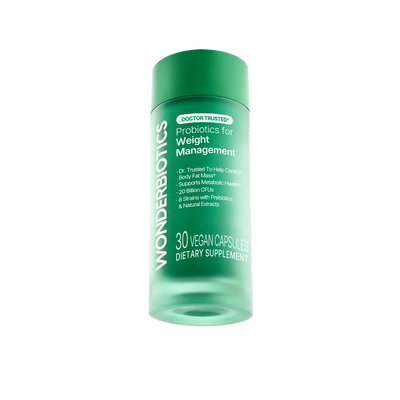
WONDERBIOTICS Probiotics for Weight Management is one option built around the naturally acid-resistant Bifidobacterium animalis subsp. lactis B420™ strain, with proprietary PolarSeal delivery technology and disclosed in vitro survival test data.
What Actually Happens to Probiotics in the Stomach
The stomach is a hostile environment for live bacteria. Stomach acid sits between pH 1.5 and 3.5 when food is present, and most bacterial cells lose membrane integrity within minutes of exposure at the lower end of that range. The small intestine adds bile salts, which disrupt bacterial cell membranes through detergent-like action.
These conditions are exactly the reason the gut microbiome looks the way it does: most environmental bacteria from food cannot survive transit. Only strains with specific structural or genetic adaptations (acid-tolerance genes, spore forms, robust cell walls) make it through in meaningful numbers.
For oral probiotics, this translates to a practical question: what fraction of the bacteria on the label actually arrive in the small intestine alive? Early human in vivo studies using intestinal perfusion demonstrated that some Bifidobacterium strains delivered in fermented milk survive small intestinal transit in measurable quantities, providing the foundation for the modern understanding that probiotic delivery is possible but strain- and format-dependent.[1]
In in vitro studies that simulate gastric and intestinal conditions, free (unencapsulated) Lactobacillus and Bifidobacterium often show several log reductions in viable count (a 7 log reduction means a 10,000,000-fold drop). Encapsulated versions of the same strains typically retain much higher viability, sometimes losing only 3 logs (a 1,000-fold drop) under the same conditions.
Terms to Know!
- Colony-forming unit (CFU): the standard unit for counting viable bacteria in a probiotic product; one CFU represents one bacterial cell capable of forming a colony under lab conditions. The CFU number on a label depends on when it was measured (at manufacture vs at the end of shelf life).
- Microencapsulation: a manufacturing technique that coats probiotic cells with a protective layer of polysaccharides, proteins, or other biopolymers; the coating delays release of bacteria until they reach the intestine, improving survival through gastric acid.
Approaches That Improve Survival
Naturally acid-resistant strains
Some strains have intrinsic adaptations that allow them to tolerate gastric conditions without specialized delivery technology. The probiotic definition itself, established by the International Scientific Association for Probiotics and Prebiotics, emphasizes that effects depend on the specific strain.[2] This applies to survival as much as to clinical endpoint effects.
Among non-spore-forming probiotics, Bifidobacterium animalis subsp. lactis (including strains like B420™, HN019, BB-12), Lactobacillus rhamnosus GG, and Lactobacillus casei Shirota are commonly cited as more acid-tolerant than other lactic acid bacteria. The molecular reasons include cell wall composition, lactic acid production (the bacteria themselves contribute to their micro-environment's acid tolerance), and stress-response gene expression.
Strain-intrinsic resistance does not eliminate the need for proper delivery; it means the strain has a more forgiving baseline.
Spore-forming probiotics (Bacillus coagulans)
Spore-forming probiotics work on a different mechanism. Their dormant spore form is structurally protected against heat, low pH, and bile salts in ways that vegetative bacterial cells are not. Bacillus coagulans strains, in particular, have been characterized for tolerance to acid (pH 3.0) and bile salts (0.3%), with spores remaining viable through simulated gastrointestinal conditions and then germinating in the intestine.[3]
The practical implication: a 1 billion CFU dose of Bacillus coagulans spores will lose a much smaller fraction in the stomach than a 1 billion CFU dose of unencapsulated Lactobacillus. The two are not directly comparable on survival grounds, even with identical CFU numbers on the label.
Microencapsulation and protective delivery
For strains that are not naturally acid-resistant, encapsulation technology is the standard approach. Multiple peer-reviewed studies have evaluated alginate, cellulose acetate phthalate (CAP), xanthan gum, and combination systems. A representative study using freeze-dried Lactobacillus acidophilus and Bifidobacterium lactis found that encapsulation in alginate with cellulose acetate phthalate improved survival in simulated gastric conditions from approximately 63% (free freeze-dried cells) to 76% (encapsulated).[4]
Different encapsulation systems produce different survival profiles. The honest reading is that encapsulation meaningfully improves survival but does not produce complete protection. Marketing claims of "100% survival" are not biologically realistic.
The Labeling Honesty Question
This is where consumer-facing transparency matters most, and where the category is most variable.
CFU at manufacture vs CFU at end of shelf life. Probiotic cells die over time even in unopened packaging. A product labeled "50 billion CFU at time of manufacture" may contain considerably fewer viable cells by the expiration date. Industry voluntary guidelines and best-practice frameworks recommend labeling the CFU number at the end of shelf life, not at manufacture.[5] The U.S. Office of Dietary Supplements explicitly notes that consumers should look for products labeled with CFU at end of shelf life rather than at time of manufacture, because dead bacteria do not provide probiotic benefits.[6]
The "billion-CFU arms race." Some products lead with very high CFU numbers (100+ billion) as a marketing differentiator. A higher CFU number is not automatically better. The relevant questions are:
- Is the CFU number measured at end of shelf life?
- Is it for a strain with published human evidence at that dose?
- Is the dose comparable to what was used in the supporting trial?
A 10 billion CFU product of a strain with strong RCT evidence at 10 billion CFU is more aligned with science than a 100 billion CFU product of strains without strain-level evidence at any dose.
In vitro survival tests vs in vivo survival demonstration. Most "survival rate" claims you see on probiotic labels come from in vitro simulated gastric testing, not from human in vivo measurement. In vitro tests are useful for comparing formulations under standardized conditions and are the basis of most published survival data. They are not the same as demonstrating viable arrival at a specific intestinal site in human subjects, which requires more complex study designs.
A product that discloses its in vitro testing conditions and results is being more transparent than one that simply asserts "survives stomach acid" without specifying how it was measured.
How to Read a Label for Survival
Five questions cut through most marketing.
Is the strain named with a deposited identifier? Lactobacillus rhamnosus GG, Bifidobacterium animalis subsp. lactisB420™, Bacillus coagulans GBI-30 6086. An anonymous "Lactobacillus blend" cannot be evaluated against any published evidence.
Does the label specify CFU at end of shelf life? Or is it ambiguous? Or does it say "at time of manufacture"? End-of-shelf-life labeling is the more meaningful disclosure.
Is the strain naturally acid-tolerant, spore-forming, or encapsulated? All three are valid approaches to survival; missing all three is a red flag.
Does the manufacturer disclose specific survival test data? Numbers like "X% survival in simulated gastric conditions at pH Y for Z minutes" are more meaningful than vague "survives stomach acid" claims. Even better is when both the testing conditions and the result are stated.
Does the dose match what was used in the supporting clinical trial? A strain studied at 10 billion CFU/day with a positive result is not the same as the same strain at 1 billion CFU/day with no comparable trial.
How WONDERBIOTICS Fits This Picture
WONDERBIOTICS Probiotics for Weight Management is built around the named strain B420™ (Bifidobacterium animalis subsp. lactis 420). Bifidobacterium animalis subsp. lactis is one of the more acid-tolerant probiotic species, and the strain has published human RCT data on weight-management endpoints in overweight and obese adults.[7]
For delivery, WONDERBIOTICS uses PolarSeal Technology. In simulated acidic test conditions, 99.9% of the bacterial strain survived; at the point of consumption, 98.2% of the bacteria remained alive. These are in vitro test results and shelf-life measurements, not direct demonstration of in vivo human intestinal arrival. The combination of a strain with intrinsic acid tolerance and a delivery technology designed for additional protection sits among the better-positioned approaches in the category, with the caveat that finished-product human in vivo survival testing in WONDERBIOTICS users specifically has not been conducted.
Beyond the probiotic strain, the formula includes:
- Eriomin® (lemon extract), a citrus flavonoid extract studied at the ingredient level for endogenous GLP-1 support and adiponectin levels in prediabetic adults.[8] Ingredient-level results, not finished-product results.
- Dihydroberberine, a modified version of berberine that achieves higher plasma berberine exposure at lower doses. It supports maintaining healthy blood sugar levels already within the normal range. Direct human evidence at the dihydroberberine level remains limited; its role here is to deliver berberine more effectively, with the active end-form remaining berberine in tissue.
The formula also features CraveLock™ Technology, a proprietary synergistic approach to appetite management and Food Noise.
The core ingredients in the formula are backed by 624 clinical studies covering 44,692 participants. The formula was developed by PhD scientists and industry experts.
We recommend taking it consistently for 3-6 months alongside a balanced diet and regular movement, to give your gut time to adapt and your body time to respond.
FAQ
Should I take my probiotic on an empty stomach or with food?
Both have arguments. Empty-stomach dosing means the bacteria pass through more quickly, with less time exposed to acid. Food-with dosing buffers acid temporarily, raising stomach pH slightly. Most published studies have used with-meal dosing because that is what trial protocols typically specify. For strain-specific guidance, follow the label or the cited trial's protocol.
Do refrigerated probiotics really survive better?
Refrigeration slows cell death during shelf storage, which is why some products (particularly those with sensitive strains or higher per-strain doses) require it. Shelf-stable products use stabilization technology and strain selection to maintain viability at room temperature. Refrigerated does not automatically mean stronger; shelf-stable does not automatically mean weaker. The relevant question is whether the product is labeled and stored according to its design.
Are higher CFU products always better at reaching my gut?
No. A 100 billion CFU dose of a sensitive, unencapsulated strain may end up delivering fewer viable cells to the intestine than a 10 billion CFU dose of a naturally resistant strain or one with effective encapsulation. Dose-evidence match (what was used in the supporting trial) matters more than chasing the largest number on the shelf.
Why don't more products do in vivo human survival testing?
In vivo survival testing in humans requires complex study designs (intestinal perfusion, ileostomy patients, or similar approaches) that are expensive and difficult to recruit for. The category as a whole relies on in vitro simulated GI testing for survival data, supplemented by clinical trials of finished products that measure clinical endpoints rather than survival per se. Knowing this is part of being a literate probiotic consumer.
Match the Strain, the Delivery, and the Label
A probiotic that actually survives stomach acid is one with (a) a named strain with intrinsic resistance or spore form, or (b) documented encapsulation, or (c) both, plus (d) transparent CFU labeling at end of shelf life and (e) a dose that matches the supporting evidence.
A product that meets these criteria is more likely to deliver what its label suggests. For a probiotic built around a naturally acid-resistant Bifidobacterium strain (B420™), with PolarSeal delivery technology and disclosed in vitro survival test data, WONDERBIOTICS Probiotics for Weight Management is one option built on that logic.
References
- Pochart P, Marteau P, Bouhnik Y, Goderel I, Bourlioux P, Rambaud JC. Survival of bifidobacteria ingested via fermented milk during their passage through the human small intestine: an in vivo study using intestinal perfusion. Am J Clin Nutr. 1992;55(1):78-80. https://academic.oup.com/ajcn/article-abstract/55/1/78/4715216
- Hill C, Guarner F, Reid G, et al. Expert consensus document. The International Scientific Association for Probiotics and Prebiotics consensus statement on the scope and appropriate use of the term probiotic. Nat Rev Gastroenterol Hepatol. 2014;11(8):506-514. https://www.nature.com/articles/nrgastro.2014.66
- Fares C, Albayati M, Trif M, et al. In vitro safety and functional characterization of the novel Bacillus coagulans strain CGI314. Front Microbiol. 2023;14:1302480. https://www.frontiersin.org/journals/microbiology/articles/10.3389/fmicb.2023.1302480/full
- De Prisco A, Mauriello G. Probiotication of foods: a focus on microencapsulation tool. Trends Food Sci Technol. 2016;48:27-39. https://www.sciencedirect.com/science/article/abs/pii/S0928098710001569
- Consumer Healthcare Products Association and Council for Responsible Nutrition. Best Practices Guidelines for Probiotics. 2017. https://www.chpa.org/public-policy-regulatory/voluntary-codes-guidelines/best-practices-voluntary-guidelines-probiotics
- National Institutes of Health, Office of Dietary Supplements. Probiotics: Fact Sheet for Health Professionals. https://ods.od.nih.gov/factsheets/Probiotics-HealthProfessional/
- Stenman LK, Lehtinen MJ, Meland N, et al. Probiotic with or without fiber controls body fat mass, associated with serum zonulin, in overweight and obese adults: randomized controlled trial. EBioMedicine. 2016;13:190-200. https://www.sciencedirect.com/science/article/pii/S2352396416304972
- Ribeiro CB, Ramos FM, Manthey JA, Cesar TB. Effectiveness of Eriomin® in managing hyperglycemia and reversal of prediabetes condition: A double-blind, randomized, controlled study. Phytother Res. 2019;33(7):1921-1933. https://onlinelibrary.wiley.com/doi/10.1002/ptr.6386


